Power Team Hydraulic Tools: Why the Lowest Quote Cost Me 23% More (And How to Test a Cylinder Before It Fails)
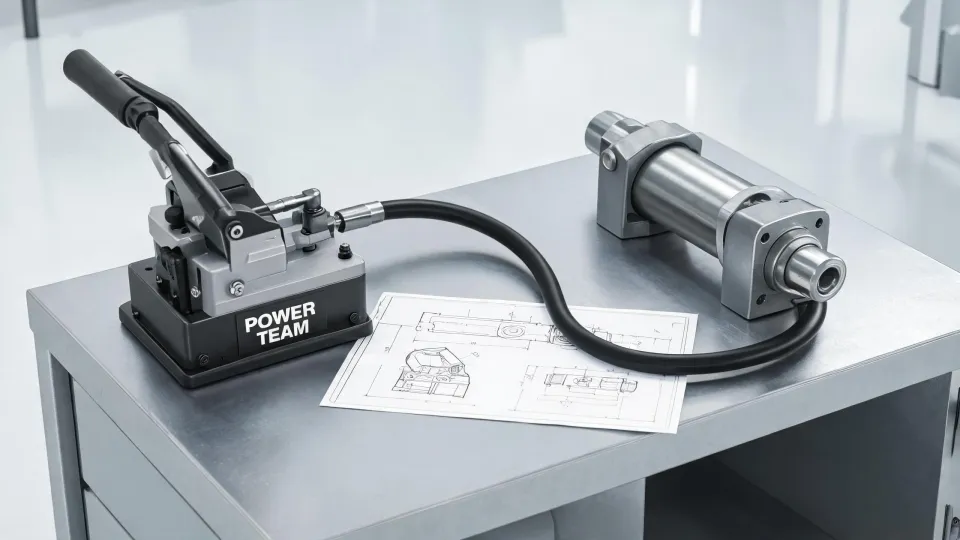
The Bottom Line First
If you're sourcing a Power Team 100 ton hydraulic press, a Power Team hydraulic pump, or any industrial hydraulic gear, here is what five years of purchase data taught me: the lowest quoted price was the cheapest option in only 3 out of 14 major orders. The other 11 cost us more — through downtime, rework, or parts that didn't survive their first quarter.
Sticker price is a starting point. Not a decision. Never a decision.
What actually drives cost is whether your hydraulic cylinder holds pressure six months from now, whether that SAE wrench set survives daily use in a maintenance bay, and whether the pump you bought requires a specialist to service. That's the math nobody puts in the RFP.
Why You Should Trust This Assessment
I manage procurement for a 120-person industrial maintenance operation. My annual hydraulic tooling budget runs around $180,000, spread across 20+ vendors. I've negotiated everything from single Power Team hydraulic pump replacements to full press station builds. Every order goes into a cost-tracking spreadsheet that now spans six years and roughly 340 line items.
When I first started, I assumed the purchasing playbook was simple: get three quotes, take the middle one, negotiate down. That worked fine for office supplies. Hydraulic equipment is a different animal.
Three budget overruns later — each one tied to a "savings" decision — I built a total cost of ownership (TCO) model specifically for hydraulic tools. It changed how I buy.
The Hidden Costs Nobody Quotes You
Here's something vendors won't tell you: the first quote you get for a Power Team 100 ton hydraulic press rarely includes the accessories and service items that make it actually usable in production.
On a recent comparison, Vendor A quoted $8,400 for the press unit. Vendor B quoted $7,200 — clearly the "smarter" buy on paper. But when I ran the TCO, the gap flipped:
- Vendor B's press required a separate hydraulic pump ($1,100), hydraulic oil and filtration setup ($340), and a pressure gauge rated for 100-ton operation ($210). Total: $8,850.
- Vendor A's quote was a complete system — press, pump, gauges, hoses, and initial fluid fill. Nothing else to buy.
Vendor A was $450 cheaper after accounting for everything. The "budget" option wasn't. And that's before I factor in the two weeks of downtime we would have had waiting for the separate pump to arrive.
To be fair — sometimes the cheaper quote really is cheaper. When we sourced a 1-1/2 in. pro quiet sump pump check valve for our coolant recycling station, the lower-priced supplier delivered exactly what was promised, on time, with no surprises. The difference was that it was a commodity part with a clearly defined spec. Hydraulic systems rarely work that way.
How to Test a Hydraulic Cylinder for Internal Leakage — Before You Buy
Most buyers focus on load capacity and stroke length. That's fine. What they miss is the internal leakage test — the single most reliable indicator of whether a cylinder will hold up under real load.
Here's the procedure I use during evaluation. It takes 20 minutes and has saved us at least four returns:
- Set the cylinder fully extended under a known load (or against a rigid stop).
- Hold pressure for 10 minutes at rated working pressure. Watch the pressure gauge.
- Record any pressure drop. A drop of more than 5% indicates internal bypass — fluid is leaking past the piston seal inside the cylinder.
- Check rod retraction under no load. With the pressure released and the cylinder vertical, an internally leaking cylinder will slowly retract on its own.
- Inspect the return flow. On a system with a flow meter, elevated return flow with no external leak points to internal bypass.
A cylinder that fails this test will fail on the job. It might take a month. It might take a day. But it will fail — and when a 100-ton press loses holding pressure mid-operation, you're not looking at a repair. You're looking at a safety incident and a production stoppage.
Here's the other thing: internal leakage gets worse, not better. What starts as a 3% drop becomes 15% within a few hundred cycles. If a supplier won't let you run this test before purchase, that's a red flag.
The SAE Wrench Set Question
Not everything in the hydraulic toolkit is high-stakes. A wrench set SAE sizing is one of those items where people tend to overthink or underthink simultaneously.
The short version: buy based on the fittings and hose connections in your actual system. If you're running Power Team hydraulic pumps and cylinders, the fittings are industrial standard — but I've seen maintenance teams buy a $45 SAE set from a big-box store and then strip a $200 hose fitting because the wrench jaws were undersized by a fraction.
My rule: buy one good SAE set (the kind with laser-etched sizing and a lifetime warranty), keep it in the hydraulic tool crib, and stop replacing it every 18 months. The amortized cost is lower and the fittings last longer.
When the Cheap Option Actually Makes Sense
I want to be honest about the limits of this framework. There are situations where the low bid genuinely is the right call:
Commodity components with zero integration risk. Check valves, seals, O-rings, basic hoses. If the spec is clear and the part is standard, price is a legitimate deciding factor. Not the only one — but a fair one.
Non-critical applications. A hydraulic jack used twice a year for positioning — not lifting — doesn't need the same TCO scrutiny as a press running three shifts.
Short-term or single-use needs. If you need a Power Team hydraulic pump for a one-month project and then it goes into storage, the calculus changes. Reliability still matters, but the service-life multiplier shrinks.
The framework isn't "always buy premium." It's "match your cost model to your actual risk exposure." A $7,000 press and a $70 check valve don't deserve the same analysis.
But for anything that holds pressure, lifts load, or keeps a production line running — calculate the full cost. Then decide. The cheapest quote has cost me more times than I care to admit. I stopped guessing and started measuring.

Maren Jorgensen
Maren Jorgensen is an independent hand tool and torque applications analyst covering wrenches, pliers, screwdrivers, hammers, sockets, ratchets, hex keys, and tool sets. She applies ISO 6789-1 torque-tool conformance principles while examining jaw capacity, leverage, fastener engagement, torque range, accuracy, handle geometry, and material hardness. Her practical guides help tradespeople and procurement teams select suitable tools, plan controlled tightening, and compare durability without relying on brand reputation alone.