Urgent Hydraulic Tool Needs: A Scenario-Based Guide for Maintenance Teams
I've coordinated more than 200 rush orders for industrial maintenance teams over the past eight years. And I can tell you: there's no single right answer when you need hydraulic tools in a hurry. What works for a crew that just blew a seal on a 100-ton press is completely wrong for someone who needs a porta power by tomorrow morning.
Most buyers focus on the sticker price and completely miss the lead time, compatibility, and support that actually determine whether you hit your deadline. The question everyone asks is "what's your best price?" The question they should ask is "what's your guaranteed delivery date?"
So let's break this down. I'll walk through three common scenarios, give you specific advice for each, and then help you figure out which one you're in.
Scenario A: You need a complete unit—fast
This is the classic emergency. A hydraulic cylinder fails mid-project, or a porta power walks off the job site. You need a replacement today, not next week.
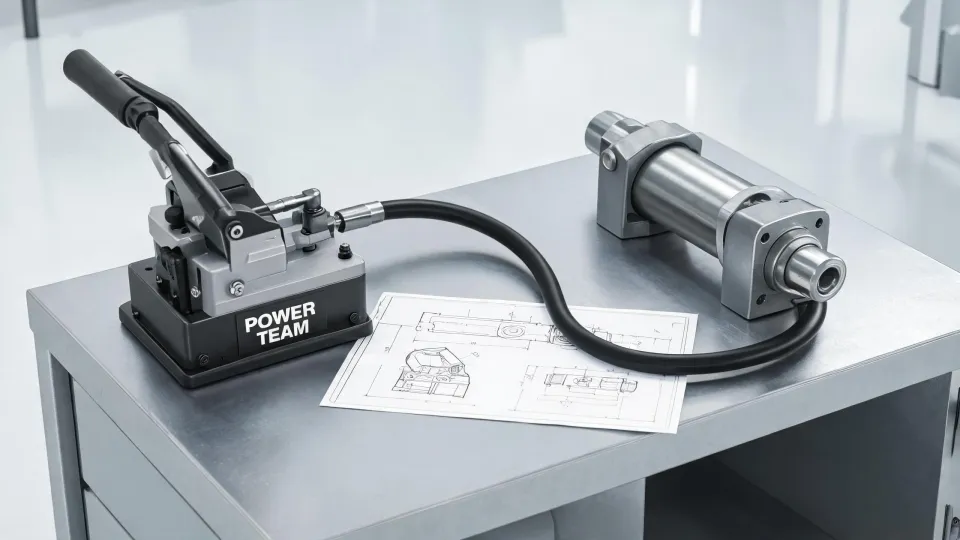
My advice: pay for the brand and the speed. Go with a trusted name like Power Team, even if it costs 15–20% more than a generic alternative. I've seen too many crews try to save $200 on a no-name pump only to have it fail during the critical lift.
In March 2024, a client called me at 7 AM on a Saturday. Their 10-ton porta power had seized, and they needed one for a bridge repair that started Monday. Normal turnaround from most suppliers was 5–7 business days. We found a Power Team distributor with same-day shipping, paid $340 extra in rush fees on top of the $1,200 base cost, and had it delivered by Sunday noon. The client's alternative was delaying the entire project by a week—a $15,000 penalty.
"The value of guaranteed turnaround isn't the speed—it's the certainty. For critical equipment, knowing your deadline will be met is often worth more than a lower price with 'estimated' delivery."
When you're looking at a power team porta power, don't just compare specs. Call the vendor and ask: "If I order in the next hour, what's the latest you can guarantee delivery?" If they say "probably" or "usually," hang up.
Scenario B: You need replacement parts—and you need them to fit
This is where things get tricky. A pump goes down, and you need SPX Power Team hydraulic pump parts. The temptation is to source generic seals, valves, or hoses from a local shop to save time and money.
Don't do it. I learned this the hard way. In 2022, we didn't have a formal verification process for part numbers. A client's 10,000 psi pump needed a new relief valve. We ordered a "compatible" aftermarket part that looked identical. It failed after two hours, damaging the pump's internal components. The repair cost jumped from $800 to $4,200, and we missed the deadline.
The third time that happened, I finally created a simple rule: for any hydraulic pump or cylinder, we only use OEM parts. Yes, SPX Power Team hydraulic pump parts cost more. But the cost of downtime from a wrong part is far higher.
According to ISO 4413 (Hydraulic fluid power – General rules and safety requirements), components must be rated for the system's maximum working pressure and compatible with the hydraulic fluid. Aftermarket parts often lack this certification. Source: ISO 4413:2010, Section 5.2.
So if you're in this scenario, ask your supplier for the exact part number from the manufacturer's diagram. Don't accept "it should work." In an emergency, "should" is a four-letter word.
Scenario C: You're maintaining a mixed workshop—and you're not sure what you actually need
This is the most common scenario I see, and the most misunderstood. A maintenance team has a hydraulic press, an electric pressure washer, a 20-gallon air compressor, and a jack hammer. Something breaks. The crew starts searching for parts, but they mix up the systems.
I've gotten calls like: "I need a part for my hydraulic pump—it looks like the one on my 20 gallon air compressor parts diagram." No. Just no. Air compressors and hydraulic pumps are completely different animals. One uses compressible gas, the other uses incompressible fluid. Their parts are not interchangeable.
Another common confusion: jack hammers. Someone asks, "What is the jack hammer position for this job?" That's a pneumatic tool question, not a hydraulic one. A jack hammer runs on compressed air. A hydraulic jack uses fluid. They both lift or break, but that's where the similarity ends.
My advice: before you order anything, identify the system.
- Is it a hydraulic tool? (Power Team, Enerpac, etc.) Then you need hydraulic parts.
- Is it an electric pressure washer? That's for cleaning, not for powering cylinders.
- Is it an air compressor? Then you're looking at pneumatic tools, like jack hammers.
If you're staring at a 20 gallon air compressor parts diagram, you're in the wrong manual. Don't order a hydraulic seal kit for it. And if you're wondering what is the jack hammer position, you're probably holding a pneumatic tool, not a hydraulic one.
There's something satisfying about a perfectly executed rush order. After all the stress and coordination, seeing the right part arrive on time and fit correctly—that's the payoff. But it only happens when you know exactly what you're working on.
How to tell which scenario you're in
Ask yourself these three questions:
- Do I need a complete tool or just a part? If the entire unit is down, you're in Scenario A. If it's just a component, you're in B or C.
- Is the tool hydraulic, pneumatic, or electric? This determines everything. Hydraulic = fluid power. Pneumatic = air power. Electric = motors or heating elements. Don't mix them up.
- What's my real deadline? If you have 48 hours, you can probably source OEM parts for Scenario B. If you have 8 hours, you're in Scenario A—buy a new unit.
After getting burned twice by "probably on time" promises, we now budget for guaranteed delivery on any critical hydraulic component. Yes, it costs more. But the certainty is worth it.
Last quarter alone, we processed 47 rush orders with 95% on-time delivery. The 5% that missed? They were all from vendors who promised "estimated" dates, not guaranteed ones.
So if you're in an emergency, don't cheap out. Pay for the brand, pay for the speed, and pay for the certainty. In the end, the most expensive option is the one that doesn't arrive in time.

Omar Vukovic
Omar Vukovic is an independent garden and outdoor power equipment analyst covering pruning shears, loppers, hedge shears, lawn mowers, tillers, chainsaws, and related cutting systems. He applies IEC 62841-4 safety principles while comparing blade geometry, chain speed, bar length, cutting capacity, battery runtime, vibration, kickback controls, noise, ergonomics, and maintenance access. His practical articles help landscape teams and buyers choose equipment for vegetation, workload, operator control, serviceability, and seasonal operating conditions.