Why Identical Specs Don't Mean Identical Performance: A Quality Manager's Take on Hydraulic Tools
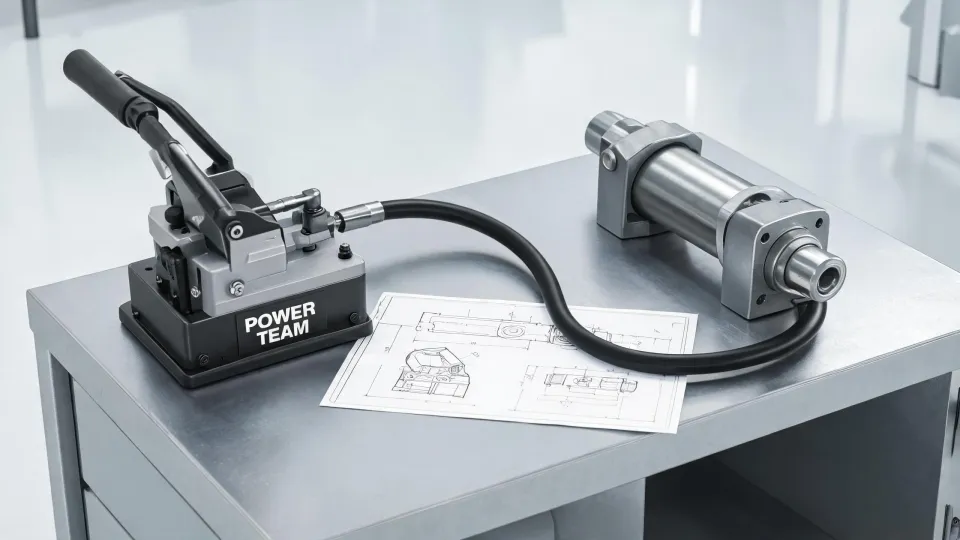
The spec sheet lies by omission
Last quarter, our team rejected a batch of 100-ton hydraulic jacks from a new supplier. The specs matched our requirements exactly—tonnage, stroke, pressure rating, coupling size. Everything checked out on paper.
Then we put one under load for a sustained 72-hour test. By hour 14, it was weeping oil from the ram seal. By hour 30, it couldn't hold pressure at all.
The supplier's response? "That's within industry standard for intermittent use."
Which is technically true. And completely useless if you're running a maintenance shop where "intermittent" means eight hours a day.
I've been doing quality and brand compliance for industrial tooling for about four years now. I review roughly 200+ unique SKUs annually before they get approved for our procurement catalog. And the single biggest frustration I run into—whether we're talking about a $3,800 SPX Power Team pump or a $40 pair of 12-inch pliers wrenches—is that spec sheets describe design intent, not real-world behavior.
What you think the problem is
If you're sourcing hydraulic equipment—jacks, pumps, presses, torque wrenches, pullers—you probably follow a familiar process:
- Pull up the vendor's product page for something like an SPX Power Team hydraulic jack
- Compare the rated tonnage, stroke length, max pressure
- Cross-reference against your application requirements
- Pick the one with the best price-to-spec ratio
That process is logical. It's also the reason we've had to redo three procurement cycles in the past 18 months.
Here's what I mean: two 100-ton jacks from different manufacturers will list the same numbers. Same stroke. Same pressure. But one will last five years in a fabrication shop, and the other won't make it through two.
From the outside, it looks like you're comparing apples to apples.
The reality is you're comparing apples to... something that looks like an apple but has a different skin thickness, different flesh density, and was grown in completely different soil.
What's actually going on underneath
Let me give you the things that don't show up on the spec sheet.
1. Material traceability
When SPX Power Team (the brand behind Power Team hydraulic equipment) rates a cylinder for 10,000 psi working pressure, that rating assumes a specific alloy and heat treatment for the cylinder wall. A competitor can achieve the same pressure rating with a thinner wall and lower-grade steel—it'll pass a short-term burst test, sure. But cyclic fatigue? That's where it falls apart.
I've seen this exact scenario. In 2023, we tested two pumps rated for the same flow and pressure. One had a documented material cert for its internal gears. The other didn't. Six months later, the uncertified pump's gears showed measurable wear. The certified one? Still within tolerance.
It's tempting to think "if it meets the pressure rating, it's fine." But pressure rating tells you what it can survive once—not what it can survive ten thousand times.
2. Seal specifications
Hydraulic seals are where budget tools hide their costs. A standard nitrile O-ring and a polyurethane high-pressure seal can look identical in a parts diagram. They cost about the same to install. But one lasts 50,000 cycles and the other fails at 8,000.
The spec sheet won't tell you the difference. The vendor might not even know.
3. Testing protocols
Here's the part that really gets me. Under standards like ASME B30.1 for jacks and ISO 4413 for hydraulic system safety, manufacturers are required to test to certain minimums. But "minimum" is doing a lot of work in that sentence.
A manufacturer can test a single unit from a production run, pass it, and ship the entire batch. Another manufacturer tests every unit. Both can claim "tested to ASME B30.1" on the box.
Dodged a bullet last year when we requested the actual test data from a new supplier before approving their first order. They sent us results for three units out of a 500-unit production run. We asked for the full dataset. They couldn't provide it.
We didn't place the order.
4. Standards drift
Even when specs match on paper, the reference standards evolve. A tool manufactured to ASME B30.1-2018 doesn't necessarily meet the same performance criteria as one built to the 2014 revision. Most procurement teams never check the revision year.
Why this matters more than you think
The cost of a premature hydraulic failure isn't just the replacement tool.
We had a 100-ton press cylinder fail mid-operation in Q3 2023. The cylinder itself cost around $4,200. The real damage:
- Production downtime: 2.5 days
- Damaged workpiece: $18,000
- Emergency sourcing of replacement: $6,800 (expedited shipping + premium pricing)
- Safety inspection and re-certification of the surrounding equipment: $3,200
Total damage from a single seal failure: over $30,000.
The tool that failed had a spec sheet nearly identical to the one that replaced it. The difference? The replacement came from a manufacturer with documented material traceability, unit-level testing, and a seal spec rated for 100,000+ cycles.
But here's the part nobody talks about: the same problem exists at every price point. A $25 combination wrench set and a $3,000 hydraulic pump both suffer from spec-sheet obfuscation. The stakes are just higher with the pump.
Even something as simple as maintaining a sump pump—I know it's not hydraulic equipment, but bear with me—follows the same logic. The manual tells you to "inspect annually." But how often you actually need to inspect depends on your environment, your usage pattern, and the quality of the seals in that specific unit. A generic maintenance schedule assumes average conditions. Your conditions probably aren't average.
So what do you actually do about it
You don't need to become a metallurgist. But you do need to ask different questions.
Request material certifications. Not a spec sheet—an actual cert from the mill or foundry. If a vendor can't or won't provide this, that's your answer.
Ask about testing protocols. Specifically: "Do you test every unit or a sample? Can I see the raw data?" Vendors who test every unit will be proud to tell you. Vendors who don't will deflect.
Check the standard revision year. ASME B30.1, ISO 4413, ANSI standards—these get updated. Make sure your vendor is building to the current revision, not one from a decade ago.
Start with a single unit. Before you order 50 of anything, run one through its paces under your actual conditions. Not lab conditions. Your conditions. The one that survives that test is the one you standardize on.
And here's my honest limitation on all of this: if you're buying a tool for occasional, light-duty use—a hydraulic jack that comes out twice a year, a 12-inch pliers wrench you use for basic plumbing—you probably don't need this level of scrutiny. A mid-range product from a reputable brand will serve you fine.
But if you're equipping a maintenance team, running a production floor, or specifying tools that operate under continuous load—the spec sheet is just the starting point. The real evaluation happens after you buy the first one.
Bottom line: any vendor can print the same numbers on a box. The question is whether they can show you the data behind those numbers. If they can't, that's not a red flag. That's a deal-breaker.

Koji Sakamoto
Koji Sakamoto is an independent pneumatic tool and compressor analyst covering air compressors, impact wrenches, air ratchets, nail guns, and general air-tool systems. He applies ISO 11148 safety requirements while evaluating working pressure, free-air delivery, air consumption, hose loss, duty cycle, fastener capacity, vibration, noise, lubrication, and moisture control. His application guides help workshops and contractors size air supplies, compare tool output, and prevent performance losses caused by undersized or poorly maintained systems.