How Does a Hydraulic Jack Work Step by Step? A Field Tech's No-Nonsense Answer
-
The Short Answer (Read This If You Have 30 Seconds)
-
Why I'm Telling You This
-
The Step-by-Step Breakdown (The Version That Actually Matters)
-
What Most Buyers Get Wrong
-
The Tools That Actually Show Up In Emergency Calls
-
The Mindshift You Need to Accept
-
What This Means Practically
-
Where This Advice Doesn't Apply
The Short Answer (Read This If You Have 30 Seconds)
A hydraulic jack works by pushing hydraulic fluid from a small piston into a larger piston. Small force in, big force out — that's Pascal's law doing the heavy lifting. You pump the handle, the small piston moves a tiny volume of oil, the large piston rises with multiplied force. There's no magic, no electronics, no compressor. Just incompressible fluid and surface area math.
But here's the thing nobody tells you when you're standing on a shop floor at 6 a.m. with a seized bearing and a client calling every ten minutes. The theory works. The execution is where jobs die.
Why I'm Telling You This
I coordinate emergency hydraulic equipment jobs for industrial maintenance teams. I've handled 400+ rush orders in nine years — pumps, cylinders, pullers, presses, the whole catalog. Last quarter alone we shipped 47 time-critical units with a 94% on-time number. The 6% that slipped? Almost none of them slipped because of the equipment. They slipped because somebody assumed they understood the mechanism without checking the details.
So when someone asks me "how does a hydraulic jack work step by step," I don't give them the textbook answer. I give them the one that keeps them from eating a $12,000 downtime bill.
The Step-by-Step Breakdown (The Version That Actually Matters)
Here's the full sequence, in plain language.
- You apply force to the handle. That handle is a lever. Levers multiply force too — most people forget this part. Your 40 lbs of hand pressure becomes 200+ lbs at the pump piston.
- The small piston compresses hydraulic oil. Oil is incompressible. Unlike air, it doesn't shrink. Push it on one end, it moves on the other. This is not a detail you can skip.
- The oil travels through a check valve into the cylinder. Check valves are one-way doors. They let oil in, they don't let it back out. This is why your jack doesn't drop when you stop pumping.
- The oil pushes against the large piston. Same pressure, bigger surface area. If the large piston has 10× the surface area, you get 10× the force. That's the whole trick.
- The load rises. Slowly. Reliably. Provided the seals hold.
And that last sentence — "provided the seals hold" — is where 80% of field failures happen. Not the theory. The seals.
What Most Buyers Get Wrong
Most buyers focus on tonnage rating and completely miss duty cycle, oil viscosity tolerance, and seal material compatibility with the ambient temperature at the job site.
It's not that tonnage doesn't matter. It matters a lot. But a 100-ton cylinder with the wrong seals in a 15°F environment is less useful than a 50-ton cylinder that's actually rated for cold weather. I've watched this play out. A client ordered a 100-ton unit for a bridge steel job in late January. On paper, perfect. In practice, the seals stiffened up and it couldn't hold pressure at temperature. We swapped them to a cold-rated model and ate the overnight freight to keep the schedule. Cost us roughly $900 extra. Saved the relationship.
Here's the question everyone asks: "What's the biggest tonnage I can get?" The question they should be asking: "What's the cycle time, and what's my operating temperature range?"
The Tools That Actually Show Up In Emergency Calls
In my experience, three categories dominate rush jobs:
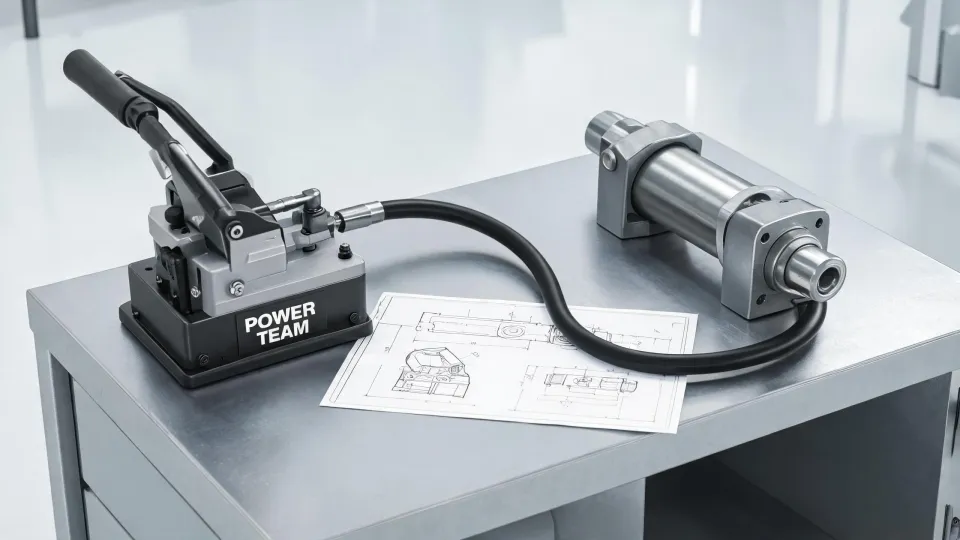
- Porta Power units. Power Team Porta Power is the workhorse. Self-contained, portable, works in tight spaces. If I had to pick one tool for a mobile service truck, it's this. Named after the SPX Power Team heritage line that's been field-proven since the 1950s.
- Hydraulic pullers. A Power Team hydraulic puller gets bearings and gears off shafts that a manual puller won't touch. When you're looking at a 20-ton press-fit and a production line shutdown clock, this is the call you make.
- Hand tools that play support roles. Even a pliers wrench 6 inch has its place — final torque checks, small hydraulic line fittings, hose clamps. The 6-inch size is right for confined spaces. Not glamorous, but necessary.
And yes, sometimes you get a curveball. Last March, a client called because their 1/2 HP pedestal sump pump failed during a hydraulic press install — separate systems, same facility, both on the critical path. We helped them source a replacement and bundled it with the hydraulic order to save them a week of waiting. Not our core category, but when the client's line is down, the answer is yes, not "that's not our product."
The Mindshift You Need to Accept
It took me about five years and roughly 150 emergency calls to understand something. The equipment isn't the bottleneck. The bottleneck is the assumption that "hydraulic is hydraulic."
People walk in expecting one answer to fit everything. One jack. One puller. One pump. And then they hit a temperature problem, or a seal incompatibility, or a duty cycle they didn't plan for, and the 48-hour window closes on them.
The 'a jack is a jack' thinking comes from an era when hydraulic equipment was mostly manual, low-pressure, and used in forgiving environments. That's changed. Modern industrial hydraulics runs at higher pressures, tighter tolerances, and wider environmental ranges. The old mental model doesn't fit.
What This Means Practically
If you're specifying a hydraulic jack, cylinder, puller, or Porta Power unit for a real job — not a classroom — here's the checklist that matters:
- Operating temperature range at the actual site, not the warehouse
- Duty cycle — how many cycles per hour, how long between cool-downs
- Seal compatibility with the fluid you're running and the environment
- Service and parts availability in your region — a jack that takes 6 weeks for a seal kit is a liability
What was best practice in 2020 may not apply in 2025. Standards have tightened. Fluid options have expanded. Seal materials have evolved. The fundamentals — Pascal's law, check valves, force multiplication — haven't changed. But the execution absolutely has.
Where This Advice Doesn't Apply
To be fair, if you're lifting a 2-ton vehicle in a garage on a mild day with a standard floor jack, most of the nuance I just described won't matter. Buy a quality jack, keep it topped off, inspect the seals annually. You're fine.
Also, if you're working with exotic high-pressure systems above 10,000 PSI, or operating in classified hazardous environments, get an engineer involved. I'm an emergency coordinator, not a design engineer. I know what fails in the field. That's different from what passes a design review.
And I'm not 100% sure every failure mode I've listed matches every brand's specification — manufacturers differ on seal ratings and duty cycle calculations. But the pattern holds: the mechanism is simple, the environment is not.
That's the part worth remembering when the phone rings and the deadline is 36 hours out.

Elise Fournier
Elise Fournier is an independent builders hardware and tool storage analyst covering hinges, handles, brackets, casters, drawer slides, door locks, hooks, tool boxes, chests, cabinets, carts, and bags. She references ANSI/BHMA A156.9 cabinet-hardware practices while examining cycle life, rated load, pull force, slide extension, caster capacity, corrosion finish, drawer retention, sealing, and transport ergonomics. Her selection guides help installers, workshops, and buyers plan durable fittings and storage around access, load, mobility, and environment.