I've Blown $12K on Hydraulic Equipment Mistakes: A Scenario-Based Buyer's Guide
There's No Single Right Answer (And Anyone Who Says Otherwise Is Selling Something)
I've been handling hydraulic equipment orders for seven years. In that time, I've personally made — and documented — about 14 significant purchasing mistakes. Total damage? Somewhere north of $12,000 in wasted budget, expedited shipping fees, and replacement parts that shouldn't have been necessary.
Here's what I've learned: the "best" hydraulic tool doesn't exist. What exists is the right tool for your specific situation. And most buying guides skip that part entirely.
This isn't a product roundup. It's a decision framework. I've grouped the buyers I've worked with (and the mistakes I've made) into three scenarios. Find yours, then read the relevant section.
- Scenario A: Industrial maintenance / production floor — you need hydraulic pumps, cylinders, presses, and torque wrenches that run daily.
- Scenario B: Marine / boat applications — you're looking at hydraulic jack plates, trim systems, or compact lifting equipment.
- Scenario C: Fluid handling / dewatering — submersible pumps, sump pumps, and high-volume transfer equipment.
Scenario A: Industrial Maintenance & Production
This is where I've made most of my mistakes.
In 2019, I ordered four hydraulic torque wrenches from a "budget-friendly" supplier to save about $2,100 compared to the Power Team quote we had on the table. The spec sheets looked nearly identical. Six weeks later, two of the four wrenches failed mid-job on a refinery shutdown. Recalibration alone cost $890. The shutdown delay cost us a $3,400 penalty. That $2,100 "savings" turned into a $4,290 problem.
"We didn't have a formal vendor qualification process back then. Cost us when a rush order bypassed the usual checks and we ended up with counterfeit seals in a critical cylinder."
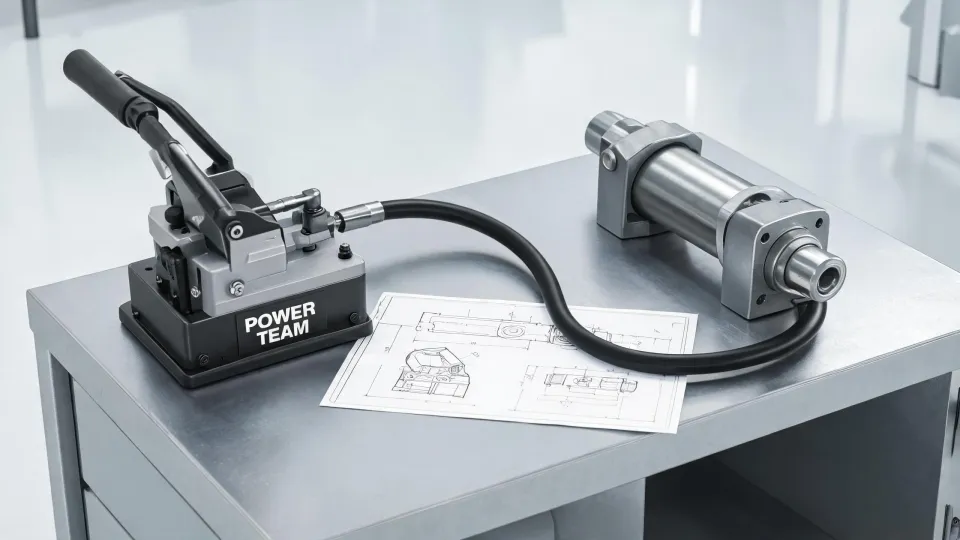
Here's what I tell everyone now: for industrial hydraulic tools — pumps, cylinders, presses — the brand ecosystem matters more than the spec sheet. Power Team (SPX) has been making this stuff since the 1940s. Their pump parts are backward-compatible across generations. That means when a seal fails on a 12-year-old cylinder, you can actually get the part.
With off-brand equipment, I've found that parts availability drops off a cliff after about three years. A $200 pump that you can't repair is a $200 pump that becomes landfill.
Quick math: A Power Team 10-ton cylinder runs roughly $600–$900 depending on stroke. A comparable no-name unit might be $350. But if the no-name unit fails at year two and you replace it, you've spent $700 and lost a day of production. The "expensive" option was cheaper.
That said — and this is important — not every application needs premium equipment. If you're running a single hydraulic press for 20 minutes a day in a small shop, a mid-tier brand will likely outlast your need for it. The calculus changes when equipment is running 8+ hours in critical operations.
Scenario B: Marine Hydraulic Systems (Jack Plates & Boat Applications)
Boat owners ask me about hydraulic jack plates constantly. If you're not familiar: a hydraulic jack plate is a bracket mounted between your boat's transom and outboard motor that lets you raise, lower, and set back the engine Hydraulically. It changes your prop's depth and distance from the hull, which affects shallow-water performance, hole shot, and top-end speed.
Here's where I've seen people waste money: they buy the cheapest hydraulic jack plate they can find, then wonder why the pump fails after two seasons of saltwater exposure.
Marine hydraulics are a different beast entirely from shop hydraulics. Corrosion, UV exposure, and constant thermal cycling eat cheap components alive. The seals that work fine in a climate-controlled factory will crack and weep in a Florida summer.
This pricing was accurate as of Q3 2024. Marine hydraulic components have seen 8–12% price increases year-over-year since 2022. Verify current pricing before budgeting.
For jack plates specifically, I'd budget $400–$1,200 depending on setback and lift capacity. The lower end gets you a basic unit with a manual override; the upper end gets you integrated gauges and faster actuation. If you fish shallow water regularly, the upgrade pays for itself in one saved lower unit.
One thing I learned the hard way: don't mix marine hydraulic fluid with standard ISO hydraulic oil. They're not interchangeable. The marine stuff has anti-corrosion additives that standard oil lacks, and using the wrong fluid voids most warranties.
Scenario C: Fluid Handling & Dewatering Pumps
Submersible sump pumps and dewatering pumps occupy a weird space in the hydraulic world. They're often bought separately from the rest of a hydraulic system, which means they don't benefit from the ecosystem argument I made in Scenario A.
A 1/2 HP 1-1/2" submersible sump pump is the workhorse of residential and light commercial dewatering. You're looking at $100–$250 depending on brand and switch type. A 1.5 HP model for heavier duty runs $180–$400. These aren't precision hydraulic tools — they're commodity items, and the brand matters less.
But here's the counterintuitive part: for sump pumps, the cheap option is often the right call.
I know that sounds like it contradicts everything else in this article. But sump pumps have a defined lifespan (5–7 years for most residential units), and the technology hasn't changed meaningfully in decades. Paying double for a "premium" sump pump usually gets you a slightly better switch and marginally better materials — not double the lifespan.
Instead of upgrading the pump, upgrade the backup. A battery backup system or a secondary pump on a separate circuit will do more for your flood protection than a fancier primary pump.
The exception: if you're running a commercial dewatering operation — construction sites, mining, flood response — the calculus flips. Downtime costs real money, and you want the pump that's easiest to service. In that case, standardize on a brand with local parts availability.
How to Figure Out Which Scenario You're In
If you're still not sure where you fall, ask yourself these three questions:
- What's the cost of downtime? If a failed tool stops production, you're in Scenario A. Buy for reliability and parts availability.
- What's the operating environment? Saltwater, UV, temperature swings — that's Scenario B. Buy for corrosion resistance first, everything else second.
- Is this a critical system or a commodity purchase? If it's a commodity with a predictable lifespan, don't overthink it. That's Scenario C. Buy mid-range and invest the savings in redundancy.
One more piece of hard-won advice: whenever you're buying hydraulic equipment, ask for the maintenance schedule and parts diagram before you order. If the vendor can't produce those within a day, that tells you something. I learned that lesson in September 2022 after a $2,300 order arrived with no documentation and a proprietary fitting that required a custom adapter to connect to anything else we owned.
The lowest price on the quote sheet is never the lowest cost in reality. But the right price depends entirely on which scenario you're in. Figure that out first, and the rest gets a lot simpler.

Maren Jorgensen
Maren Jorgensen is an independent hand tool and torque applications analyst covering wrenches, pliers, screwdrivers, hammers, sockets, ratchets, hex keys, and tool sets. She applies ISO 6789-1 torque-tool conformance principles while examining jaw capacity, leverage, fastener engagement, torque range, accuracy, handle geometry, and material hardness. Her practical guides help tradespeople and procurement teams select suitable tools, plan controlled tightening, and compare durability without relying on brand reputation alone.