Power Team Hydraulic Jack Catalogue vs. Aftermarket: An Admin Buyer's Comparison
What I'm Comparing, and Why
When our maintenance team needs a hydraulic jack, pump, cylinder, press, torque wrench, or hose, I'm the person who turns the request into a purchase order. I'm an office administrator for a 120-person industrial services company. I manage about $180,000 in annual ordering across eight vendors. I report to operations and finance, which means I care about three things: the job gets done, the paperwork is clean, and nobody asks me why a critical repair sat idle for two days.
My initial approach to Power Team equipment was simple: get the lowest quote. That was wrong. After three budget overruns and one missed shutdown window, I started comparing total cost and delivery certainty instead of just unit price.
So this is a comparison between two paths:
Path A: Power Team OEM catalogue and authorized Power Team repair support.
Path B: Aftermarket hydraulic tools, generic parts, and independent repair shops.
I'm comparing them across five dimensions: catalogue documentation, repair support, lead-time certainty, total cost, and audit trail. The same logic applies to other maintenance documents—a pressure washer troubleshooting manual, a bolt torque chart, or how to read centrifugal pump curve data. If the documentation is weak, the purchase is weak.
If you search for power-team parts, you'll find two ecosystems: the OEM catalogue and the aftermarket. They look similar at first. They are not.
Dimension 1: Catalogue and Documentation
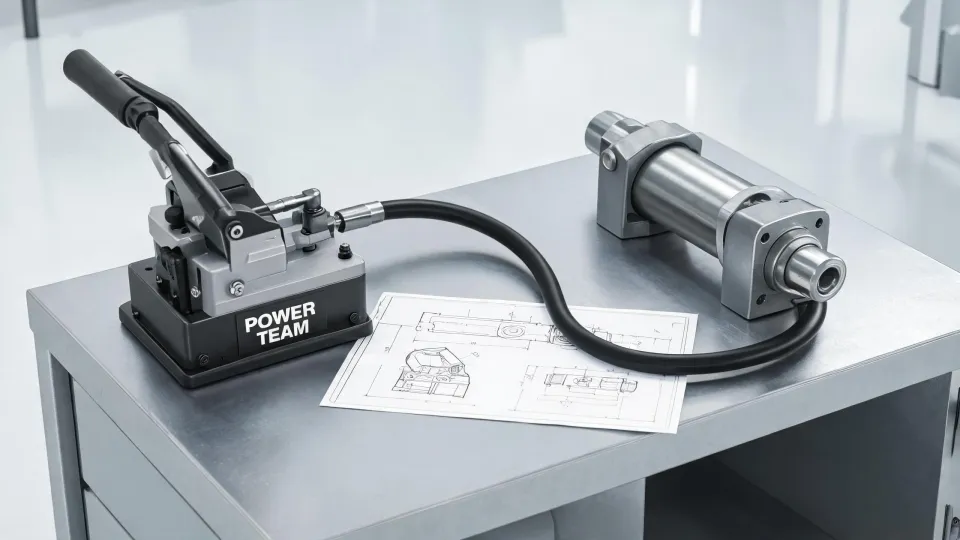
This is where the Power Team hydraulic jack catalogue earns its keep. A proper catalogue gives you capacity, stroke, collapsed height, oil capacity, and the repair kit numbers. You can match a jack to a cylinder, a pump to a press, and a torque wrench to the right socket. That matters when you're ordering from a desk and can't walk out to the shop floor.
Aftermarket listings are often thinner. '100-ton hydraulic jack' might be the whole description. No stroke. No oil capacity. No repair parts diagram. Not ideal. Workable if you have a senior tech who knows the exact model. Risky if you don't.
Here's something vendors won't tell you: standard catalogue lead times often include buffer time. That buffer is not necessarily how long your order takes. It's how long the vendor needs to protect itself from production delays. If you need a guaranteed date, ask for it in writing—not a 'should ship by Friday' promise.
Documentation also affects safety. A bolt torque chart is not a universal cheat sheet. Torque values depend on thread size, material, lubrication, and the equipment manufacturer's spec. If you're using a generic chart for a Power Team press or a critical flange, you're guessing. And a pressure washer troubleshooting manual is the same story: the manual tells you whether the problem is the unloader, the nozzle, or the pump seal. A forum post might tell you to replace the wrong part.
'Pricing and lead times in this article are based on Q1 2025 vendor conversations. Hydraulic equipment availability changes fast, so verify current rates and dates before you budget.'
Dimension 2: Repair Support
Power Team repair support is the opposite of a generic repair shop. Authorized service centers typically have access to parts diagrams, torque specs, and test procedures. They can document what was replaced and why. That documentation goes into your maintenance file. Finance likes it. Safety likes it. The next tech who opens that jack likes it.
Independent repair shops can be faster and cheaper, especially for simple seal kits or hose replacements. I've used them. Sometimes it's fine. But when the repair is on a critical path—say, a 100-ton press that's holding up a shutdown—the risk shifts. If the shop can't provide a test certificate or a parts list, you're buying 'probably fixed.'
In March 2024, we paid $400 extra for rush delivery on a replacement cylinder. The alternative was missing a $15,000 shutdown window. The extra money bought a guaranteed delivery date, not just speed. That's the difference. A cheap part that arrives Wednesday when you needed it Tuesday is not cheap.
My experience is based on about 70–90 orders annually for mid-size industrial maintenance in North America. If you're running a small shop or sourcing internationally, your calculus may differ. But the principle usually holds: in an emergency, certainty is worth paying for.
Dimension 3: Lead-Time Certainty
This is the dimension most people underweight. When a hydraulic jack fails, the cost isn't just the replacement. It's the crew standing around, the production line down, the client asking for updates. Our internal estimate for a two-person crew and lost production was about $900 per hour in 2024. That number changes the math fast.
OEM catalogue items sometimes cost more. But if the vendor can commit to a date and provide tracking, you can plan around it. Aftermarket sellers may quote a lower price, then ship from a third-party warehouse with no real ETA. That's the trap.
Speed, documentation, price. Pick two. In a planned overhaul, you can pick documentation and price. In an emergency, you pick speed and documentation, then pay for it.
Dimension 4: Total Cost and Audit Trail
Total cost includes the invoice, the downtime, the labor, and the finance team's time. I once found a great price from a new vendor—$1,200 cheaper than our regular supplier. Ordered 20 hose assemblies. They couldn't provide a proper invoice, only a handwritten receipt. Finance rejected the expense report. I ate the cost out of the department budget. Now I verify invoicing capability before placing any order.
Power Team OEM parts and repair usually come with cleaner paperwork: part numbers, serial numbers, test data where applicable. That reduces back-and-forth. It also helps when you need to show why you paid more than the lowest quote. The audit trail is not glamorous. But it's what keeps procurement out of trouble.
If you're looking up how to read centrifugal pump curve data, the same logic applies. Free information can be useful. But if it's not tied to your specific model and serial number, it can cost you more in wrong parts and downtime than a paid manual or a service call.
Dimension 5: When to Choose Which
Here's my practical rule set:
- Choose Power Team OEM catalogue and authorized repair when: the equipment is on a critical path, safety documentation is required, the part must match exactly, or the repair needs a warranty and test record.
- Choose aftermarket or independent repair when: the job is planned, you have internal technical review, the part is non-critical, and you can verify the invoice and warranty terms before ordering.
For emergency work, I default to the path with a guaranteed date. Not because OEM is always better. Because 'probably Tuesday' is not a plan.
Honestly, the lowest quote used to win in my spreadsheet. Now it doesn't. The quote that keeps the shutdown on schedule, the invoice that clears finance, and the documentation that satisfies the next audit—that's the one I budget for.
That's the trade-off. And in hydraulic maintenance, trade-offs are basically the whole job.

Maren Jorgensen
Maren Jorgensen is an independent hand tool and torque applications analyst covering wrenches, pliers, screwdrivers, hammers, sockets, ratchets, hex keys, and tool sets. She applies ISO 6789-1 torque-tool conformance principles while examining jaw capacity, leverage, fastener engagement, torque range, accuracy, handle geometry, and material hardness. Her practical guides help tradespeople and procurement teams select suitable tools, plan controlled tightening, and compare durability without relying on brand reputation alone.