Power Team Hydraulic Oil, Pumps, and Air Compressor Sizing: Straight Answers
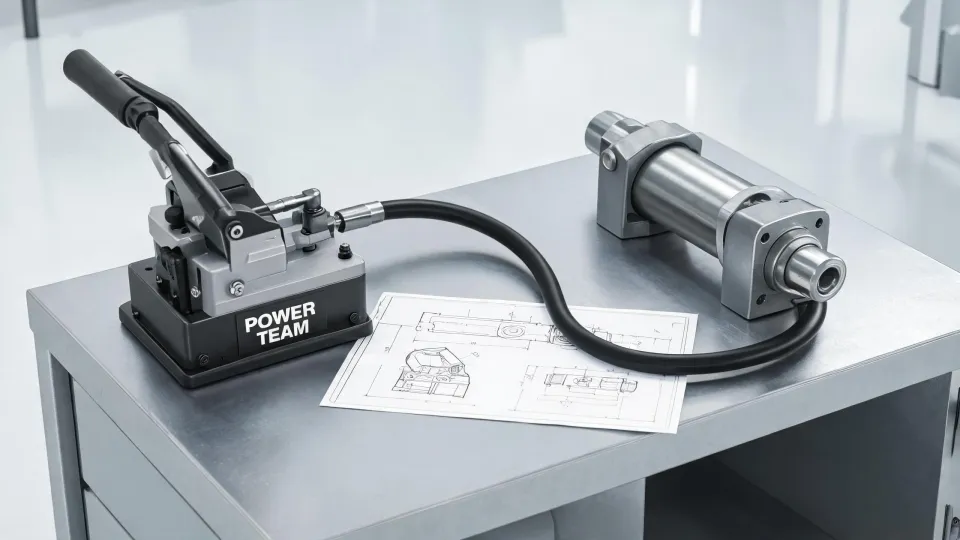
If you're asking "what size compressor to run impact wrench," the answer is CFM at 90 PSI, not tank size. For most 1/2-inch impact wrenches, you need at least 5-6 CFM at 90 PSI from the compressor pump. A 30-gallon tank just gives you a little buffer for the first few hard pulls. Move up to 3/4-inch or 1-inch impact guns, and the demand jumps to 8-14 CFM. If you're shopping for hydraulic equipment at the same time, the same basic logic applies: pressure matters, but flow is what gets the job done.
The second most common question I get is about Power Team hydraulic oil. For most indoor shops, use ISO VG 32 anti-wear hydraulic oil. That's the short version. Now let me explain why I give that answer, and where I stop being sure.
Why I feel okay being this direct
I'm a maintenance supervisor at an industrial equipment distributor. I've handled 300+ rush orders in 11 years, including same-day turnarounds for plants that had a hydraulic pump fail on a Sunday night. I don't have hard data on why some failures happen, but I can tell you this: urgent jobs are almost never the ones that were planned properly.
Power Team hydraulic pumps and cylinders show up in a lot of those calls. When someone is staring at a stopped production line, they don't want an essay. They want a decision they can trust, and they want to know why that decision won't get them in trouble.
Power Team hydraulic oil: what I actually recommend
Use ISO VG 32 anti-wear hydraulic oil in most Power Team pumps. That's not a brand loyalty statement; it's a viscosity and additive answer. ISO VG 32 is a medium-light hydraulic fluid, common in indoor industrial equipment. In hotter shops, or if the pump runs continuously, ISO VG 46 is often the safer choice.
Power Team hydraulic oil exists as a branded product, and it's a fine choice. But the spec on the bottle matters more than the label. If the pump manual says ISO VG 32 and you fill it with something thicker because "heavier is better," you'll lose flow, and the pump can cavitate when it's cold. Use something thinner and you might not build rated pressure on a hot afternoon. Check your manual, not the internet.
I'll be honest: I don't have hard data on what percentage of pump problems come from the wrong oil. Based on 11 years of troubleshooting, my sense is it's higher than people think. I've opened reservoirs that smelled like motor oil and the wear pattern told the story. (Motor oil is not a substitute for hydraulic oil. Please don't. I've seen that more than once.)
Power Team hydraulic pumps: what to look for before you panic
Power Team hydraulic pumps come in hand, electric, and air-driven versions. The fastest way to buy the wrong one is to focus only on maximum pressure. Pressure is the rating; flow is the speed. A pump rated at 10,000 psi can still feel useless on a 50-ton cylinder if it only moves a few cubic inches per minute at that pressure.
According to the Power Team product literature I keep in the shop, most of their pumps are rated to a maximum of 10,000 psi. That rating doesn't mean you should run every cylinder at 10,000 psi; the cylinder has its own rating. Check both.
I run into this more than I'd like. In March 2024, a packaging plant called on a Monday morning because their crew had spent the weekend trying to make a small hand pump drive a large cylinder. The upside of shortcutting was "zero downtime." The risk was holding up a full production line even longer. I kept asking myself: is one phone call really worth that risk? It wasn't. We arranged a loaner electric pump, and the repair took 15 minutes.
For repetitive production, an electric or air-driven pump makes sense. For one-off maintenance, a hand pump is enough. If you're not sure, count how many times per hour you need to cycle the cylinder. That number, not the catalog page, tells you which pump family you need.
What size compressor to run impact wrench: the real answer
If someone asks me literally "what size compressor to run impact wrench," I say: at least 5-6 CFM at 90 PSI for a 1/2-inch gun. More for 3/4-inch and 1-inch. Tank size is secondary. A 60-gallon tank can't make up for a pump that only delivers 3 CFM at 90 PSI; it feels strong for the first few seconds, then the pressure sags. That's the counter-intuitive part: the tank is like a battery, but the pump is the alternator.
The single biggest mistake I see is sizing a compressor by tank volume instead of CFM at 90 PSI. It's easy to blame the impact wrench, but the real problem is the compressor pump replenishing air too slowly. A big tank only delays the point where you run out of air.
- 1/2-inch impact wrench: about 4-5 CFM average, use at least 5-6 CFM compressor output.
- 3/4-inch impact wrench: about 6-8 CFM average, use at least 7-10 CFM compressor output.
- 1-inch impact wrench: about 8-12 CFM average, use at least 12-14 CFM compressor output.
These are at 90 PSI. The "average" number is usually on the tool spec sheet; the compressor output number is what you need to compare. Don't trust the peak number on the tool box. It's marketing.
Every spec sheet in our shop said the 5 HP compressor was enough for a 1/2-inch impact wrench. My gut said the run of air hose was too long. The data said 8 CFM at 90 PSI; my gut said the pressure was dropping before it reached the tool. Turns out a 100-foot length of 3/8-inch hose was starving the wrench. We swapped to a 1/2-inch hose and the tool worked. The compressor was fine.
Why I keep the 185 air compressor manual handy
When someone asks about a 185 air compressor manual, I usually assume they have a 185 CFM rotary screw unit. That's much bigger than you need for an impact wrench alone, but it can make sense if you're also feeding blast cabinets, sanders, or other pneumatic tools that demand high volume.
On the washing side, the 300 series compact washer manual is worth reading before you fill it. It seems like a simple machine, but the manual lists the recommended cleaning fluid, filter service interval, and maximum inlet temperature. Skipping that leads to the exact kind of 8:00 PM "why isn't this working" call that I get paid for.
The 185 air compressor manual has the same kind of useful stuff: oil type, drain intervals, and duty cycle. It's not exciting reading, but I've seen more than one compressor failure that started with "I read the manual later, I promise."
Where I stop giving advice
I am not a lubrication engineer. If you're running equipment at -20°F outside, or in a foundry with 120°F ambient heat, don't take my "ISO VG 32" as gospel. Call your oil supplier and confirm the viscosity and additives for your actual temperature range. Same for a large rotary screw compressor: I can help you avoid basic mistakes, but a full plant air loop needs a compressor specialist.
I'd rather tell you "this isn't our strength—here's who does it better" than pretend I can do everything. Equipment brands work the same way. Power Team hydraulic pumps and cylinders are the product line I know well; for questions where I'm over my head, I'll point you to someone who lives in that category.
"I'd rather work with a specialist who knows their limits than a generalist who overpromises."
Last thing: don't buy a 185 CFM compressor just because it seems safer. Oversized compressors waste electricity and, ironically, create more moisture problems if they run below their healthy duty cycle. Buy enough, not more.

Maren Jorgensen
Maren Jorgensen is an independent hand tool and torque applications analyst covering wrenches, pliers, screwdrivers, hammers, sockets, ratchets, hex keys, and tool sets. She applies ISO 6789-1 torque-tool conformance principles while examining jaw capacity, leverage, fastener engagement, torque range, accuracy, handle geometry, and material hardness. Her practical guides help tradespeople and procurement teams select suitable tools, plan controlled tightening, and compare durability without relying on brand reputation alone.