Power Team Hydraulic Tools FAQ: What a Quality Inspector Actually Checks Before Sign-Off
-
Power Team Hydraulic Tools: The Questions I Get Asked Most
-
Q1: When a Power Team hydraulic press arrives, what do I check first?
-
Q2: How do I know a Power Team hydraulic hose is actually service-ready?
-
Q3: What is the jack hammer position—and why does everyone get it wrong?
-
Q4: Is an extra long wrench set really necessary for hydraulic work?
-
Q5: Electric jack hammer or hydraulic system—which should I actually buy?
-
Q6: When is paying for rush delivery on hydraulic parts worth it?
-
Q7: What spec should go into every hydraulic tool contract now?
Power Team Hydraulic Tools: The Questions I Get Asked Most
I'm a quality and brand compliance manager at an industrial tooling distributor. My job is simple to describe and annoying to do: I review every hydraulic tool lot before it reaches a customer. Roughly 200+ units a year, spread across pumps, cylinders, presses, hoses, torque wrenches, jacks, and pullers. In 2024 I rejected about 11% of first deliveries—mostly documentation gaps and finish issues, not catastrophic failures. But those rejections matter, because a $400 hose failure on a jobsite can cost a customer $20,000 in downtime.
Here are the questions I actually get asked by procurement teams and maintenance leads. Short answers first, then the reasoning.
Quick reference: press spec checks → hose inspection → jack hammer position → extra long wrench sets → electric vs. hydraulic → rush fees → contract language.
Q1: When a Power Team hydraulic press arrives, what do I check first?
Don't start with the pressure gauge. Start with the paperwork—serial number, calibration certificate, and the date of the last factory test. If those don't line up, nothing else on the crate matters.
Then, before you power it up: check the ram for any scoring or discoloration on the cylinder bore. Check the reservoir oil level and look for any weeping around the seals. If it's a 100-ton press, verify the gauge matches the rated tonnage plate—I've seen mismatched plates come through twice in the last three years, and both times the vendor claimed it was 'within industry tolerance.' It wasn't.
One more thing: log the ambient temperature on the day you commission it. If your shop runs cold in winter, your first pressure readings will be off. Not catastrophically. But enough to make you think something's wrong when it isn't.
Q2: How do I know a Power Team hydraulic hose is actually service-ready?
Three checks, in this order: date code, crimp, and cover condition.
The date code is stamped on the hose jacket—usually a quarter/year format. Anything over five years old sitting in inventory should be pressure-tested before it goes on a line, regardless of what the spec sheet says. Rubber degrades in storage, and a hose that passed inspection in 2021 isn't the same hose in 2025.
The crimp is where I've seen most failures. Look at the ferrule—if the crimp diameter varies more than a few thousandths around the circumference, that hose is a liability. Cold-flow failures at the crimp are the single most common cause of on-site hydraulic blowouts I've personally reviewed.
Cover condition matters less for safety, more for longevity. Frayed outer covers mean the reinforcement layer is closer to environmental exposure than it should be. Replace them. Don't negotiate this one.
Q3: What is the jack hammer position—and why does everyone get it wrong?
The jack hammer position is the angle at which the tool is held during operation, measured relative to the work surface. Sounds trivial. It isn't.
For most pneumatic and electric jack hammers, the correct working position is perpendicular to the surface—pointing straight down for vertical work. That's the position the tool was designed around: gravity does half the work, and the piston transfers force efficiently to the chisel.
What actually happens on jobsites? Operators lean the tool at 15–25 degrees because it feels easier on their back. It isn't. Angled operation puts lateral load on the piston rod, accelerates seal wear, and reduces impact energy delivered to the chisel by an estimated 20–40%. You may not notice it on a 30-minute job. You'll notice it when the tool needs a rebuild after three months instead of twelve.
So, in plain terms: keep it perpendicular, let the tool's weight do the work, and stop leaning on it. If the operator's back hurts, the problem is technique, not the angle.
Q4: Is an extra long wrench set really necessary for hydraulic work?
Necessary? No. Useful? Yes, on specific jobs.
Hydraulic fittings on jacks and presses sit in tight, awkward places. A standard wrench often can't reach the fitting without removing adjacent components—which is a 40-minute detour to tighten a 5-minute bolt. An extra long wrench set solves that by giving you leverage and reach without disassembly.
But here's what people get wrong: they buy the longest, heaviest set they can find, then strip fittings because they applied way more torque than the fitting was rated for. Length multiplies force. If you're using a 24-inch wrench on a fitting spec'd for 30 ft-lbs, you're going to break something. For most hydraulic work, a 12-inch set covers 90% of jobs.
This worked for us, but we run mid-size equipment with predictable service intervals. If you're dealing with large-frame presses in a continuous production environment, your range needs might be different.
Q5: Electric jack hammer or hydraulic system—which should I actually buy?
Different tools, different jobs. People conflate them, and that's the mistake.
An electric jack hammer is a demolition tool. Concrete, asphalt, masonry. It's portable, it doesn't need a power unit, and it works fine for intermittent heavy-breaking tasks. Power limits are what they are—physically constrained by what you can plug into a wall.
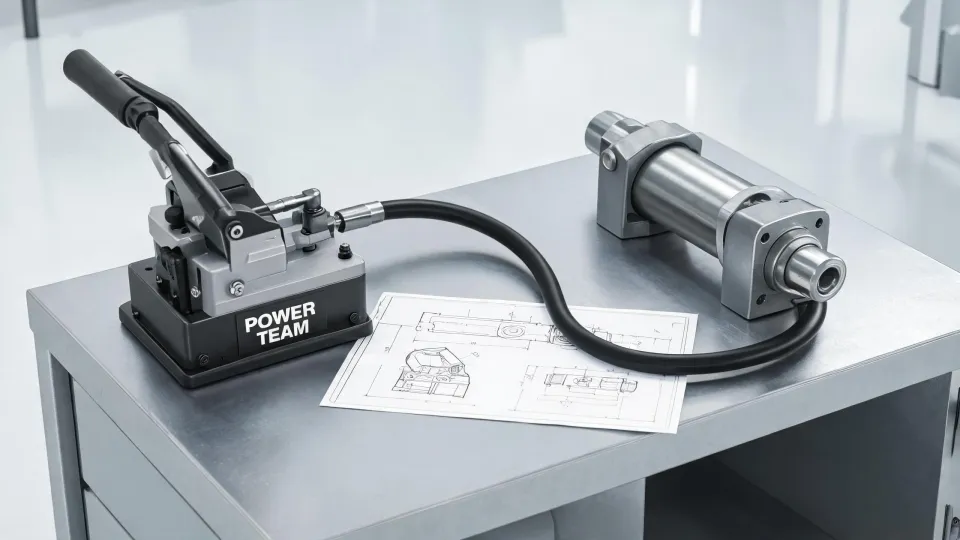
A hydraulic system—like a Power Team pump-and-cylinder rig—is a controlled-force tool. It's built for lifting, pressing, and pulling with precision. Higher force, quieter operation, but you're investing in a power unit, hoses, and fittings as a system.
Here's the causation confusion I see constantly: people think hydraulic tools are more expensive because they're harder to make. That's not it. They cost more because the failure mode is more dangerous and the system requires more failure-proofing. Electric tools fail 'soft'—they stop working. Hydraulic tools fail 'loud.' A burst hose at working pressure is a completely different risk category.
Q6: When is paying for rush delivery on hydraulic parts worth it?
Almost always when the alternative is downtime, and rarely when it's just to build inventory faster.
I'll take a firm position here: the rush fee buys certainty, not speed. Speed is the mechanic. Certainty is the product.
In Q3 2024, we paid about $520 in freight premiums to get a replacement hydraulic cylinder to a customer overnight. Standard shipping would have been roughly $180 and delivered in three days. The customer was facing a weekend shutdown on a production line they estimated at $14,000 per day. $340 in extra freight against $28,000 of potential loss—that's not a hard decision.
The flip side: I've watched buyers pay rush premiums on consumables they didn't need until next quarter. That's not buying certainty. That's paying for the feeling of preparedness. Don't do that.
My rule of thumb: if the cost of the delay exceeds 10x the rush premium, pay for rush. If not, take standard delivery.
Q7: What spec should go into every hydraulic tool contract now?
Three lines. Not negotiable, in my experience:
- Serialized documentation with date-stamped factory test results. No exceptions. If a vendor can't provide this, walk away.
- Explicit storage and shipping conditions. Hoses and seals degrade. If your vendor doesn't control this, you own the problem from the moment it leaves their dock.
- A defined rejection remedy. What happens if a spec is off? Who pays for the return freight? Who absorbs the production impact? Put it in writing before you sign.
We added these in 2022 after a batch of 60 hoses came in with mismatched crimp diameters. The vendor argued it was "within industry standard." It wasn't—it was 0.008 inches outside the tolerance their own spec sheet claimed. They redid the batch at their cost once our contract language forced the conversation. Adding those three lines cost us nothing and has saved us, conservatively, $40,000+ since.
That said, I can only speak to how we buy hydraulic components in a distributor context. If you're an end-user buying one press, the leverage is different. Your mileage may vary.
Last thing worth saying: no hydraulic tool is maintenance-free. If a vendor tells you it is, that's the moment you should be most skeptical—not least.

Maren Jorgensen
Maren Jorgensen is an independent hand tool and torque applications analyst covering wrenches, pliers, screwdrivers, hammers, sockets, ratchets, hex keys, and tool sets. She applies ISO 6789-1 torque-tool conformance principles while examining jaw capacity, leverage, fastener engagement, torque range, accuracy, handle geometry, and material hardness. Her practical guides help tradespeople and procurement teams select suitable tools, plan controlled tightening, and compare durability without relying on brand reputation alone.