Power Team Hydraulic Tools vs. Generic Alternatives: What I've Learned Approving 200+ Tool Purchases a Year
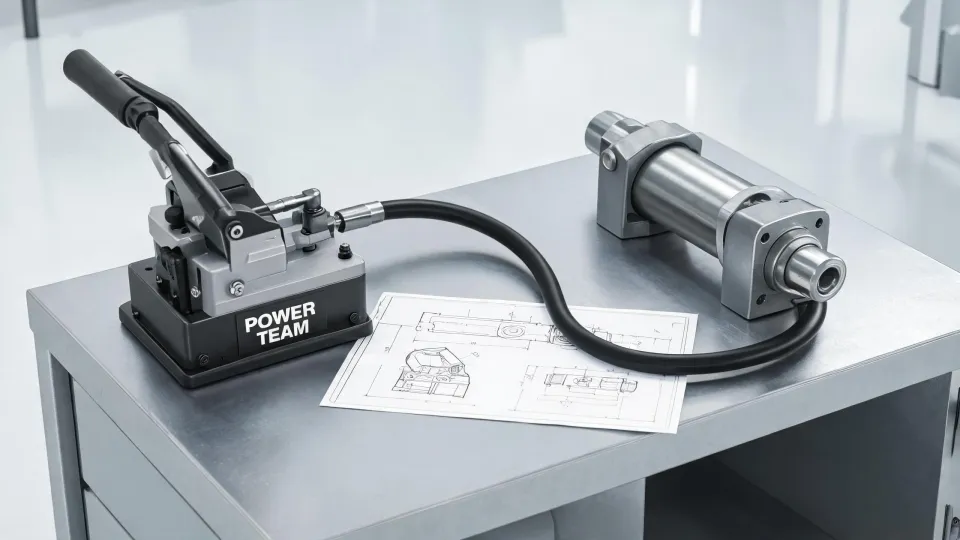
Real talk: my job title says "Quality & Brand Compliance Manager." What that actually means is I review every tool purchase request our maintenance teams submit before it reaches procurement. Last year I processed 247 requests. About 35% got kicked back—usually for spec mismatches or lazy justifications.
And I've noticed something. Most of our worst tool headaches trace back to one root decision: buy brand-specific or cherry-pick the "best" from each category. Sounds boring, right? It gets less boring when you're standing next to a hydraulic hose that just blew at 9,000 psi because someone saved $40 buying a non-spec replacement.
So here's the comparison. Not a sales pitch—just the dimensions that actually matter when you're deciding how to allocate your tool budget.
The Two Approaches
Brand-specific: You commit to one manufacturer—say, Power Team—for related categories. One supplier, one spec sheet, one warranty contact.
Category-specific: You pick the best-rated option in each category. Best hydraulic jack from Brand A. Best hose from Brand B. Best impact wrench from wherever. Best sub compact circular saw from whoever wins the reviews.
On paper, category-specific always wins. You get "the best" at everything. In practice, it falls apart on one thing: integration.
Dimension 1: Hydraulic Systems—Choosing Components That Fit Together
Start here because failure is most expensive.
I've had vendors ask: "Why can't I buy a cheaper jack, pair it with a good hose, and use a separate pump?" Technically, you can. What you're actually doing is betting that three sets of interface specs align—thread pitch, pressure rating, flow requirements, and fluid compatibility.
Here's the thing about hydraulic equipment: the pressure rating on a power team hydraulic hose matters only if the fittings match your cylinder and pump. I've seen a 10,000 psi hose mated to an 8,000 psi-rated cylinder with a 3/8" NPT fitting—and the vendor insisted it was "within tolerance." Their tolerance. Not ours.
In 2023, we tried saving money by buying third-party hoses to pair with Power Team cylinders. Most worked fine. One failed at 9,200 psi during a routine pressure test—well within what should have been safe operating range. We rejected the entire batch. The manufacturer blamed "installation error." We didn't have installation error. We had a fitting that didn't fully seat because the thread engagement was 2mm shorter than the OEM spec.
Looking back, I should have paid for the OEM hoses. But at the time, the savings looked real—about 22% on a 40-hose order across six service trucks. That's roughly $3,800. The redo cost us $6,200 in labor, shipping, and downtime.
Now every hydraulic contract includes a compatibility verification clause. Any mixed-brand hydraulic assembly requires written sign-off from both manufacturers. Funny how often that requirement makes the "cheaper" option disappear.
What does this mean for your power team hydraulic jack catalogue decision? If you're running a mixed-brand hydraulic setup, you're managing complexity across every component. A single-brand system means one torque spec, one service interval, one parts number to look up. When your technicians are troubleshooting at 2 AM, that matters more than the 15% procurement savings.
The counterintuitive part: I've found that mixed-brand hydraulic systems often have higher upfront quality because each component is individually vetted. But they have lower long-term reliability because no one owns the integration. The failure mode shifts from "component failure" to "system failure." Component failure is annoying. System failure is dangerous.
Dimension 2: Sump Pump Float Switches—When Brand Loyalty Goes Too Far
Not everything needs to match. This is where I draw the line.
Let's talk about sump pump float switches. It's a float that triggers a pump when water rises. Simple electromechanical component. Failure mode is isolated: either the switch fails open (pump doesn't run, basement floods) or fails closed (pump runs constantly, burns out).
We had a facility team spend three weeks chasing a "nuisance alarm" issue. Turned out the pump itself was fine—the float switch was getting stuck on mineral buildup. They replaced it with a $28 switch from a different brand. Problem solved. No compatibility issue. No system integration concern. Just a component doing its one job.
Here's where the contrast gets uncomfortable: for hydraulic systems, I mandate single-brand sourcing. For float switches, I actively discourage paying a brand premium. The question isn't "is this the best switch?" It's "is this switch independent enough that failure doesn't cascade?"
If the answer is yes, buy the best value. The causation here is often backwards from what people assume—we think expensive components are more reliable. In practice, components with good application engineering behind them are more reliable. Sometimes that engineering costs more. Sometimes it doesn't.
Dimension 3: Impact Wrenches and Compact Saws—Is It Actually Worth It?
This question comes up constantly: "Is an impact wrench worth it?"
I can't give you a universal answer. But I can give you the decision framework we use.
We tested four impact wrenches last year across our fleet maintenance team. Same rated torque output on paper. Two high-end brands, one mid-tier, one budget. Six technicians, ten identical bolt assemblies, blind test. The high-end and budget units showed an 18% spread in actual achieved torque. Nobody knew which was which until after.
An impact wrench is worth it when speed and consistency matter. It's not worth it when you're tightening the same six bolts once a month. The cost isn't the tool—it's the training, the calibration, the battery ecosystem, and the maintenance schedule.
Where I see people go wrong: they buy the mid-tier impact wrench, use it for 80% of tasks, and then wonder why the budget one "doesn't hold up." It doesn't hold up because it wasn't designed to run 30% of its duty cycle at max torque. That's not a product failure. That's a specification mismatch.
Same logic applies to sub compact circular saws. If you're doing framing cuts in tight spaces, the compact form factor is the feature. If you're cutting plywood in an open shop, a full-size saw gives you more stability and blade visibility for less money. Ask yourself: what's the actual constraint? Space or budget?
Here's what surprises people: in our testing, the mid-tier compact saws outperformed the budget full-size units in cut quality by a wider margin than the price difference suggested. The "compact" version had better blade stabilization because the smaller housing reduced vibration. Sometimes the specialized tool is better because it's specialized, not despite it.
My Decision Rules (After 247 Reviews)
Go brand-specific when:
- The failure modes cascade across components
- You need unified warranty or traceability
- Training burden matters more than unit cost
- Specifications are interdependent (hydraulic pressure ratings, electrical load calculations)
Go category-specific when:
- The component fails in isolation
- Replacement cost is low relative to downtime
- The interface is genuinely standardized (NPT fittings, standard blade arbor sizes)
- You've actually verified compatibility, not assumed it
The honest answer: most teams should run a hybrid. Brand-specific for hydraulic systems and anything safety-critical. Category-specific for accessories, consumables, and standalone tools.
Put another way—don't build a system from the "best" parts. Build a system where the parts work together. Sometimes that means one brand. Sometimes it doesn't. The trick is knowing which situation you're in before you place the order, not after the hose blows.
"An informed customer asks better questions and makes faster decisions. I'd rather spend 10 minutes explaining why a $400 hose is different from a $120 one than deal with a system failure report afterward."
Note on specifications: Hydraulic pressure ratings and compatibility requirements vary by manufacturer. Always verify current specs with the OEM before mixing components from different brands. Regulatory information is for general guidance only—consult OSHA and relevant standards bodies for current requirements.

Maren Jorgensen
Maren Jorgensen is an independent hand tool and torque applications analyst covering wrenches, pliers, screwdrivers, hammers, sockets, ratchets, hex keys, and tool sets. She applies ISO 6789-1 torque-tool conformance principles while examining jaw capacity, leverage, fastener engagement, torque range, accuracy, handle geometry, and material hardness. Her practical guides help tradespeople and procurement teams select suitable tools, plan controlled tightening, and compare durability without relying on brand reputation alone.