Power Team Pump Repair vs. Replacement: A Procurement TCO Comparison
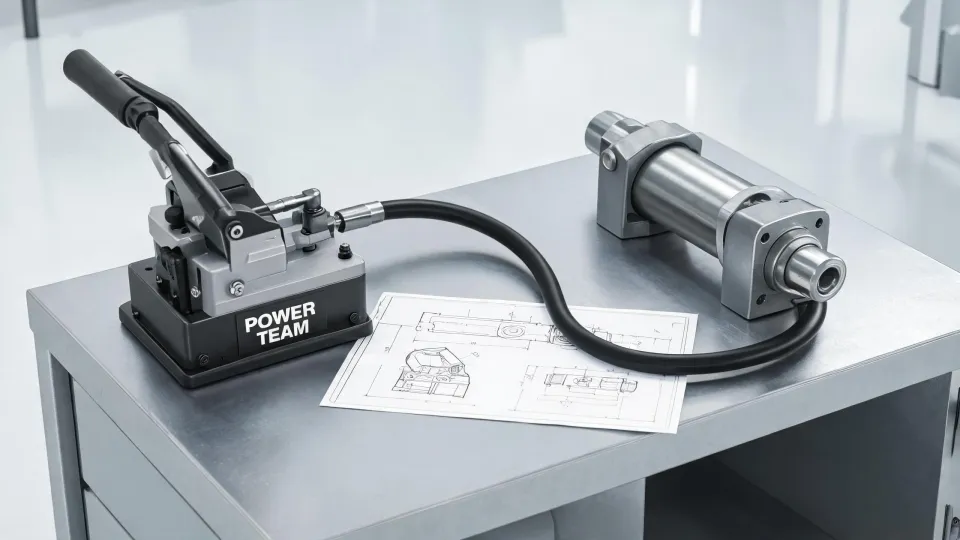
I manage maintenance procurement for a 260-person industrial service company. We spend about $180,000 a year on hydraulic tools, pumps, cylinders, torque wrenches, jacks, and rebuilds. Over the past six years, I have tracked every invoice in our cost system. In our asset system, we tag the whole line as power-team. When someone asks whether to repair power team pumps or replace them, I do not start with the quote. I start with total cost of ownership. When people ask about power team repair, I give them the same framework. This is the comparison I use: authorized Power Team repair/rebuild versus generic hydraulic shop or replacement. I compare them on three dimensions: seal and parts traceability, downtime, and true TCO.
One quick note: this is not about sump pump systems. A sump pump moves water. A Power Team hydraulic pump creates pressure for cylinders, presses, torque wrenches, and jacks. The failure modes and standards are different, even if both are called pumps. If you maintain sump pump systems, use a separate PM schedule and do not borrow hydraulic pump assumptions.
Dimension 1: Seal measurement and parts traceability
From the outside, a rebuild quote looks simple. The shop says they will replace the seals and test the pump. The reality is that seal measurement is where cheap rebuilds go wrong. If you do not measure the cylinder seal correctly, you are guessing. And guessing in a 10,000 psi system is not a cost-control strategy; it is a downtime strategy.
The question how to measure hydraulic cylinder seals comes up every time. Measure the hardware, not just the old seal. Use calipers to record the rod diameter, bore diameter, gland depth, groove width, and seal cross-section. Check the Power Team service literature for the cylinder model. If the manual is missing, measure the groove and the mating surfaces. Do not order by sight. A seal that looks close can fail fast under pressure. The old seal may be swelled, chewed, or compressed, so it is a bad baseline.
Authorized Power Team repair wins this dimension in my records. They have model-specific seal kits and documented measurements. A generic shop may be good, but if they freehand the seal selection, you own the risk. I have seen a $900 rebuild turn into a $3,400 redo when the wrong seal cross-section passed the bench test and failed in service. That number is from our internal repair log, not a published study. When a customer sees a press leaking again two weeks after a repair, they do not blame the seal. They judge your maintenance team. That is the quality perception cost.
ISO 4413 covers general safety requirements for hydraulic systems. It is not a seal-measurement guide, but it is the baseline for why pressure integrity matters. ISO 5598 defines the vocabulary so you and the shop use the same terms. If the job involves Power Team torque wrenches, calibration should follow ISO 6789; that is a separate line item in our TCO.
This is also where small tools matter more than people think. A 6003 Joker combination wrench is not a seal measurement tool, but it is the kind of low-profile wrench that helps when you are pulling a cylinder in a tight frame. If your tech cannot get to the fitting, the job takes longer and the risk of a nicked seal goes up. In my opinion, the tool budget is a rounding error compared with the cost of one failed rebuild.
Dimension 2: Downtime and turnaround
On paper, a local shop often looks faster. They may promise 48 to 72 hours. Authorized Power Team repair may quote 5 to 10 business days. That is a real gap. I get why people go with the faster quote. When a press is down, a week feels expensive.
But I weigh the risk. The upside was about $2,000 in lower repair cost and three days faster turnaround. The risk was a pump failure during a scheduled outage. I kept asking myself: is $2,000 worth potentially missing a customer deadline? The worst case was a full line stop and expedited replacement. The best case was we saved a little and looked smart. The expected value said go local, but the downside felt too big for a critical unit.
For non-critical power team pumps, the faster local option can be fine. For a pump that supports a 100-ton press or a torque wrench calibration line, I want documented testing and a warranty. Turnaround speed is not the same as turnaround certainty. To be fair, some local shops are excellent and have the right test bench. But you need proof, not a promise.
Dimension 3: Total cost of ownership
The lowest invoice is rarely the lowest total cost. Our TCO spreadsheet includes freight, pickup and delivery, expedite fees, seal kits, labor, testing, warranty, and downtime. It also includes the cost of a redo. When I ran the numbers for a typical Power Team pump repair, the authorized route was about 18% higher on the invoice. After hidden costs, the gap narrowed to 4%. On critical units, the authorized route was actually cheaper once we counted downtime.
Granted, this requires more upfront work. You have to get the model number, the service history, and the seal measurements. You have to track the invoice against the original quote. But that work is what makes the comparison honest. If you skip it, you are just comparing guesses.
Looking back, I should have required a seal measurement sheet with every rebuild. At the time, the quote looked good and the shop had a good reputation. If I could redo that decision, I would add one line to our repair PO: attach rod, bore, gland, and seal dimensions. That single change would have caught two bad rebuilds before they happened.
Which should you choose?
Choose authorized Power Team repair or a documented rebuild when:
- The pump or cylinder is critical to production.
- The unit runs high cycles or high pressure.
- You need traceable parts and a warranty.
- You have the model number and can verify seal dimensions.
- Downtime cost is higher than the repair price difference.
Choose replacement or a generic shop when:
- The pump is obsolete and repair exceeds 60% of new cost.
- The unit is non-critical and a backup exists.
- You can inspect the shop's test bench and warranty terms.
- You can measure the hydraulic cylinder seals yourself and hold the shop to those numbers.
Personally, I keep a simple rule: if the repair touches a safety-critical hydraulic circuit, it goes to a documented Power Team repair process. If it is a low-pressure utility pump, I will take the faster, cheaper option with clear warranty terms. That is not a brand loyalty thing. It is a risk-adjusted cost thing.
And one last practical note: keep your tooling ready. A 6003 joker combination wrench, a good caliper set, and the Power Team service literature will save you more money than another round of vendor haggling. The vendors can only quote what you can describe. If you cannot describe the seal, you are not buying a repair. You are buying hope.

Leila Farzan
Leila Farzan is an independent welding, abrasives, and cutting accessories analyst covering welders, electrodes, wire, grinding wheels, flap discs, cutting discs, drill bits, saw blades, hole saws, and router bits. She references ISO 525 abrasive-product dimensions and ISO 9606-1 welding qualification concepts while examining wheel speed, grit, bond, electrode class, duty cycle, kerf, tooth geometry, and material compatibility. Her guides help fabricators choose consumables, control process risk, and compare cut or weld quality.