The Hidden 40%: Why Your Hydraulic Tool Budget Keeps Overrunning
I've been managing our maintenance tooling budget for seven years. In that time, I've approved purchases for everything from a box of fittings to a 100-ton press. And I can tell you the single most expensive mistake I keep seeing—one I've made myself, more than once—has nothing to do with picking the wrong brand.
It's simpler than that. And it's costing industrial buyers somewhere between 30% and 40% more than the number on the quote.
The Problem You Think You Have
When most maintenance teams need hydraulic equipment, the process looks like this: get three quotes, compare the unit prices, pick the middle one or the cheapest one that looks credible, done.
That was my process in 2022 when we needed to replace two aging cylinders on our shop floor. I remember comparing a Power Team unit against two alternatives. The Power Team quote came in about $340 higher per cylinder. I went with the cheaper option.
Four months later, I was explaining to our operations manager why we'd lost three days of scheduled maintenance time waiting on replacement seals and a hose that didn't match the spec on the cylinder we bought. That "savings" of $680 turned into roughly $4,100 in downtime, expedited shipping, and a rush order from a local supplier who charged us whatever they wanted because they knew we were stuck.
Here's the thing: I've seen this movie. I've seen it across 200+ purchase orders. And the pattern is almost always the same.
The Real Problem: You're Pricing a Tool, Not a System
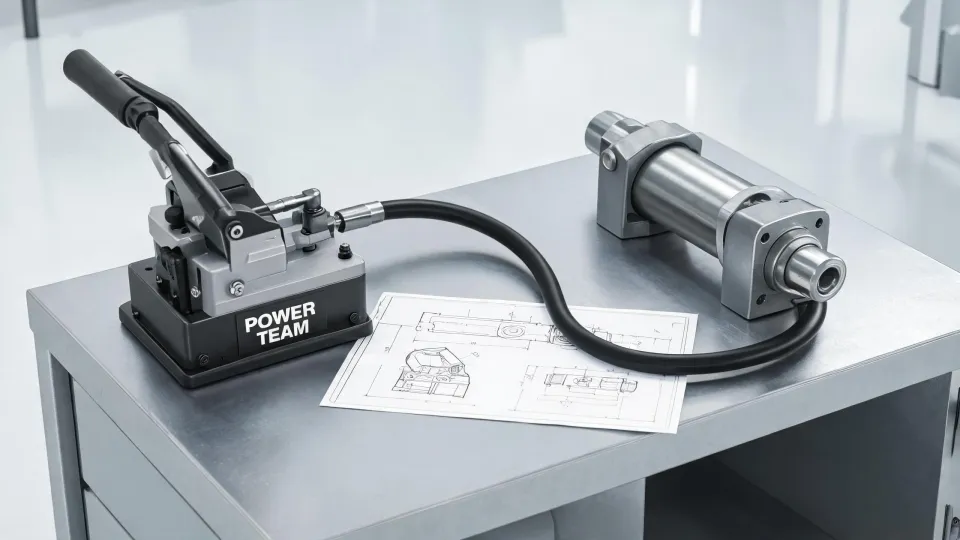
Hydraulic equipment doesn't work in isolation. A cylinder needs a pump. A pump needs a hose rated for the pressure. A hose needs the right fittings. And if you're using a torque wrench—especially something like a ½-inch drive electronic torque wrench—you need calibration documentation that satisfies whoever audits your safety program.
Most buyers focus on the unit price of the main component and completely miss the accessories, consumables, and support costs that surround it.
I've made this mistake. In 2023, I built out a cost calculator after getting burned twice on hidden fees—once on fittings, once on calibration. Our procurement policy now requires quotes from three vendors minimum, and the quote template has six extra line items that didn't exist before: hose compatibility, fitting standards, oil specification, calibration schedule, seal kit availability, and warranty response time.
That last one matters more than people think.
When we audited our 2023 spending, we found that 41% of our "budget overruns" on hydraulic tooling came from one of two things: either a hose failure that took the whole system down, or a calibration lapse that forced us to pull a tool out of service on a job that was already scheduled. Neither of those problems appeared anywhere on the original purchase quote.
People think the cheap vendor saves you money. Actually, vendors who build quality into their full product line can afford to charge more because they know—and their customers know—that the total cost runs lower over time. The causation runs the other way.
What It Actually Costs You
Let me give you the numbers from our own tracking. Over the past six years, I've documented every order in our cost system. Here's what the pattern looks like for a typical hydraulic tool purchase:
- Quoted unit price: what you see on the P.O.
- Hose and fitting compatibility: 8–15% of unit price if you need to re-spec after delivery
- Hydraulic oil specification errors: you'd be surprised how often this happens. We once ordered the wrong viscosity for a press because the manual didn't specify, and the vendor didn't ask. Cost us a full seal kit replacement. Not covered under warranty.
- Calibration downtime: for torque wrenches, this runs 3–5 days of tool unavailability per cycle if you don't plan ahead
- Expedited freight: I've paid $180 in rush shipping on a $75 seal kit because we couldn't wait the standard lead time
Add those up, and the cheapest quote isn't the cheapest purchase. Not even close.
The most frustrating part of managing this: the same issues recurred despite clear specs on our end. You'd think a written PO would prevent compatibility errors, but interpretations vary. One vendor shipped a hose rated for 10,000 psi but with fittings that weren't matched to our existing pump manifold. That cost us $450 in re-work and two days of lost time.
That's when I stopped treating the quote as the whole picture.
The Question You Should Be Asking
The question everyone asks is "what's your best price?" The question they should ask is "what's included in that price, and what's the replenishment path for the next five years?"
I get why people go with the cheapest option—budgets are real, and procurement pressure is real. But the hidden costs add up. And they don't show up until you're already committed.
Here's the framework I use now. It's not perfect. But it's kept us from making the same mistake twice:
- Ask for the full spec sheet, not the marketing sheet. You want to see pressure ratings, hose compatibility standards, and fluid specifications. If the vendor can't produce this quickly, that tells you something.
- Price the consumables separately. Seals, hoses, fittings, oil—get a five-year cost estimate. If the vendor doesn't stock these, factor in third-party sourcing time and cost.
- Confirm calibration and service support before you buy. A tool without local calibration support is a tool that goes out of service for longer than it needs to.
- Look at the full product line. This is where brands like Power Team have an advantage—not because they're the only option, but because a full hydraulic line means compatible parts, documented specs, and service support that doesn't require chasing down four different suppliers.
Case in point: we recently standardized on Power Team hydraulic hose and fittings across three of our work cells. The upfront cost was maybe 12% higher than the mixed-vendor setup we had before. But in the first year, we eliminated two hose failures and one compatibility return. That's roughly $2,800 in avoided downtime and re-work, against an upfront premium of about $900.
Do the math. It's not complicated.
The Line You Have to Draw
I'm not saying buy the most expensive option every time. That's not a strategy—that's just spending more.
What I am saying is that the price on the quote is a starting point, not the final number. And if you're not tracking the cost of hoses, seals, calibration, and downtime, you're not actually managing your hydraulic tool budget. You're managing a wishlist and hoping the rest works out.
For me, the turning point was simple: I calculated the worst case on a cheap cylinder purchase—complete seal failure at 6 months, out of warranty, $3,500 redo. Best case, maybe saves $800. The expected value said go for it. But the downside felt catastrophic given our production schedule.
I went with the higher-priced option that time. It's been running for 18 months without a seal issue.
Maybe that's luck. Maybe it's quality control. But I've stopped pretending those are the same thing.
"The lowest quoted price often isn't the lowest total cost. After tracking 200+ orders over seven years, I'd put the real markup from hidden costs at 30–40% above the sticker price. The vendors who understand this are the ones who keep your equipment running."
If you're building or revising a hydraulic tool procurement standard, start with the accessories. The cylinder is the easy part. The hose, the oil, and the calibration schedule are where the budget actually lives.

Helena Duarte
Helena Duarte is an independent pipe, valve, and pump applications analyst covering fittings, ball valves, gate valves, check valves, butterfly valves, flanges, hose clamps, centrifugal pumps, sump pumps, and submersible pumps. She uses ISO 5208 pressure-testing concepts and ISO 9906 pump acceptance methods while comparing pressure class, seat leakage, Cv, head, flow, efficiency, solids passage, seal materials, and installation orientation. Her guides help specifiers and maintenance teams match fluid-handling components to service conditions and acceptance criteria.