The Hidden Cost of Hydraulic Pump Failures: What Procurement Gets Wrong
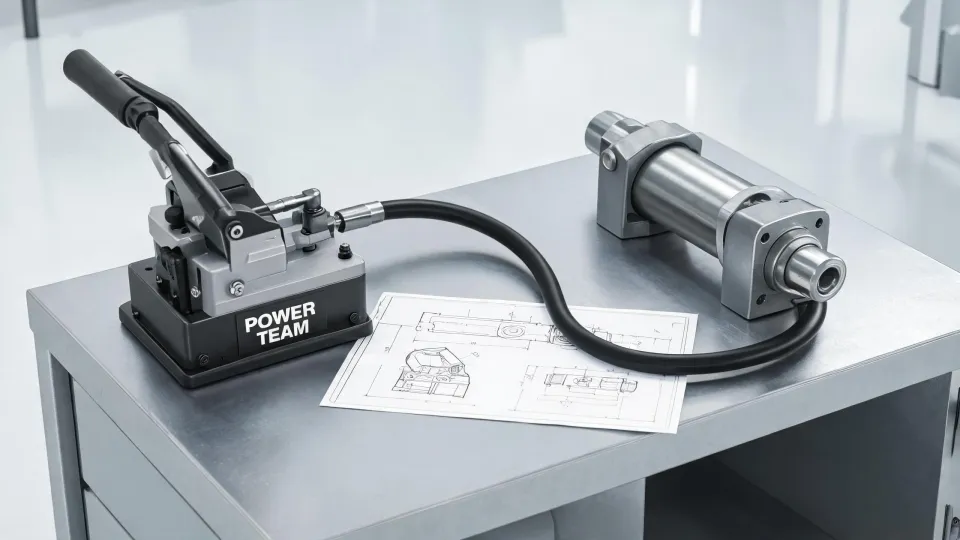
Here's the scene I've been part of too many times: a pump stops building pressure. The maintenance team calls. Someone needs a replacement today. And procurement gets the emergency-shipping quote.
I manage purchasing for a 45-person industrial services company. We spend about $220,000 a year on tools and equipment, and I've tracked every invoice for the last six years. So when I say the real cost of a hydraulic pump failure isn't the pump, I'm not guessing.
The Surface Problem Everyone Focuses On
Most buyers focus on pump price. Max pressure. Flow rate. Maybe a brand name if they've been burned before. The question everyone asks is “What’s your best price?” The question they should ask is “What’s the total cost if this thing fails on Week 3 of a five-week job?”
That’s not a rhetorical question. In Q3 2023, I compared quotes for a 10,000 psi hydraulic pump. The budget option was $1,850. The unit we already used, from the line with the Power Team logo on the side, was $2,120. I almost went with the budget option until I added in the extras: freight, a filter upgrade, and a spare seal kit. That “cheap” pump ended up at $2,140 before we even ran it. The Power Team pump included the filter and a proper test certificate. The real difference was $20.
I’m not saying every “expensive” option is worth it. But I am saying the price on the quote sheet is the worst number to compare when the pump is headed to a jobsite where downtime costs more than the equipment.
Why Cheap Pumps Aren’t Cheaper
Here’s the part that took me years to learn. A hydraulic pump’s nameplate is not a promise. It’s a valid operating point. The actual performance depends on the system around it—fluid, filtration, hoses, fittings, duty cycle, temperature. You can take a perfectly good pump and ruin it with the wrong fluid or a dirty connector.
People think expensive vendors deliver better quality. Actually, vendors who deliver quality can charge more. The causation runs the other way. The companies that survive failures, callbacks, and “can you fix this by Thursday?” questions build that reliability into their price. You’re not paying for the pump. You’re paying for the engineering judgment attached to it.
That’s why I eventually standardized our mobile hydraulic setups on Power Team hydraulic pumps. Not because they’re the cheapest—they aren’t. Because every one we’ve used, from the low-ton units to the heavy-duty presses, behaves the way the spec sheet says it will behave. That matters when a crew is standing around waiting.
A pump is a small part of the system. But a small failure has a way of turning into a very large invoice.
The Real Cost of "Probably On Time"
In March 2024, we paid $400 extra for rush delivery on a cylinder. The alternative was missing a $15,000 event for a client. That $400 wasn’t for speed. It was for certainty. I’ve been burned by “probably Thursday” too many times.
In 2022, a vendor promised a pump Friday. I didn’t listen to the little voice that said their responsiveness had dropped after we signed the PO (note to self: trust that). It arrived the following Tuesday. The crew idled for 11 hours. That cost us $7,800 in labor and rebooking. The $350 “premium” we could have paid for guaranteed delivery would have been the cheapest part of the week.
Emergency situations change the math. If you’re buying a pump because your current one is down, the only thing that matters is delivery certainty. “Best price” becomes a dangerous phrase. The most expensive sentence in industrial procurement is “probably on time.”
Now, I’m not saying you should always pay for rush service. I’m saying you should price the risk of being wrong, not just the speed of the shipment.
What Actually Fixed Our Costs
After six years of tracking invoices, I’ve come to believe something that sounds a little strange: the best way to cut hydraulic equipment costs is to buy fewer pumps.
1. Match the system, not the nameplate
Before you order, demand the curve. I’m not talking about becoming an engineer. I’m talking about basic literacy. We made a one-page guide for our team on how to read centrifugal pump curve data—whether it’s a water transfer pump or a hydraulic unit. Yes, centrifugal curves aren’t the same as positive displacement curves. But the habit of asking “what’s the curve?” filters out vendors who don’t understand their own products.
If a salesperson can’t show you a curve, they’re guessing. And you’ll pay for their guess eventually.
2. Stock the small stuff
A 7 inch pliers wrench is one of the cheapest tools we own. It’s saved us hours on line changes and fitting swaps. But don’t confuse that with system reliability. A wrench won’t fix a pump that’s undersized for the duty cycle.
3. Know what actually belongs in your inventory
We also keep a 1/3 hp submersible sump pump in service for low-voltage vaults and trench water. That little pump is not a hydraulic tool. It’s part of the same lesson: match the equipment to the actual job. The 1/3 hp unit costs about $200 and does exactly what it’s supposed to do. We don’t use it for anything else, and we don’t pretend a bigger pump is always better.
4. Use brands as a risk shortcut
A brand isn’t a magic shield. But when you see a Power Team logo on a pump, you’re seeing the result of decades of industrial failures and fixes. The logo is a polite way of saying "we already tested this so you don’t have to." In procurement, that’s worth real money.
The Bottom Line
Here’s my simplest advice: stop comparing purchase prices. Compare the cost of being wrong.
That starts with understanding pump curves, asking the uncomfortable questions, and buying a system that shows up when you need it. The brand matters less than the behavior. But when behavior is hard to verify quickly, a Power Team hydraulic pump is a comfortable truth, not a gamble.
And if you’re in a hurry, pay for certainty. A $400 rush fee is nothing compared to a $7,800 idle crew. I learned that the expensive way.

Maren Jorgensen
Maren Jorgensen is an independent hand tool and torque applications analyst covering wrenches, pliers, screwdrivers, hammers, sockets, ratchets, hex keys, and tool sets. She applies ISO 6789-1 torque-tool conformance principles while examining jaw capacity, leverage, fastener engagement, torque range, accuracy, handle geometry, and material hardness. Her practical guides help tradespeople and procurement teams select suitable tools, plan controlled tightening, and compare durability without relying on brand reputation alone.