The Right Way to Buy Hydraulic and Pump Parts Depends on One Number: Your Downtime Cost
I'm a procurement manager at a 340-person industrial maintenance and fabrication company. I've managed our MRO spare-parts and consumables budget — roughly $2.1 million a year — for seven years, negotiated with 40+ vendors, and logged every order in our ERP system.
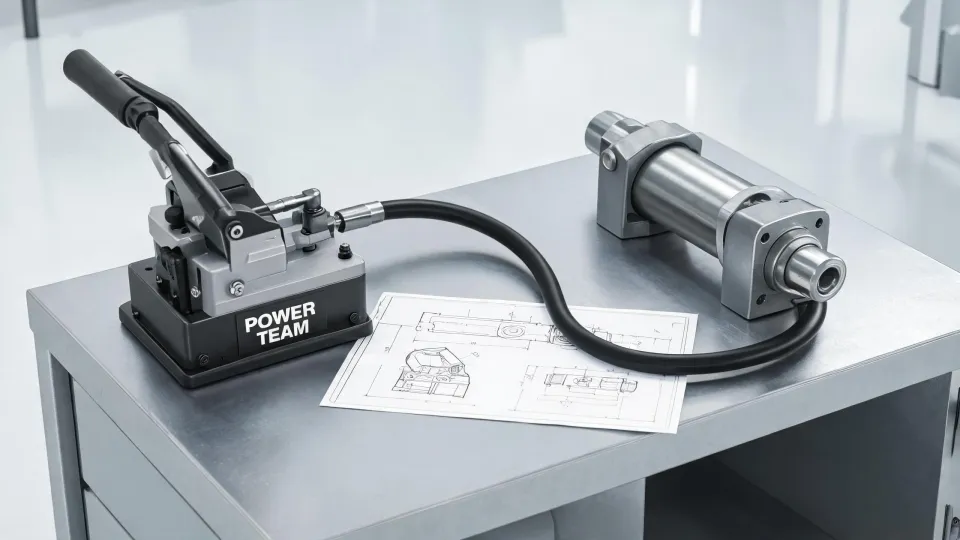
Here's the question I get most often: should we buy OEM Power Team hydraulic pump parts or aftermarket? Is branded hydraulic oil worth the premium? Is a $180 rebuild kit for a 3hp submersible pump smarter than a $420 replacement?
I never answer that directly. Because it doesn't have one answer.
The variable that decides it isn't unit price. It's downtime cost per hour.
A $45 seal kit is a bargain on a machine that costs $1,800 an hour to have down. That same $45 kit is money wasted on a backup sump pump in a corner nobody walks past. Same part. Opposite answer.
So I sort every purchase into one of three scenarios before I even open a quote.
- Scenario 1: One machine, and if it stops, production stops.
- Scenario 2: A fleet of equipment where nothing is individually irreplaceable.
- Scenario 3: Auxiliary equipment nobody thinks about until it fails.
Scenario 1: One Machine, and If It Stops, Production Stops
The July 2023 press failure changed how I think about spare parts inventory. Our 40-ton press lost a pump seal on a Tuesday afternoon. Normally there'd be a spare cartridge on the shelf. There wasn't — I'd trimmed that inventory line the previous quarter to free up working capital, and it looked great on the report.
We air-freighted the replacement. $1,900 for the part, $640 in expedited freight, 11 hours of a two-person line sitting idle, then weekend overtime to catch up. Call it $6,000+ to avoid holding a $1,100 part.
Here's what I do differently now in this scenario:
Buy to OEM spec. When the cost of getting it wrong is 11 idle hours, the 20–30% delta between a genuine pump cartridge and the cheapest thing that threads in is not your optimization target. Your target is not having this conversation again.
Buy the fluid the manual actually calls for. Our Power Team pumps specify an anti-wear hydraulic oil in the ISO VG 32–46 range depending on ambient temperature. ISO 3448 is the standard that defines those viscosity grades. You cannot eyeball this from a pail.
They warned me about spec-matching top-off fluid. I didn't listen. In February 2023 a night tech topped off a reservoir with ISO VG 68 because it was the only pail in the shop and the machine sat in a 45°F bay. Cold-start cavitation, wiped pump, $2,600 in parts and freight. The correct pail would have cost $90.
Cleanliness beats brand. ISO 4406 expresses fluid contamination as a three-number code, and every OEM service guide I've read treats fluid cleanliness as the primary driver of hydraulic component life. You can hit the right viscosity grade and still destroy a pump with a dirty transfer container. A $30 sealed transfer jug is cheaper than a rebuild.
Stock one full spare of your two most failure-prone assemblies. Not a full warehouse. Two items, plus seal kits and filters.
I had four hours before second shift started on one of these calls. Normally I'd wait for three quotes. There was no time, so I went with the local distributor at 22% over the online price because he'd have it on the dock by 2pm. In hindsight that was the easiest 22% I ever spent. Not because it was cheap — because it was certain.
In Scenario 1, you're not buying a part. You're buying a guaranteed recovery time.
Scenario 2: A Fleet, Where Nothing Is Individually Critical
This is where most of my budget actually lives, and it's where process efficiency pays for itself. Last year we ran roughly 130 hydraulic and pumping assets across three sites. Individually, almost none of them justify emergency freight. Collectively, they justify a system.
Three things changed our numbers.
Consolidate fluid specs where the manuals agree. If 80% of your fleet's documentation accepts the same grade, buy that grade in bulk and keep the exceptions in a separate, labelled pail. Where the manuals disagree, they win — you don't force one fluid across equipment it wasn't spec'd for.
Cut suppliers, then negotiate. We went from six fluid and parts suppliers to one primary and one backup. Fewer POs, better tier pricing, and — honestly the bigger win — one person to call when something's wrong.
Put reorder points in the system. This is the part people underrate. Switching to a single supplier with a blanket PO and quarterly releases cut our turnaround on stocked hydraulic parts from 5 days to 2. More importantly, the automated reorder points removed the 'nobody ordered it' failures. Not because people got more careful — because the system stopped depending on people being careful.
One warning: don't let consolidation blur the scenario lines. If a machine on this list is genuinely irreplaceable, it's Scenario 1 no matter how small it looks on the asset register.
Scenario 3: Auxiliary Equipment Nobody Notices Until It Fails
Sump pumps, coolant pumps, 3hp submersible pumps, portable air compressor parts. This is where the counterintuitive advice lives.
Stop rebuilding them. Do the labor math before you do the parts math. Pulling a submersible pump out of a sump, breaking it down, sourcing a seal kit, reassembling, and dropping it back is often a four-hour job. At $85 an hour loaded, that's $340 of labor on a $420 pump. Buy two new ones and shelve the spare. It's not laziness, it's arithmetic.
That said, knowing how the pump actually works changes what you stock. A centrifugal pump doesn't push fluid with a piston or a gear — it spins an impeller inside a casing and converts velocity into pressure. Two consequences that matter to a buyer: it won't self-prime, and its flow drops as discharge pressure rises. That tells you how these units fail — shaft seals, bearings, wear rings, and running dry. So stock seal kits and wear rings. Stop trying to rebuild the motor.
And if the same pump fails three times in a year, the part isn't the problem. Dry running, a throttled discharge, or abrasive solids in the sump are. A better pump won't fix bad plumbing.
Same logic for portable air compressor parts. Filters, belts, and drain valves are commodities — buy them anywhere. Unloader valves and pressure switches are not. A failed pressure switch on a portable unit is a safety event, not a line item. Pay for the correct specification, not the lowest quote.
How to Tell Which Scenario You're In
Four questions. Be honest on the first one, because that's where most people misclassify themselves.
- If this asset stops right now, does revenue stop, or does somebody grab a mop?
- What's your realistic recovery time with no spare on the shelf? Multiply that by your hourly cost of downtime. Compare it against the price gap between the cheap part and the correct part. I've never once seen the gap win that comparison.
- Who specifically owns fluid cleanliness in your operation? If the honest answer is 'nobody in particular,' you're in Scenario 1 whether you planned to be or not.
- Can it be rebuilt in under 30 minutes, on the floor, without a crane, a lift, or a confined-space permit? If not, buy the assembly instead of the kit.
None of this is about being cheap or being premium. It's about putting money where the hours are.
The cheapest invoice and the lowest cost are two different numbers. Once you know which scenario you're standing in, the rest is arithmetic — and the arithmetic is usually not close.
Part and fluid prices referenced here reflect quotes we received in late 2024 and early 2025. Verify current pricing with your distributor, since hydraulic component and freight costs move with the market. Always follow the OEM specification for the specific equipment you're servicing, and verify current standards at the issuing body (ISO 3448 for viscosity grades, ISO 4406 for contamination coding).

Amara Nwosu
Amara Nwosu is an independent hydraulic tool and pump systems analyst covering jacks, cylinders, pullers, torque wrenches, hand pumps, power pumps, and porta-power equipment. She applies ISO 4413 safety principles while examining rated pressure, cylinder force, stroke, oil volume, flow, return type, hose condition, load holding, pressure loss, and relief protection. Her technical guides help maintenance and construction teams configure compatible systems, verify safe capacity, and diagnose slow or unstable operation.