How to Measure Hydraulic Cylinder Length (And Avoid the Parts Mistakes I Made)
-
Why I Started Measuring Stroke Before Length
- How to Measure Hydraulic Cylinder Length Correctly
-
The Parts Ordering Side: SPX Power Team Hydraulic Pump Parts and the Packing Nut Wrench
-
Why You Shouldn't Trust 'Direct Replacement' Claims Without Verification
-
When the Simple Measurement Method Isn't Enough
The most useful measurement for a hydraulic cylinder replacement is not the overall length. It's the retracted length between mounting centers and the stroke. If you only take one thing from this article, make it this: stroke determines whether the cylinder does the job, and overall length alone will lead you straight to the wrong part. In the past 18 months, I've used this mindset to catch 22 cylinder orders before they became expensive mistakes.
Let me explain why I'm confident about this. I'm a maintenance coordinator who's been handling hydraulic equipment orders for eight years. I've personally made, and documented, 23 significant ordering mistakes that totaled roughly $15,000 in wasted budget. The good news is that the mistakes became the basis for a checklist our team still uses. The more public good news: you don't have to repeat them.
Why I Started Measuring Stroke Before Length
The trigger was in March 2023. A press cylinder was leaking and we needed a replacement fast. I measured the old cylinder while the rod was fully extended, and the tape said 42 inches. I found a replacement listed as 42 inches overall. On paper, the numbers matched. When it arrived, the rod extended only 8 inches, not the 16 inches we needed. The cylinder body was longer than the old one, so it didn't fit the mount brackets either. That order came to about $4,700 with freight—though I might be misremembering the exact freight charge—and it sat in a crate for months before we sent it back.
When I compared the old and new cylinders side by side, I finally saw the issue clearly. The overall length is a composite of the body length and the stroke. If you measure the cylinder in the extended position, you're mixing two variables into one number. The result is a guess, not a dimension. That's the lesson: measure the stroke separately from the body/mounting length, and don't let the tape measure lie to you.
How to Measure Hydraulic Cylinder Length Correctly
Here's the procedure I now use for standard tie-rod and welded cylinders. It works in most shop environments, and it's simple enough to write on a dry-erase board.
Step 1: Identify the Mounting Style
Cylinders come with clevis mounts, pin mounts, flange mounts, or foot brackets. The mounting style determines which points you measure between. For a clevis or pin mount, measure between the centerline of the pin holes. For a flange mount, measure from the flange face to the centerline of the rod clevis or rod eye. If you measure the wrong reference points, the cylinder may be 'the same length' but still not fit.
Step 2: Measure the Retracted Length
With the rod fully retracted, measure between the mounting centers (or the flange face and rod end). This is often called the closed center distance. It tells you whether the cylinder can physically fit in the space where it's mounted. Write it down before anything else.
Step 3: Measure the Stroke
Extend the rod fully, mark the rod at a fixed reference point, retract it fully, and measure the distance the rod moved. Or if you have access to a spec sheet, stroke = extended length - retracted length, measured between the same reference points. Why does this matter? Because stroke is the dimension that determines how far the cylinder can push or pull. A 1-inch difference in stroke often means the machine can't complete its cycle—or worse, it bottoms out and damages internal components.
Honestly, I'm not sure why so many supplier spec sheets list 'overall length' without saying whether the rod is extended or retracted. My best guess is that it's a copy-and-paste habit from old catalogs. Either way, it's not a number you should trust by itself.
Step 4: Measure Bore and Rod Diameter (for Rebuild Parts)
If you're ordering seals or a rebuild kit, you need both bore diameter and rod diameter. These two numbers, along with stroke, are the core identifiers for most cylinders. Length alone won't get you the right seal kit. If you can't find a manufacturer tag, use a caliper on the rod and measure the bore from the port opening if possible.
The Parts Ordering Side: SPX Power Team Hydraulic Pump Parts and the Packing Nut Wrench
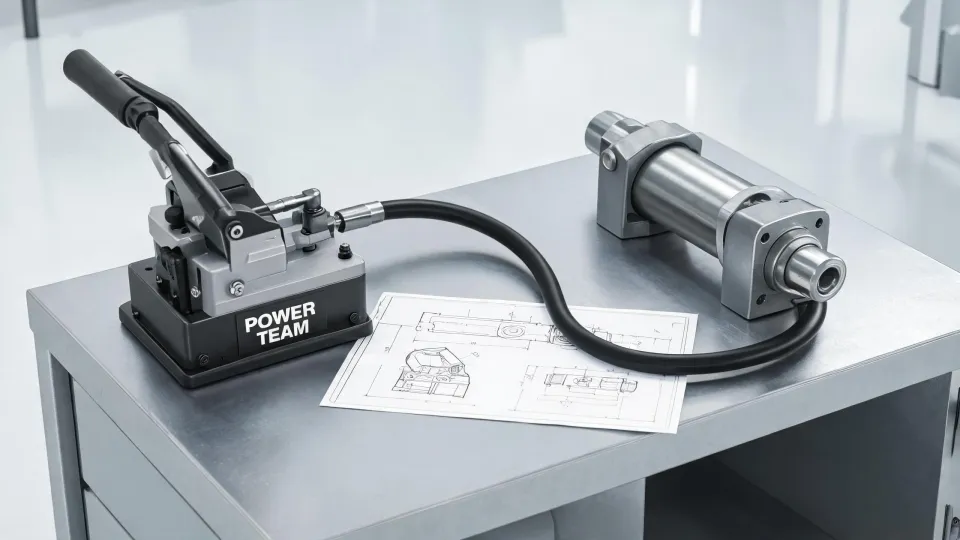
Measuring the cylinder correctly is only half the battle. The other half is ordering the right supporting components. I spend a lot of time with power team hydraulics equipment, and I've seen more than one replacement order get delayed because of a small missing part.
Take the packing nut wrench, for example. On a Power Team hydraulic pump, the packing nut around the pump shaft or valve has to be tightened with a specific wrench. I once ordered a service kit for a Power Team pump and assumed the packing nut wrench was included. It wasn't. The kit had seals and O-rings, but no wrench. We had to order the wrench separately with expedited freight, and the pump sat apart for two extra days. Now I keep a packing nut wrench in the maintenance cart whenever we have a Power Team pump in the fleet. It's a relatively inexpensive tool—I want to say around $60, but don't quote me on that—and it's saved hours of downtime since.
The same logic applies to portable air compressor parts. If you're running an air-driven hydraulic pump, the air supply is part of the system. A clogged air compressor filter or a bad regulator can make a hydraulic pump seem failed. I started tracking portable air compressor parts as part of our hydraulic maintenance checklist after a false alarm in 2024. We almost ordered a $900 pump replacement when the actual problem was a $25 air compressor filter. The pump was fine; the air supply wasn't.
So when you're looking at spx power team hydraulic pump parts, slow down and make a complete list. Include the pump, the hoses, the fittings, the cylinder, and any special tools like the packing nut wrench. One missing item can kill your whole timeline.
Why You Shouldn't Trust 'Direct Replacement' Claims Without Verification
I'm not saying all listings are dishonest. But per FTC guidelines (ftc.gov), a seller has to substantiate claims like 'direct replacement' or 'fits X' with truthful evidence. That doesn't mean every listing is accurate—it means you should ask for the spec sheet and verify the part numbers yourself. If a listing says it will fit a Power Team cylinder but doesn't show the stroke or rod diameter, be skeptical.
“The cheapest hydraulic part is the one that fits the first time. The most expensive is the one you have to ship back.”
When the Simple Measurement Method Isn't Enough
I want to be honest: the process above works for the vast majority of standard tie-rod and welded cylinders. It may not work for everything. If you're dealing with a telescopic cylinder, you need the extended length and the retracted length, plus each stage's stroke and diameter. If the cylinder has internal position feedback, the transducer is part of the replacement logic—geometric measurements alone won't be enough. And if the ports are oriented differently on the replacement, even a perfect center distance won't make it fit.
Also, don't assume that a slightly longer cylinder is okay because 'we can shim it.' In hydraulic systems, mount alignment and rod travel limits are there for a reason. I've made that mistake too, and the repair bill is not fun.
If you have the original serial number or a nameplate from the old cylinder, use that first. The manufacturer's spec sheet is always a better source than your tape measure alone. But if you're measuring in the field, the four steps above will keep you out of the kind of trouble that turned my March 2023 order into a $4,700 floor decoration.

Maren Jorgensen
Maren Jorgensen is an independent hand tool and torque applications analyst covering wrenches, pliers, screwdrivers, hammers, sockets, ratchets, hex keys, and tool sets. She applies ISO 6789-1 torque-tool conformance principles while examining jaw capacity, leverage, fastener engagement, torque range, accuracy, handle geometry, and material hardness. Her practical guides help tradespeople and procurement teams select suitable tools, plan controlled tightening, and compare durability without relying on brand reputation alone.