Power Team Hydraulic Equipment: Stop Asking the Price Before Asking What's Not Included
-
My opinion: transparent pricing is the only pricing worth trusting
-
Argument 1: The base price never includes the stuff that actually matters
-
Argument 2: Compatibility is a hidden cost, and it hits from every side
-
Argument 3: Support is the part of the quote you can't see
-
What about price? A fair question
-
The checklist I use now
I've been handling maintenance and equipment orders for eight years. I've personally made—and documented—twelve significant purchasing mistakes, totaling roughly $15,000 in wasted budget. That number looks worse written down than it felt at the time, which is saying something, because it hurt.
That's why I now maintain our team's pre-purchase checklist. It's not a list of specs. It's a list of the things I used to forget. The first item on that list isn't a brand or a model number. It's a question: What's not included?
My opinion: transparent pricing is the only pricing worth trusting
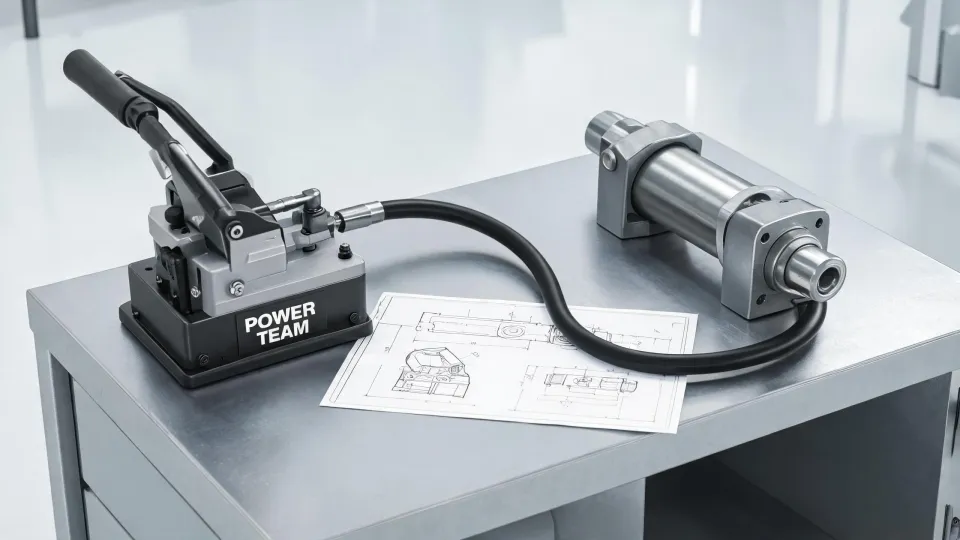
If you're buying a Power Team hydraulic ram or a Power Team electric hydraulic pump and comparing only the base price, you're setting yourself up for a surprise. I used to chase the low quote. I stopped after the 2017 coupler incident. Let me show you what I mean.
Argument 1: The base price never includes the stuff that actually matters
The first time I ordered a Power Team hydraulic ram, I was excited about the price. It was a 10-ton ram, and the quote was about 20% lower than the next one. I didn't ask whether hoses, couplers, and gauges were included. They weren't. I found out when I opened the box and saw a bare cylinder sitting in foam. The ram was real, but useless without the right coupler.
I spent $315 on a hose, a coupler, and a gauge. Then the coupler thread pitch was wrong. The vendor said the ram used a different fitting. I checked the ram, checked the coupler, checked the thread gauge. It was a mismatch that a two-minute phone call would have caught. That mistake cost $129 in restocking fees plus a week of delay. The 'cheap' quote ended up being $129 more than the 'expensive' quote, and I had to wait another week. That's when I started asking 'what's NOT included?'
The same lesson hit harder in September 2022. I ordered a Power Team electric hydraulic pump for a 100-ton press. The pump had plenty of pressure—rated for high pressure, no problem. But I never checked the reservoir size against the cylinder displacement. The cylinder needed more oil per stroke than the pump reservoir could supply. Every full stroke drained the reservoir. The pump ran, the cylinder moved, and then the system cavitated (ugly sound, and worse for the pump). We added an external reservoir and hoses, which came to about $700. If the vendor had asked about the cylinder displacement before quoting, I'd have bought the larger reservoir from day one. That's transparent pricing: not just showing the price, but asking the questions that reveal the real price.
And let's be clear about what a Power Team electric hydraulic pump actually is. It's an oil pump, not a water pump. I know that sounds obvious, but a teammate once almost ordered a transfer pump because 'it's just a pump.' A water pump moves water at low pressure and high volume. A hydraulic pump moves oil at high pressure and lower volume. If you search for 'water pump' and land on a hydraulic pump page, you're in the wrong aisle. That distinction isn't a typo—it's a $2,500 mistake waiting to happen.
Argument 2: Compatibility is a hidden cost, and it hits from every side
Hydraulic tools are systems. The ram, pump, hoses, couplers, and reservoir all have to be sized together. According to Power Team's published performance data (product documentation, 2025), pumps are rated by pressure, flow, and reservoir capacity. The horsepower rating on the nameplate is almost meaningless by itself. I learned that lesson with an air compressor, of all things.
People ask 'what size air compressor for air impact wrench' all the time. That's the right question, but the answer is useless if you don't ask at what pressure and for how long. A compressor that delivers 5.5 CFM at no load might only deliver 3.2 CFM at 90 psi. A 1/2-inch impact wrench can need more than that under hard use. I bought a compressor because the box claimed 'sufficient CFM.' It ran constantly, the duty cycle was too low, and the impact wrench lost torque. Even after choosing that compressor, I kept second-guessing. What if I had missed something else in the spec? The two weeks between delivery and install were stressful. When I saw the small tank and the duty-cycle rating, I knew I'd made a mistake. The rating was right there on the nameplate—I just didn't know what to look for.
The same thing happened with hand tools. I added a long pattern wrench set to an order once because it was bundled as a 'deal.' The bundle seemed like a no-brainer. It wasn't. The wrench set was made from softer material, and when I used the 24-inch pattern to break loose a tie rod nut, it rounded the edges before the nut moved. I ended up buying a better set from a different source anyway. That's a buy-twice situation, and the hidden cost came straight out of our schedule.
When any of those mismatches happens—compressor vs. impact wrench, wrench vs. fastener, pump vs. cylinder—the hidden cost comes out of your production time. That's the part of the quote nobody writes down.
Argument 3: Support is the part of the quote you can't see
The third thing I learned is that support and warranty are part of transparent pricing. In March 2023, a critical delivery was delayed because a distributor couldn't tell me the exact seal kit model before shipping. The website had a low price, but the person on the phone didn't know the product. I kept asking myself: can I afford to risk it? The upside was about $1,800 in savings. The risk was missing a deadline by a week. I calculated the worst case: a $2,400 redo plus lost customer trust. Best case: saving $1,800. The expected value said the low quote was acceptable, but my gut said otherwise. I ignored my gut. The delivery was late, the seal kit was wrong, and the job took three days longer than planned. That vendor failure changed how I think about backup plans. One critical deadline missed, and suddenly a second source didn't seem like overkill.
Power Team has been around in one form or another for decades, and the brand heritage is solid. But heritage only helps if the distributor can apply it to your system. When you buy a Power Team hydraulic ram from a distributor who asks about your pump flow and cylinder stroke, that distributor is adding transparency to the spec. The support itself is part of the quote.
What about price? A fair question
I'm not saying price doesn't matter. Price matters. But if you have two quotes for a Power Team electric hydraulic pump, and one is lower but missing hoses, fittings, oil, and shipping, while the other is higher but includes them, you're not comparing apples to apples.
The surprise wasn't the price difference between those two quotes. It was how much hidden value came with the 'expensive' option—support, compatibility checks, faster answers. I never expected that. I still look for competitive pricing. I just do it after I've asked the 'what's not included' question.
The checklist I use now
- Define the system before the product: cylinder displacement, pump flow, reservoir capacity, voltage, and the fluid type. If you need to move water, buy a water pump. If you need high-pressure oil, buy a hydraulic pump.
- Ask for every connection: hoses, couplers, fittings, gauges, oil.
- Ask 'what's NOT included?' before 'how much?'
- Ask for support response times and warranty coverage before you order.
- For air tools, don't stop at 'what size air compressor for air impact wrench.' Ask for CFM at 90 psi continuous, tank size, and duty cycle.
- Buy a long pattern wrench set on purpose, with material and rating specifications, not as a bundle add-on.
- Call the distributor and ask one question about your specific pump and ram combination. If they can't answer, keep looking.
Bottom line: The vendor who lists all fees upfront—even if the total looks higher—usually costs less in the end. I only believed that after ignoring it and paying $129 in restocking fees and $700 in reservoir upgrades. Now I ask 'what's not included' before I ask 'how much,' and I don't feel bad about it. Trust me on this one. Take it from someone who has spent $15,000 learning the difference.

Maren Jorgensen
Maren Jorgensen is an independent hand tool and torque applications analyst covering wrenches, pliers, screwdrivers, hammers, sockets, ratchets, hex keys, and tool sets. She applies ISO 6789-1 torque-tool conformance principles while examining jaw capacity, leverage, fastener engagement, torque range, accuracy, handle geometry, and material hardness. Her practical guides help tradespeople and procurement teams select suitable tools, plan controlled tightening, and compare durability without relying on brand reputation alone.