How to Size a Hydraulic Pump: 7 Steps I Check Before Every Order
-
When This Checklist Applies
-
Step 1: Start With Tonnage and Working Pressure
-
Step 2: Match the Pump Type to Your Environment
-
Step 3: Don't Guess on Hydraulic Oil
-
Step 4: Connections and Hoses — The Step Most People Skip
-
Step 5: Don't Forget the Hand Tools
-
Step 6: Verify the Spec Sheet Against a Real Standard
-
Step 7: Compare Total Cost, Not Quote Price
-
Common Mistakes I See Every Month
When This Checklist Applies
This is for anyone specifying a hydraulic pump and supporting tooling for an industrial maintenance team or production floor. If you're looking at quotes from different suppliers — some four times the price of others — and trying to figure out which specs actually matter, this is for you.
I've reviewed hydraulic equipment orders for about four years. Roughly 150–200 items a month pass through my desk before they ship. In 2024, I rejected close to 10% of first deliveries due to spec mismatches. That number is too high, and most of those rejections could've been avoided with a better upfront checklist.
Seven steps. Let's go.
Step 1: Start With Tonnage and Working Pressure
Before you look at pump specs, know what the job actually requires. Two numbers matter most: maximum tonnage and working pressure (usually 10,000 psi for standard industrial hydraulic systems).
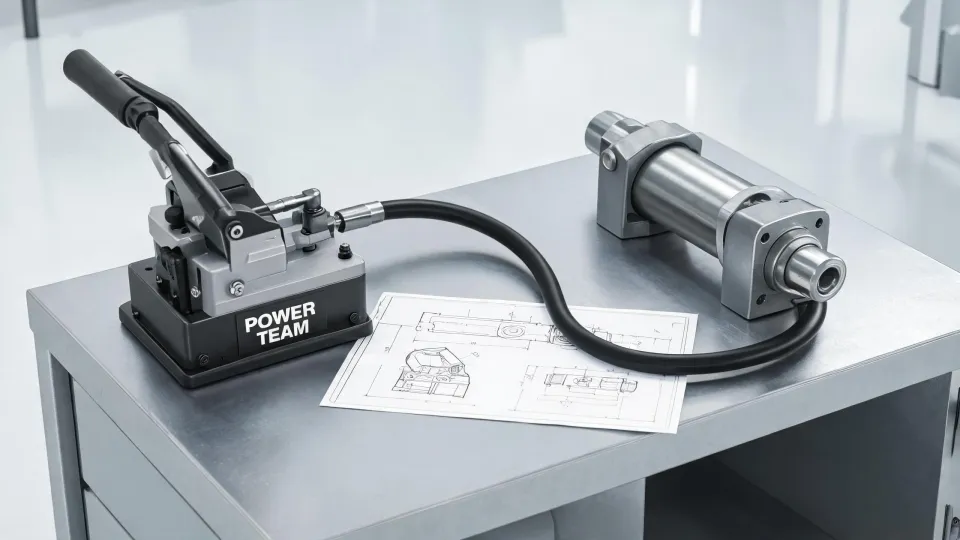
If you're using a power team hydraulic puller, the tonnage is stamped on the unit. But that's the puller's capacity — not the pump's output requirement. You need to account for hose length, cylinder volume, and pressure drop across fittings.
My rule of thumb: size the pump at 70–80% of the maximum system rating, not right at the edge. If your math says you need exactly 10 tons, buy 15. It sounds like overkill until you're pulling a bearing that's been rusted in place for a decade (ask me how I know).
For a quick sanity check on how to size a hydraulic pump: required pump flow = cylinder volume ÷ desired cycle time, then add 20% margin.
Step 2: Match the Pump Type to Your Environment
Manual, air-driven, or electric?
Manual pumps are fine for low-volume work — a few cycles a day. They're cheap, portable, and have almost nothing to break. But if a technician is running 50 cycles per shift, a hand pump is a productivity killer and an ergonomic problem waiting to become a workers' comp claim.
Air-driven pumps work well in shops with existing compressed air infrastructure. No electrical concerns, decent cycle speeds, and they tolerate dirty environments better than electric units.
Electric pumps are the default for high-cycle industrial use. Look for units with external pressure regulation and a gauge rated to at least 1.5× your max working pressure.
To be fair, manual pumps still make sense for field service where power isn't available. Just don't spec them for shop use where a tech runs 100 cycles a day.
Step 3: Don't Guess on Hydraulic Oil
Power team hydraulic oil — or any brand's oil — isn't just "generic hydraulic fluid." Viscosity grade matters. ISO VG 32 or 46 covers most industrial applications, but check the pump manufacturer's spec sheet. Running the wrong viscosity can drop efficiency by 20–30% and heat up the system faster than you'd expect.
Change intervals depend on environment. Clean, climate-controlled shop: 500–1,000 hours. Dusty foundry floor: cut that in half. I've seen a pump seize at 200 hours because someone topped off with motor oil. (Surprise, surprise.)
One thing I don't have hard data on: how much the brand of oil actually affects long-term pump life. The spec sheet says one thing, but in practice, viscosity and contamination control seem to matter far more than brand. I wish I had tracked that better across our maintenance logs.
Step 4: Connections and Hoses — The Step Most People Skip
This is where I see the most failures, and it's the least glamorous part of the system.
Check three things:
- Thread type. NPT, JIC, and BSP are not interchangeable. I once watched a crew force an NPT fitting into a BSP port. It threaded in about two turns, then leaked under pressure. That mistake cost us a six-hour shutdown and roughly $2,000 in lost production.
- Pressure rating. Hoses need a safety factor of at least 4:1 against your system's maximum pressure. A 10,000 psi system needs hoses rated to 40,000 psi burst — which usually translates to a 10,000 psi working pressure hose. Check the printing on the hose jacket.
- Length. Longer hoses reduce effective pressure at the tool. For every 10 feet over 20, expect about a 3–5% pressure drop. If you're already running at 90% capacity, that drop matters.
Step 5: Don't Forget the Hand Tools
Hydraulic pumps and rams get all the attention, but the hand tools around them matter too.
For hydraulic fittings and small-line work, a good pliers wrench beats an adjustable wrench every time. The parallel jaws don't round off hex fittings, and the ratcheting mechanism saves knuckle skin. Knipex-style pliers wrenches are the ones most techs reach for. (I've bought three for the shop and they keep walking off — that's how you know they're good.)
For metric fasteners, a 19mm ratcheting wrench is the workhorse size for most hydraulic fittings and mounting bolts. Get one with a reversible mechanism and a slim head — you'll need it in tight spaces. Flex-head versions cost a bit more but pay for themselves the first time you're working behind a manifold block.
These aren't the glamorous parts of a hydraulic toolkit. But a rounded-off fitting at 3 PM on a Friday is a special kind of frustration.
Step 6: Verify the Spec Sheet Against a Real Standard
Every hydraulic component should meet a recognized standard. Check for:
- ISO 4413 — hydraulic system safety and design rules
- ASME B30.1 — jacks and lifting equipment
- SAE J517 — hydraulic hose specifications
- ISO 4406 — fluid cleanliness codes (important for warranty claims)
If a supplier can't tell you which standard their pump or cylinder meets — and show documentation — treat that as a red flag. "Industry standard" without a number isn't a spec. It's marketing.
I only started insisting on documented standards after a batch of cylinders came in with a "10,000 psi rated" stamp but no test certificate. We tested them in-house and found three units that failed at 8,500 psi. The vendor's response: "within industry tolerance." We sent them back and rewrote our PO terms to require ISO 4413 documentation.
Step 7: Compare Total Cost, Not Quote Price
Here's where I'll get on my soapbox for a minute.
The lowest quote is rarely the lowest total cost. Factor in:
- Setup and fitting compatibility. If a cheap pump requires new hoses and adapters, that $300 pump just became a $600 setup.
- Downtime cost. If a $200-cheaper pump fails mid-project and stalls your maintenance window, what does that cost per hour? For most industrial operations, it's far more than the pump.
- Replacement frequency. A pump that lasts three years versus one that lasts eight changes the math considerably.
- Service and parts. Off-brand pumps often mean six-week lead times for replacement seals. Brand-name units usually have parts on the shelf.
I get why people chase the lowest number — budgets are real, and procurement incentives often reward first-cost savings. But in my experience reviewing orders, the cheapest option has cost us more in about 60% of cases. That $200 savings turned into a $1,500 problem once (and I'm using that number because I have the PO in front of me).
Not every cheap option is bad. Some budget pumps are perfectly adequate for light-duty work. But you need to know which category you're buying into.
Common Mistakes I See Every Month
Mistake #1: Spec'ing the pump without the cylinder. These are a system. Match them.
Mistake #2: Forgetting the pressure gauge. Buy a calibrated gauge. A $40 gauge prevents a $4,000 mistake.
Mistake #3: Assuming "power-team" means all parts are interchangeable. Power-team is a brand line, not a universal system. Old and new series don't always share fittings. Check the coupler style before ordering.
Mistake #4: Skipping the pre-delivery inspection. Open the box. Check the pressure rating on the gauge. Verify hose thread type. Ten minutes of inspection beats a week of back-and-forth returns.
Mistake #5: Not documenting what you received. Take photos of nameplates and serial numbers. If something fails within warranty, that documentation makes the difference between a hassle-free claim and a month of emails.
None of this is complicated. It's just a checklist — and most of us stop using checklists right around the time we need them most.

Helena Duarte
Helena Duarte is an independent pipe, valve, and pump applications analyst covering fittings, ball valves, gate valves, check valves, butterfly valves, flanges, hose clamps, centrifugal pumps, sump pumps, and submersible pumps. She uses ISO 5208 pressure-testing concepts and ISO 9906 pump acceptance methods while comparing pressure class, seat leakage, Cv, head, flow, efficiency, solids passage, seal materials, and installation orientation. Her guides help specifiers and maintenance teams match fluid-handling components to service conditions and acceptance criteria.