Power Team Hydraulic Ram & SPX Power Team Pump: A 3-Scenario Buying Guide
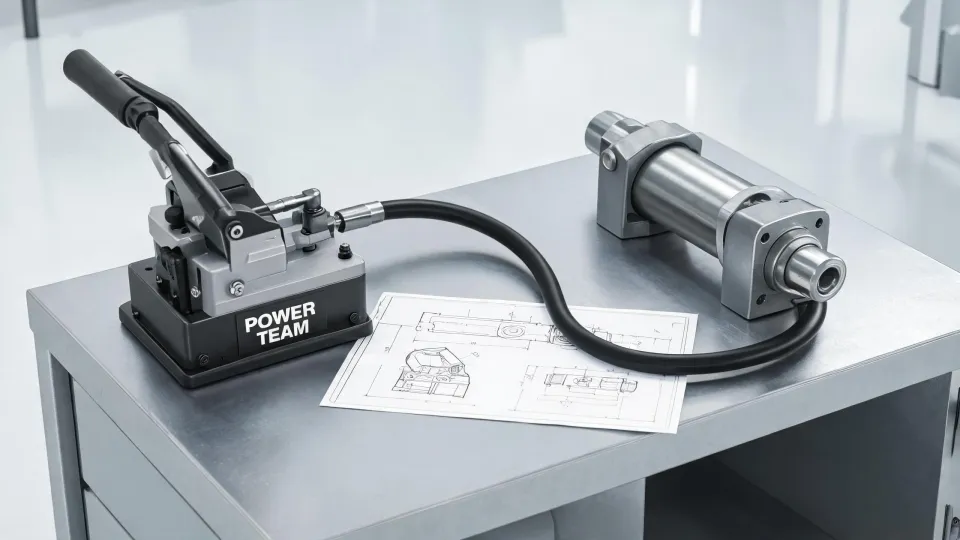
Two questions show up in my inbox more than any others: “What is the best high torque impact wrench?” and “Which SPX Power Team pump do we need?” Most people expect a model number back. After years of coordinating emergency hydraulic tool orders, I can tell you the honest answer is: it depends on the situation you’re buying for.
In my role, I’ve handled 200+ rush jobs in the past five years, including same-day turnarounds for plants where a downed press was costing more per hour than the replacement part. I’ll say up front that I used to think one standard package—a mid-size Power Team hydraulic ram, a good SPX Power Team pump, and a big impact wrench—could serve every maintenance team. That idea lasted about a year.
Start with three questions, not the spec sheet
Before we get to tonnage, reservoir size, or torque ratings, I ask three things:
- Where will the work actually happen? Is the part coming to the bench, or is the team going to the machine—possibly up on a mezzanine or outside in the yard?
- How much time do you really have? Not the “ideal” turnaround. Hours, days, or weeks changes your tooling choices more than any brand does.
- How heavy is the work? A 5-ton die change with 1/2-inch bolts is a different world from a 100-ton structural lift with 1-1/2-inch flange bolts.
Those three answers split almost every team I work with into one of three scenarios. Here they are.
Scenario 1: Machine down, clock running
You know this scenario by the first sentence of the phone call: “It stopped building pressure” or “The press is down and the line is stopped.” Downtime is measured in hours, and the tooling has to work where the machine sits.
For lifting, positioning, and freeing stuck components, this is where a Power Team hydraulic ram earns its keep. A 10–30 ton Power Team hydraulic ram paired with a portable air-over-hydraulic or battery-operated pump covers most breakdown work without turning the repair into a moving job. A shop-grade electric pump with a large reservoir is a great tool at the bench; it’s the wrong tool to drag across a plant at 11 p.m.
And for the question I hear constantly—what is the best high torque impact wrench for breakdown work?—here’s my contrarian take: it’s not the biggest gun in the catalog. A mid-size 1/2-inch cordless impact with genuine reverse torque in the 800–1,000 ft-lb class is the one that actually gets used. It fits between hydraulic manifolds, it goes up ladders, and it will break loose most flange and mounting bolts you’ll meet on a repair call. The 3/4-inch monsters stay in the truck. A tool that isn’t at the work site is no tool at all.
One more suggestion for this scenario, and it sounds mundane until it saves a shutdown: if your crew runs SPX air-operated pumps, keep a spare AP12 sump pump on the shelf. The SPX Power Team part number is 96023926. Sump assemblies crack, pick up contamination, or simply wear out, and when that happens the pump stops delivering oil. Waiting two days for a rush shipment turns a two-hour repair into a two-day outage.
Scenario 2: Part on the bench, deadline on the calendar
The second scenario is less dramatic but just as real. The component is already out and on the workbench; production is waiting; and the finish date is fixed. Last October, a block plant called us in that exact spot: a press cylinder was pulled on a Tuesday afternoon, the restart was scheduled for 06:00 Thursday, and the normal repair lead time was six days. That left roughly 36 hours.
This is where controlled shop equipment earns its keep. I prefer an SPX Power Team pump matched to a bench press, or a ram mounted in a press frame. When you’re pressing a bearing off a shaft or aligning a cylinder gland, repeatable, controllable force matters more than raw speed. A hand pump will do the job, but after 40 cycles your arm and the job will both slow down.
Here’s what surprises a lot of people: the biggest time-saver on reassembly is not an impact gun. It’s a 10 piece ratcheting wrench set. That sounds too simple, but think about a 24-bolt flange. With a standard combination wrench, you flip it every half turn. With a ratcheting box end, the wrench stays on the fastener and you save two or three seconds per bolt. Multiply that by the number of fasteners in a full rebuild, and the time adds up.
And a caution I repeat on every rebuild: use the high-torque impact wrench to break stubborn fasteners loose, then put it down. Run fasteners in with the ratcheting wrench and finish with a calibrated torque wrench. Hydraulic fittings and cylinder bolts have torque specs for a reason. The impact wrench’s speed is exactly why it shouldn’t do the final tightening.
Scenario 3: Planned shutdown, heavy loads
The third scenario is planned weeks or months ahead: a shutdown overhaul, a press rebuild, a large structural lift. Here the focus shifts from portability to capacity and system design.
When loads go beyond roughly 50 tons, you’re usually looking at multiple high-tonnage Power Team hydraulic rams supplied by one SPX Power Team pump with enough flow and reservoir capacity. The system is only as strong as its weakest part. I’ve watched crews pair a perfectly good ram with an undersized pump and then wonder why the lift takes most of the shift. It’s not the ram’s fault—the pump just can’t feed it.
The impact wrench question gets a different answer in this scenario, too. On 1-inch and larger fasteners, what is the best high torque impact wrench? Usually a 3/4-inch or 1-inch drive unit with the torque to handle those diameters. But the number on the box isn’t the whole story. If the air supply can’t deliver enough flow, or if the crew can’t safely handle the reaction force, the extra torque is a liability. Spec the tool against the compressor and the fastener list, not just against the highest spec sheet.
How to tell which scenario you’re in
Still not sure? Use these three checks:
- The machine is in place, and the clock is in hours. Buy portability: a Power Team hydraulic ram and compact pump, plus a mid-size 1/2-inch high torque impact wrench.
- The part is on the bench, and the finish date is fixed. Set up a controlled SPX Power Team pump and press setup, and put a 10 piece ratcheting wrench set in the toolbox.
- Weeks of lead time and heavy components. Plan a system: high-capacity rams, a high-flow pump, and heavy-duty impact tools matched to the fastener sizes.
I’ll leave you with a rule from our own order desk. The cheapest quote is not the cheapest purchase if the right tool isn’t there when it’s needed. I’ve seen a few hundred dollars saved on the front end turn into several thousand dollars of freight and overtime on the back end. In a rush situation, time is not overhead—time is the entire point. Buy for the scenario and for total cost, and you won’t go far wrong.

Maren Jorgensen
Maren Jorgensen is an independent hand tool and torque applications analyst covering wrenches, pliers, screwdrivers, hammers, sockets, ratchets, hex keys, and tool sets. She applies ISO 6789-1 torque-tool conformance principles while examining jaw capacity, leverage, fastener engagement, torque range, accuracy, handle geometry, and material hardness. Her practical guides help tradespeople and procurement teams select suitable tools, plan controlled tightening, and compare durability without relying on brand reputation alone.