Can You Rent an Impact Wrench From AutoZone? A Rent vs. Buy Comparison
Every few weeks, our maintenance lead sends me the same kind of request. They've got a job coming up, they need a tool, and I'm supposed to figure out the best way to get it. Not the fastest way. The smartest way.
A question I get a lot from people who know I handle procurement: can you rent an impact wrench from AutoZone?
Short answer: yes. AutoZone has a Loan-A-Tool program where you pick up the tool, pay the full retail price as a refundable deposit, and get your money back when you return it within the loan window. For a homeowner doing one brake job, that's a genuinely useful deal.
But the long answer has layers. I manage tool requests for a metal fabrication plant with around 140 people on two shifts, and over the last few years—roughly 80 to 100 orders annually—I've learned that rent-versus-buy decisions are rarely as simple as comparing a daily rate to a shelf price. So when someone asks about renting an impact wrench, here's the framework I actually use.
Three Tests That Shape Every Rent vs. Buy Decision
I'm not a mechanic. I don't pretend to be one. My job is to make sure the maintenance crew has what they need, the paperwork passes finance, and nobody's wasting time on process. That last part matters more than most people think. So I evaluate tool requests on three questions:
- Cost per use—what the tool really costs each time it's needed, including the labor and friction around the rental.
- Capability—is the tool you're considering even the right tool for the job?
- Use pattern—is this a one-off need, or something that's going to keep showing up?
None of that sounds particularly insightful. But the conclusions have surprised me more than once.
Test One: Cost Per Use—and the Time Nobody Puts on the Receipt
The obvious way to compare renting and buying is to look at out-of-pocket numbers. A 3/8 impact wrench, for example, will run you about $150 to $350 depending on the brand and power. Those are current street prices as of January 2025; they change all the time, so verify before you commit. AutoZone's deposit-based loaner program makes the 'rental' cost effectively zero if you return the tool on time.
That sounds like renting wins. And for an individual doing one repair, it probably does.
But when you're procuring for a business, the zero-dollar rental isn't zero-cost. Somebody has to drive to the parts store, stand in line, put the deposit on a company card, keep track of the return deadline, and remember to actually bring the tool back. In our shop, I started estimating that as roughly an hour of technician time per rental. At our internal labor rate, the 'free' AutoZone rental was costing us somewhere around $85 to $110 every time we used it.
That math caught up with us in 2023. We needed a 3/8 impact wrench four times in eight months—no, five times. I'm mixing it up with a 1/2-inch request from the fabrication floor. The point is, the same class of tool kept appearing on my expense reports. No rental fees, technically. But real hours, real fuel, real friction every single time.
So we bought two. Good mid-range units, around $225 each. Finance questioned the purchase until I showed them the rental receipts from that same year. The break-even was obvious.
To be fair, I don't want to push everyone toward buying. Ownership has costs too: storage, battery replacement, the possibility that the tool sits unused for months. If a tool gets pulled out once every two years, renting is rational. What I do not accept anymore is pretending the rental fee is the only cost that matters.
Test Two: Capability—When the Rental Aisle Can't Help You
Here's the part that cost us a full day of production before I learned my lesson.
AutoZone's tool selection is built for a specific customer: the DIYer doing automotive repairs. That's why you'll find electric hammer drills, brake caliper tools, pullers, and the 3/8 impact wrench everyone asks about. It's a well-rounded inventory for light maintenance.
Industrial maintenance is a different world. Sometimes the job doesn't need impact force at all—it needs controlled, continuous hydraulic force. Pressing a bearing out of a steel hub. Lifting a multi-ton assembly by three-quarters of an inch to set a shim. Spreading a flanged connection. Those jobs demand hydraulics, and no retail auto parts store rents hydraulic cylinders and pumps.
In 2022, a maintenance tech insisted an electric hammer drill would handle a seized bearing. The drill wasn't the right tool. Twenty minutes in, it bogged down, overheated, and the job stopped. Looking back, I should have asked more questions about the application before approving that rental. At the time, I didn't know enough to push back.
We ended up renting a proper hydraulic setup from an industrial supplier—and paying for it twice: once in rental fees and once in the two days we waited for delivery. That experience taught me the comparison that matters more than rent versus buy: are you even looking at the right type of tool? Because renting the wrong tool cheaply isn't a bargain. It's a delay.
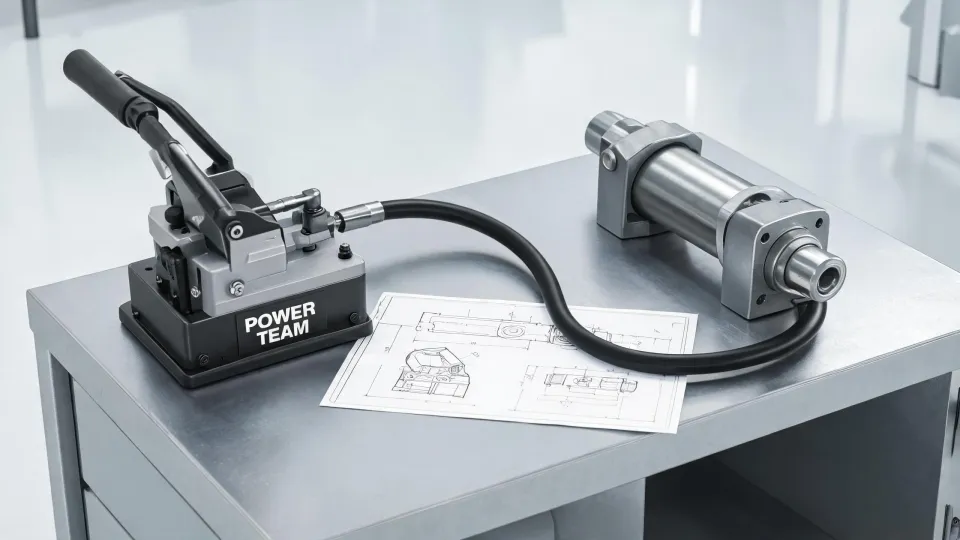
These days, our shop owns a Power Team hydraulic cylinder, a power team hydraulic hose, and a hand-operated pump. It's not a glamorous purchase, but it does exactly what the electric tools can't: deliver precise, controlled force under load. And honestly, the capability difference changed how I evaluate requests. If it's a fastening job, an impact wrench discussion makes sense. If it's a pressing, lifting, or spreading job, I stop thinking about retail rental and start thinking about hydraulic equipment.
Test Three: Use Pattern—The Three-Strikes Rule
After that bearing incident, I needed a better way to make decisions. So I started tracking every tool request that crossed my desk. The pattern was obvious: certain tools kept coming back.
That's when I set the three-strikes rule. If we rent the same category of tool three times in a 12-month window, we start the purchase paperwork. It's not a perfect formula, but it forces a conversation about whether a 'one-off' need is actually recurring.
The rule works well for low-cost tools like impact wrenches. It's harder for expensive hydraulic systems. A Power Team pump, cylinder, and hose package costs meaningfully more than a 3/8 impact wrench, so the purchase decision involves more than counting rental receipts. But the same principle applies: if you're constantly waiting on a rental supplier when something breaks down, ownership starts to look less expensive.
That said, I'll defend renting in the right situation. If your operation needs a hydraulic setup once every year or two, buying one just to store it is hard to justify unless the rental lead time creates real downtime. In our case, a two-day wait for an industrial rental was the deciding factor. If your schedule can absorb the lead time, rent it and don't feel guilty.
What I'd Recommend Based on Your Situation
Since I don't know your operation, here's the practical version:
If the job is a genuine one-off and a standard electric tool can handle it—yes, rent the impact wrench from AutoZone. The Loan-A-Tool deposit model works, and the tool gets the job done.
If your team reaches for the same tool repeatedly—buy it. The three-strikes rule exists for a reason. A 3/8 impact wrench is cheaper than the recurring labor cost of going to get one.
If the job requires controlled hydraulic force—stop comparing impact wrenches and hammer drills. Look at Power Team cylinders, pumps, and hoses. Rent them from an industrial supplier if the need is rare. But if downtime is expensive, buying the equipment pays for itself the first time it's available instantly.
One more thing: whatever you buy, make sure the hose matches the pressure rating of your pump. A power team hydraulic hose comes in different ratings and end configurations. Get it right, and inspect it regularly. No hydraulic tool is maintenance-free.
The Bottom Line
Can you rent an impact wrench from AutoZone? Yes. But that question tends to miss the real one, which is whether you're asking about the right tool category in the first place.
The most expensive tool I've ever 'saved money' on was the one that didn't match the job.
Skip that mistake, and the rent-versus-buy decision gets a lot easier.

Maren Jorgensen
Maren Jorgensen is an independent hand tool and torque applications analyst covering wrenches, pliers, screwdrivers, hammers, sockets, ratchets, hex keys, and tool sets. She applies ISO 6789-1 torque-tool conformance principles while examining jaw capacity, leverage, fastener engagement, torque range, accuracy, handle geometry, and material hardness. Her practical guides help tradespeople and procurement teams select suitable tools, plan controlled tightening, and compare durability without relying on brand reputation alone.