A Power Team Hydraulic Pump Mistake That Rewrote My Tool Box Parts List
8:40 p.m. in the Tool Crib
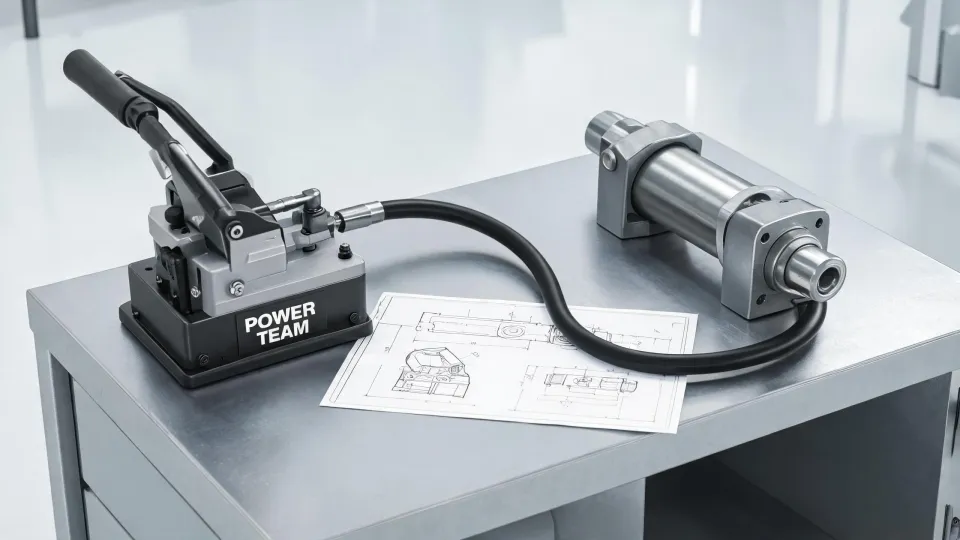
The Friday before a plant shutdown in 2022, I was sitting on a five-gallon bucket in the tool crib with an open crate in front of me. The new SPX Power Team compact torque wrench pump was sitting in its plastic cradle. It looked perfect. The pump itself worked. The problem was everything between the pump and the torque wrench head, starting with a set of adapters that I had not ordered.
I handle tooling and maintenance orders for a steel fabrication operation. I am not a hydraulic engineer. I am the person who learns what does not fit by ordering it. That method works okay for replacement bolts. It is a painful way to learn about high-pressure hydraulics.
What made it worse? I had three small adapters in my hands three weeks earlier. I told myself I would remember them. I did not. That forgotten item changed our whole weekend.
A Compact Pump for an Expensive Lesson
Our old torque wrench pump had been failing for months. We do a lot of flange bolting, so the team needed a replacement that could run 10,000 psi torque wrench heads and still fit in a transport case. I compared specs until I lost confidence in my own spreadsheet. In the end, I ordered a Power Team hydraulic pump—specifically the SPX Power Team compact torque wrench pump with an electric motor.
My purchasing manager asked a fair question when the quote came back: does that price include everything we need to connect it to our existing heads?
I said it was standard. He heard standard. What I meant was that the pump follows a common hydraulic configuration. What he needed to hear was that I had verified every port, hose end, and coupler. The two meanings were not close.
What the Quote Did Not Say
The quote itself was clear. It listed the SPX Power Team compact torque wrench pump, a control valve, and a manual. It did not hide fees. I am not blaming the distributor. They answered exactly what I asked. The problem is that a transparent quote can still be incomplete if you do not ask the right second question. I should have asked what is not included before I asked what it costs.
The new pump used different port connections than our existing torque wrench hoses. That is not exotic. Older hydraulic systems are full of mixed connectors. But common does not mean automatic. We needed pressure-rated adapters, and we needed them before Monday.
The Tool Box Parts List Was the Problem
Before the order arrived, I had started a tool box parts list for the new field kit. It included spare O-rings, hydraulic oil, rags, a pressure gauge, and—for reasons I still cannot fully justify—an 18 inch pipe wrench. I did not need that pipe wrench for a hydraulic torque wrench job. I added it out of habit. A hydraulic system with a 10,000 psi pump replaces that kind of muscle. What I actually needed was a section on the list called Connectors. That section did not exist.
When the adapters were missing, I called three local suppliers. One laughed when I asked if they stocked high-pressure hydraulic adapters on short notice. The overnight freight cost more than the adapters. More importantly, we lost a shift waiting for the package.
We did not have a formal pre-shipment checklist for hydraulic upgrades. That gap caused the mistake. I finally created a checklist after that job. It has already caught two missing components that would have caused the same kind of failure.
The Hydraulic Cylinder Question I Keep Hearing
If you found this article by searching what is the purpose of a hydraulic cylinder, here is the plain version. A hydraulic pump creates flow and pressure. A hydraulic cylinder converts that pressurized fluid into straight-line push or pull. The pump is the heart. The cylinder is the muscle. Force at the cylinder equals pressure times piston area. The cylinder also has to match the pump flow, the pressure rating, the mounting layout, and the work being done.
Our mistake was not a cylinder mismatch. But it came from the same thinking. I was looking at components instead of the full connection path. The pump is only one station in the loop. Fluid has to move from the pump through hoses, couplers, and adapters before it reaches the cylinder or torque wrench. Every part in that path has to be rated for the same pressure.
What I Do Now
Every hydraulic purchase gets a written flow path before it gets approved. The list starts with the pump, then hoses, then couplers, then adapters, then the cylinder or torque wrench head. If anything on that line is missing, the purchase order does not move. That is the tool box parts list now. It is not about perfect paperwork. It is about not repeating an expensive mistake.
The SPX Power Team compact torque wrench pump is still in service. It did not fail. I failed, because I stopped at the headline price and did not ask what was not included. The extra parts cost was about $800 and one lost shift. The lesson cost more but has been worth it.
So if you are adding a Power Team hydraulic pump to your tooling, do one thing differently. Ask for the complete list of connections, even if it makes you look picky. Walk the path from the pump to the wrench or cylinder before you place the order. And if you find an 18 inch pipe wrench on your parts list, ask why. If the answer is habit, remove it. Save that space for the part you will actually need.
Transparent pricing is important. Complete pricing is better. The right question is not only what the pump costs. It is what that cost includes, and what we are still missing.

Maren Jorgensen
Maren Jorgensen is an independent hand tool and torque applications analyst covering wrenches, pliers, screwdrivers, hammers, sockets, ratchets, hex keys, and tool sets. She applies ISO 6789-1 torque-tool conformance principles while examining jaw capacity, leverage, fastener engagement, torque range, accuracy, handle geometry, and material hardness. Her practical guides help tradespeople and procurement teams select suitable tools, plan controlled tightening, and compare durability without relying on brand reputation alone.