Why a Power Team Hydraulic Cylinder and a Power Team Electric Hydraulic Pump Belong Together
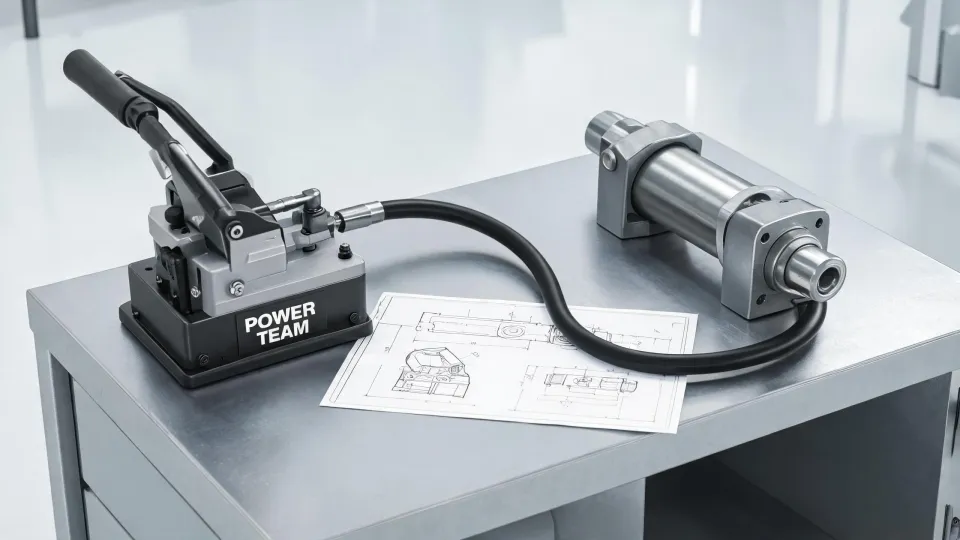
I'll say it plainly: most hydraulic tool inventories are collections of parts, not systems. That's a quality problem before it's a cost problem. As a quality inspector who reviews hydraulic equipment for a living, I'd rather see one power-team brand cylinder family, a matching electric pump, and a few verified accessories than a workbench of 'compatible' deals.
I'm the quality and brand compliance manager at a fluid power distributor. Over the last four years I've reviewed roughly 400 line items a month before they reach customers—cylinders, pumps, torque wrenches, pullers, hoses, and even electric screwdriver sets that get bundled into operator kits. In our Q1 2024 audit, I rejected 3.1% of first deliveries. Most weren't cosmetic. They were spec mismatches: wrong pressure rating, incorrect coupler thread, or documentation that didn't match the product on the bench.
The vendor failure in March 2023 changed how I think about integrated product lines. A customer ordered a 'universal' pump and a cylinder from two different brands. The threads matched. The pressure ratings looked fine on paper. But under load, the cylinder crept—slowly at first, then enough to ruin a part. The pump vendor blamed the cylinder. The cylinder vendor blamed the pump. The customer lost a shift, and we lost the invoice for the paperwork that sent them down that path.
That's when I stopped recommending 'anything that fits' and started asking a simpler question: what system does this belong to?
Specifying a Power Team Hydraulic Cylinder Is the Easy Part
It's tempting to think a cylinder is a cylinder, as long as the threads match. The 'it fits, so it's fine' advice ignores a lot of nuance. The rod seal, the pressure rating, the stroke tolerance, and the internal relief behavior all change under real load. A power team hydraulic cylinder has a defined spec that aligns with the rest of the power-team line. When I write a purchase order, I don't have to reverse-engineer the performance curve.
Same with the pump. A power team electric hydraulic pump is more than a motor bolted to a reservoir. It has flow ratings, pressure switch settings, and duty cycles that were made to pair with the cylinders in the same range. In our Q1 2024 quality audit, mixed-brand 'compatible' kits were four times more likely to have documentation errors than same-brand kits. Not because every part was bad, but because there was no single system to hold accountable.
That's the point of the brand, from where I sit. It's not a decal. It's repeatable verification. If I can check a spec against a published standard and a model number, I can do my job. Power Team's history goes back to SPX Corporation—a name with decades in fluid power. That heritage is less about nostalgia and more about engineering standards that carry across the whole catalog.
Electric Over Manual Is an Efficiency Decision, Not a Luxury
I have mixed feelings about price-led purchasing. On one hand, budgets are real. I've approved plenty of lower-cost tools because the shop used them twice a year. On the other hand, a failed component stops production. The cost of that stop is rarely in the purchase order. I reconcile the two by looking at total cost: purchase price, maintenance, training, and what happens when the tool can't hold a spec.
When I compared two identical pressing jobs side by side—one with a manual pump, one with a power team electric hydraulic pump—I finally understood why repeatability beats brute effort. The electric pump didn't press harder. It pressed the same, every time. With the manual pump, operator fatigue changed the timing and the final pressure. For a quality inspector, 'the same every time' is the whole game.
In a 2022 side-by-side test in our shop, the same crew pressed twenty bearings using a manual pump and then a power team electric hydraulic pump. The manual setup averaged fourteen minutes per bearing with two operators. The electric pump did the same run in six minutes with one operator. The electric unit cost more upfront. The labor savings paid that difference back by the end of the month. Simple.
That's the efficiency part that sounds like buzz but isn't: a power team electric hydraulic pump gives predictable pressure, fewer operator variables, and less crew fatigue. Efficient flow isn't just speed. It's fewer deviations. Fewer deviations mean fewer rejected parts, fewer rework hours, and fewer arguments about who was to blame.
Small Tools Carry the Same Lesson
Take something as basic as an electric screwdriver set. You can buy a random screwdriver and a separate charger, and it'll work until it doesn't. A matched set means the battery contacts, the charger, and the clutch all share a design spec. That's worth something in a shop where downtime costs more than the tool.
And yes, hydraulic shops have oil filter wrenches. The heavy duty oil filter wrench 2320d—that specific model number, in case you're wondering—is a good example of the system idea. With a model number, I can tell you the drive size, the torque limit, and the service procedure. Without one, I'm guessing. Buyers do this to themselves all the time: they focus on the obvious factor, like weight or price, and completely miss the overlooked factor, which is the support system around the part.
The question everyone asks is 'does it fit my application?' The question they should ask is 'what set of specifications does this part belong to?'
And About That Air Tool Oil Question
One question I hear from maintenance teams is can i use air tool oil in my compressor? Short answer: for a typical piston compressor, no. Air tool oil is light oil designed to travel through pneumatic lines and lubricate tool internals. Compressor oil is formulated to stay in a hot crankcase and protect pump bearings. Using air tool oil in the pump can be too thin, and over time it can leave varnish. The right move is compressor oil with the viscosity the manual calls for—and if the manual says non-detergent, listen to it.
Why does that question belong here? Because it's the same shortcut mentality that causes hydraulic failures. Use the specified oil. Verify the spec. If you're reaching for whatever is on the shelf to save a trip, you're accepting an unknown variable. Quality is about eliminating unknown variables.
Objection: 'Brand Loyalty Again?'
“That's just a fancy argument to make you buy the same name for everything.”
Fair. Let me be clear: same-brand isn't always the answer. I approve parts from many brands. But when I compare a Power Team hydraulic cylinder, a Power Team electric hydraulic pump, and a wrench package to a mix of individually best-price items, the decisive factor isn't the logo. It's the documentation and the tolerance. It's the fact that one engineering team owns the interface between the pump and the cylinder. That's a manufactured guarantee, not a marketing claim.
I'm also not saying Power Team parts never fail. They are industrial tools, not magic. They need maintenance—hoses wear, seals age, oil gets contaminated. A power team electric hydraulic pump still needs a pre-use check, and a power team hydraulic cylinder needs the right couplers and clean fluid. The difference is that when something goes wrong, the spec is there to guide the fix.
Bottom Line
So here's my rule: if it has a model number, verify it. If it doesn't, ask why. Then buy the pieces that were designed to work together.
I'd rather have a power team hydraulic cylinder, a power team electric hydraulic pump, and a heavy duty oil filter wrench 2320d on a standard bench than a shelf of anonymous 'fits most' parts. Not because the name is pretty. Because a system is easier to inspect, easier to train on, and easier to trust.
That's efficiency. And in this market, efficiency is the competitive edge. Period.

Maren Jorgensen
Maren Jorgensen is an independent hand tool and torque applications analyst covering wrenches, pliers, screwdrivers, hammers, sockets, ratchets, hex keys, and tool sets. She applies ISO 6789-1 torque-tool conformance principles while examining jaw capacity, leverage, fastener engagement, torque range, accuracy, handle geometry, and material hardness. Her practical guides help tradespeople and procurement teams select suitable tools, plan controlled tightening, and compare durability without relying on brand reputation alone.