Why a Power Team Hydraulic Pump Is Worth It for Small Shops
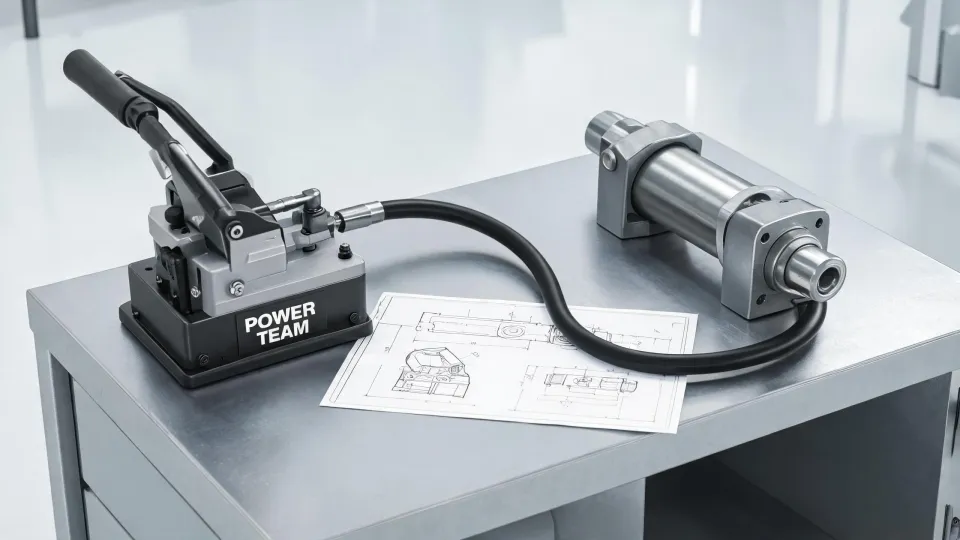
After six years of buying tools and hydraulic equipment for a 45-person industrial maintenance company, I've got a direct answer: a Power Team hydraulic pump is usually the right investment for a small shop, but only if you compare total cost instead of the first price you see. I manage an annual equipment budget of roughly $180,000, and every order I've placed is documented in our cost tracking system. That system has changed my opinion about cheap purchases more than any sales pitch ever did.
The trigger was a pump failure in March 2023. A cheaper unknown-brand pump died after fourteen months because no one had the right repair manual and the replacement parts were listed as 'unavailable.' After that, I started looking at brand heritage, documentation, and support as part of the price. That's why I now own three SPX Power Team pumps, and why I'd recommend the same approach to anyone who buys hydraulic tools for a living.
What I've learned from more than 200 purchase orders
When I say I've tracked everything, I mean it. We've processed maybe 230 orders in the last six years—I'd have to check the system to give you an exact number. Each line item goes into a spreadsheet with vendor, unit price, freight, handling, lead time, and problems after delivery. That spreadsheet is the source for everything I say about cost, and it has caught things I would have missed otherwise.
The most frustrating part of vendor management is the same problem recurring: hidden fees show up after you've committed. In Q2 2024, I compared four vendors for a $4,200 annual contract. Vendor A quoted $3,980 and looked like the winner. Vendor B quoted $4,150, but their quote included freight, no handling fee, and a 2 percent early-payment discount. Once I calculated total cost, Vendor A came out $620 more expensive than Vendor B. You don't see that difference if you only compare unit prices.
The conventional wisdom says always get three quotes and pick the lowest. My experience with 200+ orders suggests that relationship consistency often beats marginal cost savings. That's not a memo from purchasing theory. It's the result of watching 'cheap' quotes turn expensive when support disappears.
Why I trust the SPX Power Team pump
Before I wrote the first purchase order for an SPX Power Team pump, I treated the brand name with suspicion. 'Power Team' sounded like marketing. What most people don't realize is the Power Team line is part of the SPX heritage, with decades of industrial hydraulic manufacturing behind it. That matters for two reasons: parts availability and application knowledge.
In my shop, I've got a Power Team hydraulic pump, two cylinders, and a press. The pump has been boring in the best way. No leaks, no breakdowns, no drama. When I need to verify a pressure setting or a repair procedure, the manual is easy to find and it matches the actual pump. That is not true for every brand I've bought.
If you're comparing a power team hydraulic pump to another option, don't stop at maximum pressure. Compare the pump curve, the reservoir size, the port sizes, and the release valve design. I've seen two pumps with the same PSI rating behave completely differently on the same cylinder because one had a better piston pump and more oil flow. The spec sheet doesn't tell you that story.
Small orders are still real orders
Here's the issue I care about most: the industrial supply world often treats small buyers like a nuisance. I've been in rooms where a distributor's salesperson said, in confidence, 'we don't really do orders under $1,000.' That mindset is shortsighted. When I was starting out, the vendors who treated my $200 orders seriously are the ones I still use for $20,000 orders.
I do not believe small buyers should be shamed into paying higher prices or waiting longer for support. A small order has legitimate purposes: testing a product, validating a vendor, covering a one-off job. A good supplier understands that. If someone makes you feel like your order isn't worth their time, they're telling you what future service will look like.
My cost-tracking system lets me pull every line item tagged 'power-team' to review actual spend. That tag is how I noticed that the best small-order vendors don't nickel-and-dime you on freight. They build it into the price and tell you that. That's the kind of transparency I'll always pay for.
Workshop tools: impact wrench 1/2 and the wrong manual
On the shop floor, the impact wrench 1/2 drive size is the one I reach for when removing bolts from hydraulic pump mounts and cylinder brackets. It makes quick work of stubborn hardware. But here's the counterintuitive part: don't use it to reinstall fittings. An impact wrench 1/2 drive can easily over-torque a hydraulic adapter and crack the port. Use it for removal, then switch to a calibrated torque wrench for assembly.
And if your search starts with 'water pump repair manual,' slow down. A water pump repair manual is for coolant pumps in engines, not for hydraulic pumps. The sealing principles are different, the pressures are different, and the repair procedures don't transfer. I keep a water pump repair manual in the shop for our truck fleet, but it doesn't sit next to the hydraulic documentation. Mixing those two has led people down the wrong path before.
How to compress a hydraulic cylinder without wrecking it
Let's be precise about the phrase 'how to compress a hydraulic cylinder.' What most people actually need is to retract the rod fully into the cylinder before removal, repair, or storage. You normally don't want to squeeze the barrel with a press. That's how you dent the cylinder wall and damage the rod seal.
Here's the step sequence I use:
- Identify the cylinder type. Is it single-acting or double-acting? A single-acting cylinder needs the pump to retract the rod. A double-acting cylinder has a return port that does the job.
- Connect the power team hydraulic pump. Check the couplings, make sure the reservoir has oil, and confirm the release valve is closed before building pressure.
- Open the release valve slowly. This equalizes trapped pressure. If the rod moves on its own after opening the valve, let it move. Never block it with your hand.
- Use the retract function. For a single-acting cylinder, activate the pump's return-to-tank function. For a double-acting cylinder, apply pressure to the return port to push the rod back in smoothly.
- Disconnect and cap the ports. Once the rod is fully retracted, remove the hoses and put caps on the ports so debris doesn't get inside. Wipe the rod clean and apply a light oil film for storage.
If the rod doesn't move with reasonable pressure, stop and inspect. Forcing a hydraulic cylinder is a good way to turn a repairable part into scrap. And before you ask, yes, I've had to learn that the hard way on a different brand. (Should mention: I now keep a maintenance log for every cylinder in the shop.)
When a Power Team pump is the wrong choice
I'm not going to pretend the brand is perfect for every situation. If you only need an occasional emergency jack for personal vehicles, a Power Team hydraulic pump is overkill. If you need continuous high-flow operation, a hand-operated pump won't keep up; you'd want an air or electric pump, and that's a different budget conversation.
Also, no hydraulic tool is maintenance-free. Seals wear, oil gets contaminated, and release valves eventually need service. Budget for that. If you're buying a power team hydraulic pump for a mission-critical application, add a spare seal kit and a copy of the repair manual to your first order. That tiny purchase makes the difference between a two-hour repair and a two-week wait.
So, here's my honest summary: buy reliable equipment from a brand with SPX's history, find a vendor that respects small orders, use the right wrench for the right task, and learn the correct way to retract a cylinder before you need to. Do that, and your hydraulic tools will still be working long after the cheap alternatives have failed.

Maren Jorgensen
Maren Jorgensen is an independent hand tool and torque applications analyst covering wrenches, pliers, screwdrivers, hammers, sockets, ratchets, hex keys, and tool sets. She applies ISO 6789-1 torque-tool conformance principles while examining jaw capacity, leverage, fastener engagement, torque range, accuracy, handle geometry, and material hardness. Her practical guides help tradespeople and procurement teams select suitable tools, plan controlled tightening, and compare durability without relying on brand reputation alone.