Power Team Repair: 3 Scenarios, 3 Strategies, and the Mistakes That Shaped Them
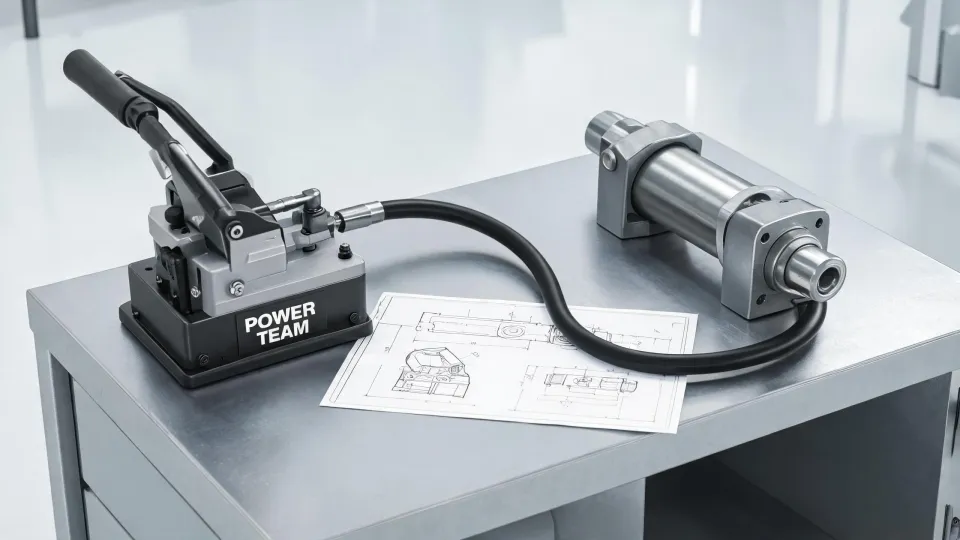
I've been working with Power Team equipment for about ten years now. I've resurrected pumps that looked completely dead, and permanently killed pumps that probably only needed new O-rings. This article is not a generic "how to repair your Power Team pump" guide — because honestly, the right repair strategy depends entirely on what kind of situation you're in.
In my experience, power team repair situations fall into three buckets. I've made expensive mistakes in all three. Here's what I'd tell my younger self.
Scenario 1: The "Just Acting Up" Repair
Your Power Team pump still works, but something is off. It takes longer than usual to build pressure. A cylinder drifts down overnight. The pressure gauge wobbles when it shouldn't.
In July 2019, we had a pump building pressure suspiciously slowly. I ordered rebuild kits, planned a full teardown, and told my supervisor we'd be down for two days. Turns out, one of the crew had swapped hoses between two pumps the week before, and a piece of thread sealant had gotten into the coupler. A $15 inline filter, a thorough flush, and we were running again within the hour. I still remember the look my supervisor gave me.
What I learned from that one:
- Check the boring stuff first. Contaminated fluid, clogged intake screens, loose couplers, worn O-rings — these cause more problems than internal pump wear.
- Keep a maintenance log. I know it sounds dull. But when something acts up, you can't trace the cause without knowing when the fluid was last changed or which hoses were connected where.
- Milky-looking fluid is a red flag. That means water in the oil. Water is death for hydraulic components.
Power Team pumps are fairly forgiving machines. But dirty oil is what ultimately kills them. If your pump is acting weird, start with the routine maintenance basics before you tear into internal parts.
One small tool tip: the dremel hses-01 electric screwdriver kit lives in my toolbox specifically for jobs like this — pump covers, valve plates, small fasteners where you need a careful hand, not a heavy impact driver. It won't do the heavy work, but it's perfect for the tedious disassembly where most things go wrong.
Scenario 2: The "I Need This Working by Tomorrow" Repair
This is the scenario that gave me gray hair. A Power Team pump fails in the middle of a critical job. Production stops. People start hovering around your workspace asking "how long?" every twenty minutes.
In September 2022, I was in exactly this position. A 10,000 psi pump with a cracked check valve — visibly cracked — and a client deadline that had zero give. I chose the field repair route, using materials on hand. It worked for about three hours before failing harder than before.
People assume the fastest repair is the one you jump on immediately. The reality is that a partial fix on hydraulic equipment often costs you more time than shutting down and doing it right the first time.
My advice for this scenario:
- Field repair — only when the problem is a known consumable: an O-ring, a coupler, a strainer. If you've seen the exact failure mode before and fixed it in minutes, go for it.
- Scheduled, proper repair — when the internals are involved. Valves, pistons, rotating groups. Those need a clean bench, proper parts, and clean fluid. The downtime hurts. The alternative hurts worse.
I remember one stretch where "we can't afford downtime" led to three failed band-aid repairs, each eating half a day. Total: 1.5 days down, plus $200 in parts. Doing it right the first time would have been one day and about $90 in parts. Hindsight is a brutal teacher.
Scenario 3: The "Is It Even Worth It?" Repair
This is the tough one. The pump runs, but barely. Metal particles come out with the oil. The noise is physically upsetting.
People assume that repairing is always cheaper than replacing because you're only paying for parts and labor. But the causation runs the other direction: the deeper the damage, the closer the repair cost gets to a new pump — without giving you a pump that's actually new. Besides the economics, there's a safety angle. ASME B30.1, which covers jacks and hydraulic lifting devices, is clear that a component with visible damage or inconsistent performance should not stay in service.
My current rule of thumb:
- Under 30% of replacement cost: Usually worth repairing.
- 30–60%: Depends on the pump's age, service history, and how critical it is to your operation.
- Over 60%: Replace it. Step away from the rebuild kit.
I once spent $1,200 rebuilding a 12-year-old Power Team pump, telling myself I was saving money versus the $1,800 new pump. It ran for about a year before the next major fault. $1,200 gone, more downtime, and we bought the new pump anyway. Penny-wise, pound-foolish. I still wince thinking about it.
How to Decide Which Scenario You're In
If you're reading this and wondering which situation applies to you, here's the five-question checklist I wish I'd had in 2017, when I made the classic mistake of junking a pump that only needed a relief valve adjustment.
- What is the exact symptom? "Won't build pressure" is too vague. "Builds to 3,000 psi and slowly bleeds down" is a diagnosis. Write it down precisely before touching anything.
- When did it last run correctly? If it was fine yesterday and bad today, suspect contamination or a broken part, not progressive wear. Wear doesn't happen overnight.
- What manual are you consulting? This may sound ridiculous, but I once caught myself reaching for the 3200 psi pressure washer manual instead of the Power Team pump manual. They're both pumps, but the pressure ratings, fluids, and service procedures are completely different. Read the right document.
- Have you covered the basics? Fluid level, filter condition, inlet screen, fittings tight. This is the pump equivalent of "have you tried restarting it." The same discipline carries over from far simpler machines — how do you maintain a sump pump? You clean the inlet, check the float switch, clear the discharge line, and replace worn parts before they fail. Hydraulic pumps follow the same logic, just with higher stakes and bigger consequences.
- What is an hour of downtime worth? If it's $500 an hour, overnight shipping for parts is obviously worth it. If it's $50 an hour, you have room to be thorough. This question matters more than people think — I've seen companies agonize over $200 in parts while losing $2,000 a day in production.
Documentation Is the Invisible Fix
I did not keep formal repair documentation until 2023. That cost us. The third time we ordered the wrong rebuild kit for the same pump, I finally started a spreadsheet: model number, serial number, purchase date, repair dates, parts used, and notes. Nothing fancy. Just a spreadsheet.
We've caught 47 potential errors with that spreadsheet in the past 18 months. Most were wrong part numbers that we caught before ordering. One was a rebuild kit that would not have fit the pump it was ordered for. That one would have been $400 plus a week of downtime.
I'm not 100% sure every shop has the same problem, but anecdotally, almost every maintenance person I talk to does. Nobody wants to be the one who creates the maintenance log. But nobody complains about having it once it gets them out of an emergency.
Summary
Here's the short version:
- Acting up? Check contamination, filters, fittings, and fluid before you disassemble anything.
- Critical deadline? Resist the field repair unless you're certain it's a consumable issue.
- Extensively damaged? Compare the repair quote against replacement. Above 60%, replace.
- Any scenario: Document everything. Model numbers, serial numbers, dates, parts used. Future you will be grateful.
I didn't learn any of this the smart way. I made the mistakes first and wrote them down so I'd stop repeating them. Hopefully you can skip a few of my bad decisions.

Maren Jorgensen
Maren Jorgensen is an independent hand tool and torque applications analyst covering wrenches, pliers, screwdrivers, hammers, sockets, ratchets, hex keys, and tool sets. She applies ISO 6789-1 torque-tool conformance principles while examining jaw capacity, leverage, fastener engagement, torque range, accuracy, handle geometry, and material hardness. Her practical guides help tradespeople and procurement teams select suitable tools, plan controlled tightening, and compare durability without relying on brand reputation alone.