Why I Tell Customers to Pay for Hydraulic Certainty, Not Cheap Delivery
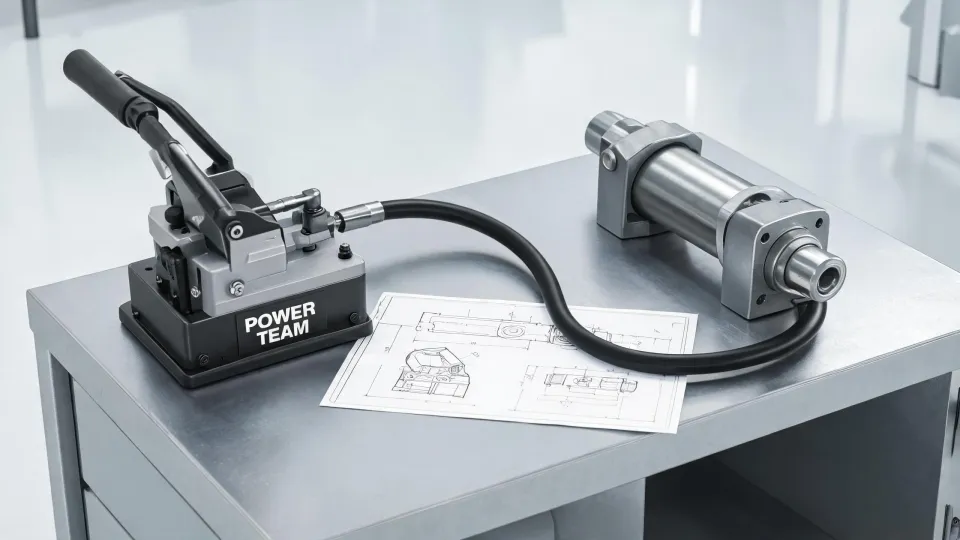
I'll say it plainly: in a hydraulic emergency, certainty is worth more than speed or price. I have watched teams save $300 on a pump and then lose 14 hours of downtime because a 'probably okay' delivery window did not hold. This is not a theory. This is how I think every time I'm triaging a rush order for a plant that is already stopped.
I'm a field service coordinator at an industrial equipment distributor. In the last six years, I've helped process more than 200 rush orders for hydraulic power units, torque wrenches, and high-tonnage lifts. The requests that worry me most are the ones where the customer says, 'I don't care what pump it is, as long as it's here Friday.' Actually, that's exactly when I start caring more.
The Manual Is the First Tool
When a Power Team electric hydraulic pump comes into the shop, I pull the SPX Power Team hydraulic pump manual before I do anything else. Boring, I know. But under deadline pressure, your memory is not your friend. You need the fluid level spec. You need the air bleed procedure. You need the duty cycle, because a pump run too long without rest can slow down at exactly the wrong moment.
According to the SPX Power Team hydraulic pump manual (SPX Flow, spxflow.com), the first step in almost any setup is confirming the reservoir level and bleeding air from the system before connecting the cylinder. I won't reproduce the whole manual here, but that habit has saved us more times than I can count.
The same principle applies to the smaller questions. Last month, a customer called at 10 p.m. and asked, 'does submersible pump need to be under water?' In almost every submersible design I know, the answer is yes: the water around the motor is the cooling path. Run it dry and you're shopping for a new motor. That answer is in the manual, but in a crisis people stop reading and start guessing.
The Real Cost of 'Probably on Time'
Let me give you a concrete example. If I remember correctly, this was March 2024—maybe the 26th, but don't quote me on that. A client needed a 10,000 psi Power Team electric hydraulic pump for a press repair the next morning. The generic alternate was $300 cheaper. It also had an estimated delivery of 'sometime between 9 a.m. and 1 p.m.' That is not a delivery time; that's a suggestion.
I did the risk math. The upside was $300 saved. The risk was missing the plant's 11 a.m. turnaround window. If the truck showed up late, or the pump arrived without the right fitting, the crew would sit idle while the client's production line stayed down. The expected cost of that failure was not a small number.
We paid the rush freight, which was around $400—maybe $500, I don't have the invoice in front of me—and the pump arrived at 6:02 a.m. I bled the system, tested it, and had it on the truck by 7:15. No drama. There is something satisfying about an emergency that ends like a normal day. That feeling is worth real money.
The Other 30 Minutes: Tools That Don't Slow You Down
Here's a less obvious angle. Everyone focuses on the pump, but emergency work is usually won in the last 30 minutes, when a mechanic has to reach a fitting behind a pump mount or turn a nut without crushing a seal. That is where a good swivel ratchet wrench set earns its space. The swivel head gets into the gap, takes the torque, and comes out without forcing you to disassemble half the assembly. It doesn't sound exciting, but after three jobs like that, you will not leave it on the bench.
I also keep a Cobra pliers & plier wrench set in the same emergency case. The pliers grab a damaged nut without rounding it further, and the plier wrench gives you a quick parallel-jaw option. For anyone who has worked under a lift with rain, hydraulic fluid, and a deadline, these are not accessories. They are part of the action plan.
Again, these tools are not magic. But when you are replacing a cylinder hose in the dark, the total time is decided by how many times a tool slips. That is where the quality premium gets real.
Yes, It's a Premium. No, It's Not a Scam.
To be fair, I understand why buyers hesitate. I have mixed feelings about rush pricing myself. On one hand, a premium feels like punishment, as if you're being charged twice for being in a hurry. On the other hand, once I've watched vendors juggle next-day freight, hotshot drivers, and 24-hour technical support, I get it. A real rush order takes a supplier's operation out of normal flow. The fee buys a lane. What I mean is: the fee buys priority, not just paper speed.
Granted, there are times when the standard option is fine. If you're stocking parts and the project does not depend on a specific day, use the slower route. But if the plant is shut down and the crew is waiting, a 'probably okay' promise is the biggest red flag in the deal. I would rather pay $100 more for a confirmed window than $50 less for a guess.
People also say all hydraulic pumps are basically the same. Actually, no. The SPX Power Team hydraulic pump manual reflects a known QC process, a known supply chain, and a known list of replacement parts. A generic unit may run fine, but you don't know its test history, its batch quality, or whether it will still be supported next year. In an emergency, 'known' beats 'sort of.'
Repeating the Point
Look, I still do the cost-benefit on every order. A budget pump has its place in stock, and I am not a premium-only guy. But after 200+ rush jobs, the pattern is clear: the risk is not the pump price; it is the chance that everything stops while you wait for a 'maybe.' That's why I will take a confirmed Power Team electric hydraulic pump over an anonymous unit with a hopeful ETA every time. The extra cost isn't a splurge. It's the price of sleep.
And if you're ever asking 'does submersible pump need to be under water?' the answer is yes—and the manual was right about that too.

Maren Jorgensen
Maren Jorgensen is an independent hand tool and torque applications analyst covering wrenches, pliers, screwdrivers, hammers, sockets, ratchets, hex keys, and tool sets. She applies ISO 6789-1 torque-tool conformance principles while examining jaw capacity, leverage, fastener engagement, torque range, accuracy, handle geometry, and material hardness. Her practical guides help tradespeople and procurement teams select suitable tools, plan controlled tightening, and compare durability without relying on brand reputation alone.