Power Team Hydraulic Pumps: 6 FAQ Answers from Someone Who's Broken a Few
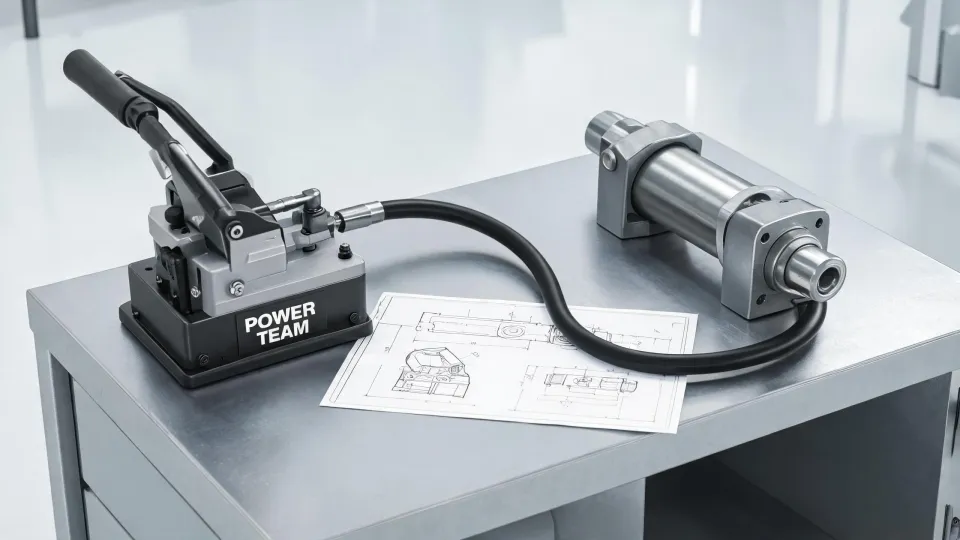
I'm a maintenance lead who's been handling hydraulic equipment orders for nine years. I've personally made—and documented—11 significant mistakes, totaling roughly $28,000 in wasted budget. Now I maintain our team's checklist so you don't have to repeat my errors.
Here are the questions I get asked most about Power Team hydraulic pumps, electric hydraulic pumps, repair, and the "does a hydraulic pump create pressure?" confusion. Each answer stands alone, so skip to the one you need.
Does a hydraulic pump create pressure?
Short answer: no. A hydraulic pump creates flow. Pressure is the result of resistance to that flow. The physics here is Pascal's law: pressure applied to a confined fluid is transmitted equally. If you deadhead a pump against a closed valve, the outlet pressure rises until something gives—a fitting, a hose, a seal, or the pump itself.
This is the mistake I see most in our shop. In my first year (2017), I assumed our old pump was weak because the gauge never moved. I ordered a bigger pump. The gauge moved even less. Turned out the relief valve was stuck open. The pump was fine; the fluid was just going back to the tank.
I don't have hard data on industry-wide misdiagnosis rates, but based on our repair tickets, I'd say 30-40% of "bad pump" calls are actually valve, cylinder, or hose issues. Before you replace anything, check the simple paths first.
What makes Power Team hydraulic pumps different?
Power Team (search sometimes writes it as one word, power-team) has been around for a long time under the SPX umbrella. That heritage matters because hydraulic pumps are safety-critical. A cheap pump may hit the same rated pressure in a catalog, but the details—material specs, relief valve behavior, seal compatibility, service documentation—are not the same.
We own several Power Team hydraulic pumps: a hand pump, an air-driven unit, and one electric hydraulic pump. They've outlasted two "budget" pumps we bought during a supply crunch (I want to say 2021, but don't quote me on that). The budget units weren't terrible; I just wouldn't trust them in a repetitive heavy-use cycle.
Brand alone doesn't guarantee correct sizing, though. A Power Team hand pump might be perfect for a small cylinder, but if you're driving a 100-ton press, you need a powered pump with enough flow and reservoir capacity. The fundamentals haven't changed, but the execution—electric controls, remote start, pressure limiting—has transformed.
Should I do Power Team repair myself?
Depends what you mean by "repair." Replacing a worn coupler or cleaning a strainer is fair game. Rebuilding the pump's internal cartridge? I'd think twice. I learned that in September 2022.
We had a Power Team pump losing pressure under load. I assumed it was a seal kit. I ordered a rebuild kit and tore it down on the bench. Turned out the valve seat was scored—a problem the kit didn't cover. The machine sat dead for a week while I sourced parts. That mistake cost $1,100 in downtime plus a rush-shipping fee (which, honestly, felt excessive).
Now our rule is: repair Power Team pumps only up to the component level the manual explicitly permits. For anything past that, we use an authorized service center. We still do the diagnostic work—flow test, pressure test, listening for cavitation—but we don't guess.
Power Team repair documentation is better than most. It only helps if you read it before disassembly, not after.
When does an electric hydraulic pump make sense?
If you're doing jobs that last more than a few minutes, or repeat multiple times a day, an electric hydraulic pump pays for itself. I remember one job in 2023: a 10-ton cylinder holding a flange alignment while a coworker torqued bolts. With a hand pump, we'd be pumping for 20 minutes. With an electric hydraulic pump, it was one button and done.
Don't oversize the electric unit just because the catalog says 10,000 psi. Flow matters more for speed. A high-pressure, low-flow pump is fine for holding pressure, but slow for moving cylinders. A two-stage pump gives you high flow at low pressure first, then shifts to high pressure at low flow. That's the sweet spot.
I wish I had tracked our electric pump utilization more carefully. What I can say anecdotally is that our air-powered and electric units get used in roughly equal amounts, and both have held up better than manual pumps for sustained pressure. And no, an electric hydraulic pump is not an electric pressure washer—which brings me to a question I really didn't expect to see in our search queries.
Why do people ask about 2000 psi electric pressure washer reviews?
This one threw me the first time I saw it in an analytics report. A 2000 psi electric pressure washer is not a hydraulic pump. It's a high-pressure water sprayer for cleaning equipment, not for powering cylinders. I think the confusion happens because "hydraulic" and "pressure" appear in both worlds.
For what it's worth, a 2000 psi electric pressure washer review is useful if your goal is washing a forklift or cleaning a concrete floor. In that range, electric washers are quieter and lighter than gas units. But if you're searching for it while looking for hydraulic tools, you're in the wrong aisle.
Our team bought one for cleaning tooling before paint. It worked well for that. We do not use it anywhere near hydraulic components—water in a hydraulic system is a recipe for rust, contamination, and seal failure. I've seen that mistake happen. It wasn't pretty.
Read reviews that mention flow rate in GPM, hose length, and warranty service. PSI alone doesn't tell you if the washer will strip grease or just spray it around.
What spec did I ignore until it cost me?
Flow rating, not just pressure. Most people ask about PSI. The pump's flow in GPM determines cycle time. We once ordered a Power Team hydraulic pump based on pressure alone. Didn't verify the flow rating. Turned out it was a low-flow model meant for torque tools. As a cylinder power source, it moved faster than a hand pump, but not by much.
We didn't have a formal spec-check process for replacements. Cost us when that pump went into a hydraulic press station and every cycle took three times longer. The press worked, but it ruined the production pace. We ended up swapping it after two weeks.
After the third time we ordered the wrong flow spec, I finally created a checklist that includes required pressure, required flow, reservoir size, duty cycle, and filter type. That checklist has caught 47 potential errors in the past 18 months. Should have done it after the first mistake. The checklist is boring. It saves money.

Maren Jorgensen
Maren Jorgensen is an independent hand tool and torque applications analyst covering wrenches, pliers, screwdrivers, hammers, sockets, ratchets, hex keys, and tool sets. She applies ISO 6789-1 torque-tool conformance principles while examining jaw capacity, leverage, fastener engagement, torque range, accuracy, handle geometry, and material hardness. Her practical guides help tradespeople and procurement teams select suitable tools, plan controlled tightening, and compare durability without relying on brand reputation alone.