Why Prevention Beats Replacement: A Procurement Manager's Case for Power Team Pumps
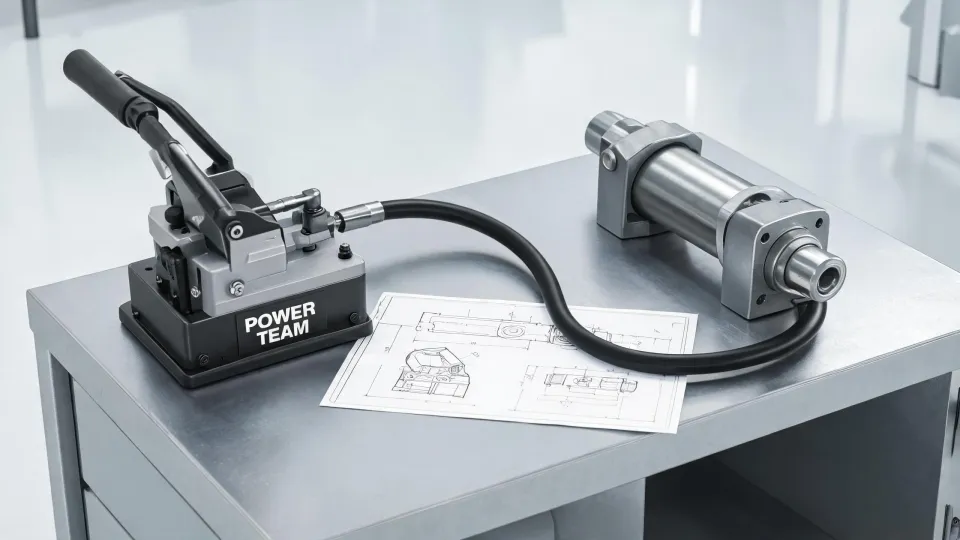
I've been a procurement manager at a 140-person industrial services company for six years. In that time, I've signed off on about 300 purchase orders for maintenance tools and hydraulic equipment, and I've tracked every invoice in our cost system. Here's what I've learned: the most expensive hydraulic tool is not the one with the highest sticker price. It's the one that fails because nobody checked it.
I'll say my opinion plainly: prevention beats replacement. I'd rather buy a Power Team pump and spend ten minutes checking it before every use than buy a cheaper pump and pay for overtime when it stops lifting. If that sounds obvious, you'd be surprised how many vendors have tried to sell me on the 'just replace it when it breaks' plan.
Five minutes of verification beats five days of correction.
Let me show you why I believe that, based on real numbers from our system.
The 'Cheap' Pump That Cost More Than It Saved
In 2023, I compared two portable hydraulic pumps for one of our service trucks. Vendor A quoted a recognized brand at $380. Vendor B quoted a no-name unit at $260. The $120 savings looked like a win. Nine months later, the no-name pump lost pressure, and the repair quote was basically the cost of a replacement. When I added shipping, a lost service day, and the labor to redo the job, the total was about $900.
That's the pattern I've seen again and again. The unit price lures you in. The total cost of ownership puts you on notice. I keep a TCO spreadsheet for every major tool category. It's not fancy. It just adds purchase price, repair history, downtime, and consumables into one number. I'm not an equipment engineer, so I can't speak to seal design or metallurgy. What I can tell you from a procurement perspective is this: the cheapest purchase is not the cheapest outcome.
When I spec a Power Team electric hydraulic pump now, I'm not paying extra for a logo. I'm paying for parts availability, documented service intervals, and a brand with an SPX heritage that still supports old equipment. I also know the manual will exist after the guy who installed it retires.
And yes, the brand often appears as 'power-team' in catalogs and on ID tags. I don't care about the hyphen. I care about the fact that I can get a service answer without chasing three different distributors.
Simple Tools Need the Same Respect
The same logic applies to a Power Team hand pump. It's a simple tool, and simple tools get ignored. But a hand pump still has a reservoir, a plunger, a check valve, and a release valve. If the oil is low or the valve is dirty, the pump will fail at the worst possible moment.
There's also an old assumption that bigger is always safer. That thinking comes from an era when hydraulic pumps were less predictable. Today, a properly sized Power Team electric hydraulic pump with clean oil and no air in the line will beat an oversized pump that nobody checks.
The same logic applies to precision tools. A preset torque screwdriver looks like a normal screwdriver, so people treat it like one. But it's a precision instrument. If you don't check the setting before a batch, one bad calibration can create a whole field of failed assemblies. The calibration check takes five minutes. The rework takes days.
We also run an electric air compressor ss5l5 in the shop for blowing out lines and running small air tools. Different machine, same rule: I put a laminated checklist next to it, and it has saved us a ton of downtime. The checklist isn't magic. It just forces someone to look at the machine before they trust it.
How Does a Hydraulic Jack Work Step by Step? It Matters
I know that sounds like a basic question. But when I ask a new technician 'how does a hydraulic jack work step by step?' I get a lot of answers that start and end with 'it goes up.' That is not enough. The practical version, in the simple mental model I use, looks like this:
- The reservoir holds hydraulic fluid.
- The pump plunger pushes fluid into the cylinder.
- A check valve keeps the fluid from flowing backward, so the load stays up.
- The cylinder piston rises and lifts the load.
- Opening the release valve lets the fluid return to the reservoir, so the load lowers.
Once you understand that flow, you can see why low oil, air in the system, or a contaminated valve causes real problems. You can also see why a ten-minute pre-use check is not a waste of time. It's a check on the exact path that makes the tool work.
Here's the counterintuitive part: the cheapest way to improve hydraulic tool reliability is not a new machine. It's making sure everyone knows what the machine is supposed to do.
OSHA's rule for hand and portable powered tools says equipment must be maintained in a safe condition (29 CFR 1910.242). The ASME B30.1 standard for jacks also points to inspection and maintenance. I don't design jacks, so I'll leave the engineering details to the engineers. But from a procurement perspective, these standards are just a formal way of saying the same thing: check the tool before you bet a load on it.
The 'We Don't Have Time' Objection
Every time I bring up inspection, someone says 'we don't have time for that.' I understand. I've said it myself. In 2024, I skipped checking the oil level on a Power Team hand pump before a supervised lift. I thought 'what are the odds?' Well, the odds caught up with me when the pump lost pressure halfway up a 10-ton lift. Nobody got hurt, but we lost the afternoon, and I had to explain the cost to my manager.
That was the last time I skipped a checklist.
I'm not saying every tool needs a full teardown before every shift. I do not mean to make this complicated. A short, documented pre-use check is worth more than any 'heavy-duty' label. When I audited our 2023 spending, I found that most of our budget overruns were not caused by expensive pumps. They were caused by failures that were entirely preventable.
Let me also acknowledge my sample size. My experience is based on about 300 purchase orders in industrial maintenance and vehicle repair. If you're in mining or heavy fabrication, your failure rates might be different. But the direction is hard to argue with: prevention is cheaper than correction.
Bottom Line
The next time someone asks whether they should buy a Power Team electric hydraulic pump, a Power Team hand pump, or a cheaper alternative, my answer is: the brand matters less than the routine. Don't buy a tool you won't inspect. Don't buy a pump with no service support. And don't let anyone tell you that checking a jack is a waste of time.
Because the most expensive tool in your shop is the one that fails. The cheapest one is the one you checked before you used it—even if its invoice had a higher number.

Maren Jorgensen
Maren Jorgensen is an independent hand tool and torque applications analyst covering wrenches, pliers, screwdrivers, hammers, sockets, ratchets, hex keys, and tool sets. She applies ISO 6789-1 torque-tool conformance principles while examining jaw capacity, leverage, fastener engagement, torque range, accuracy, handle geometry, and material hardness. Her practical guides help tradespeople and procurement teams select suitable tools, plan controlled tightening, and compare durability without relying on brand reputation alone.