Why I Don’t Buy a 10000 PSI Hydraulic Pump on Price Alone
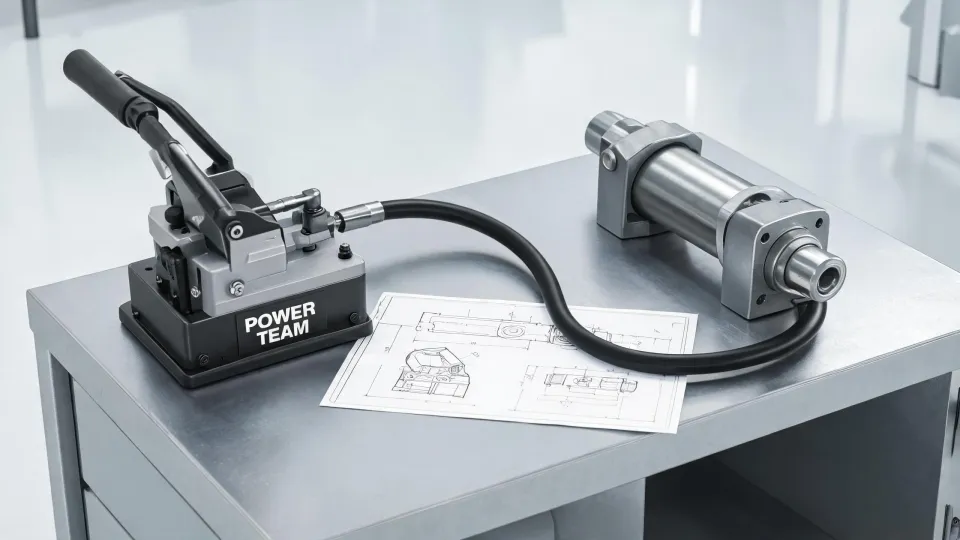
I’ll say it directly: if you’re choosing a 10000 psi hydraulic pump by unit price alone, you’re not saving money—you’re deferring the bill. I review hydraulic tool and component orders before they go to customers and to our own crews. Roughly 200 unique items a year—or rather, close to 180 since we stopped counting accessory kits as separate line items. In 2024, I rejected about 7% of first deliveries. Not because the color was off. Because the spec did not match the rating on the invoice.
If you search power-team on a distributor site, the catalog is enormous: hydraulic pumps, cylinders, presses, torque wrenches, jacks, pullers, hoses. That variety can hide a simple fact. The most expensive tool in the catalog is not the one with the highest price tag; it’s the one that fails before the job is finished, because you have to buy it twice and pay for the downtime in between.
The mistake that changed my review process
When I first started in this role, I assumed that any cylinder with the same bore, stroke, and tonnage was basically the same. I didn’t understand why someone would pay more for a brand when the spec sheet looked identical. My first sourcing mistake taught me the difference.
We needed a replacement for a power team hydraulic cylinder on a press application. The quote I approved was from a vendor who promised a direct equivalent with the same dimensions and working pressure. The price was 40% lower. On the fourth cycle, the rod seal started weeping. By the end of the week, the barrel was scored and the press was down. The vendor accepted the return, but we paid freight both ways, lost two shifts, and then expedited the original Power Team hydraulic cylinder anyway.
My initial approach was completely wrong. I thought the lowest quote was the smart buy, but three budget overruns—that one plus two more—taught me to calculate total cost of ownership before comparing vendor quotes.
Total cost is a short list, not a slogan
When I run a total-cost comparison, I stop treating the quote as one number. I make a short list:
- Unit price — including the options and accessories the tool actually needs to work in your application.
- Verification cost — pressure tests, calibration, documentation, and the time it takes to confirm the tool meets its rating.
- Maintenance cost — seal kits, filters, fluid compatibility, and how easy the unit is to take apart and rebuild.
- Failure cost — downtime, rework, safety exposure, and the expedite premium you will pay when you need a replacement yesterday.
Most purchase decisions stop after the first line. That is usually where the trouble starts.
What I check before any hydraulic order
1. Duty cycle, not just maximum pressure
A 10000 psi hydraulic pump can show that number on the gauge and still be wrong for your job. Check the duty cycle, the valve package, and the test record. We once received a pump that reached 10,000 psi but overheated after ten minutes of continuous operation. The spec sheet rated maximum pressure, not continuous work. That pump went back to the distributor.
2. Control and compatibility
When I specify an SPX Power Team torque wrench pump, I don’t start with flow rate. I start with control resolution and repeatability. Torque wrench work is about control, not just raw pressure. If the pump surges, overshoots, or cannot hold pressure at low flow, the torque wrench either under-tightens or over-tightens the fastener. One re-tensioning crew call can erase any savings from a lower quote.
3. Repair path and documentation
If you cannot buy a seal kit next week, a cylinder is not a tool—it’s a deadline with the clock running. I’ve seen budget versions of power team hydraulic cylinder components that looked right on the drawing but had no local parts support. You can choose a non-OEM spare if you want. But know the rebuild path before you need it, not after someone puts a hard stop on the schedule.
That also means I am not buying a name blindly. A brand like Power Team has a useful advantage: consistent spec sheets and available repair parts. But if another manufacturer can show better documentation and the application is simple, they can win. Brand is not the point. Evidence and support are the point.
Hydraulics also have a safety layer that ordinary purchases don’t have. A failed cylinder under load is not just a cost problem; it is a physical hazard. That is why I will not approve a 10000 psi hydraulic pump without a documented, testable relief valve setting, no matter how attractive the price is.
The small-tool version of the same mistake
This logic is not limited to big-ticket equipment. Take the ratcheting combination wrench, for example. It’s easy to grab the cheapest one, but cheap ratcheting wrenches fail at the pawl. When the pawl skips on a stubborn fitting, the user reaches for a crescent wrench and rounds off the nut. On a hydraulic manifold, that turns a five-minute fix into a two-hour replacement. I’m not saying every wrench needs to be a premium brand. I am saying that a mid-range ratcheting combination wrench with a decent warranty is worth the extra few dollars if your crew uses it daily.
What about the “best” tool questions?
I see the search query “what are the best electric pruning shears” in our analytics more often than I expected. It’s not a hydraulic tool, but the answer follows the same path. The best electric pruning shears are not the cheapest or even the most powerful. They are the ones with replaceable blades, batteries you can actually buy next year, and a repair channel that answers the phone. The same total-cost thinking applies outside the hydraulic aisle.
I don’t have hard data for every product category. My experience is based on maybe 600 orders over four years, mostly mid-size industrial tooling and hydraulic equipment in one region. If you are buying one tool for occasional use, your math might differ. But for anything used under load, by a crew, on a deadline, total cost is the only honest way to compare.
I went back and forth on this approach for a while. On paper, lower-cost options made the quarterly budget look better. But after the press incident, I stopped having that argument with myself. The cost of an unplanned failure is not a line item; it is a whole story.
My bottom line
I can hear the pushback already: “This just means you always buy premium.” No. I have rejected premium items, including a batch of hose assemblies with a crimp that did not meet the published bend radius. And I have approved low-cost tools when the application did not demand more. The goal is not to spend more. The goal is to know what a tool really costs over its life.
So here is the position I’ve settled on: the next time you quote a 10000 psi hydraulic pump, a power team hydraulic cylinder, or an SPX Power Team torque wrench pump, divide the price by years of service and add the cost of failure. That is the number that matters. The cheapest tool is the one that survives the job.

Maren Jorgensen
Maren Jorgensen is an independent hand tool and torque applications analyst covering wrenches, pliers, screwdrivers, hammers, sockets, ratchets, hex keys, and tool sets. She applies ISO 6789-1 torque-tool conformance principles while examining jaw capacity, leverage, fastener engagement, torque range, accuracy, handle geometry, and material hardness. Her practical guides help tradespeople and procurement teams select suitable tools, plan controlled tightening, and compare durability without relying on brand reputation alone.