Why I'd Rather Buy a Power Team Pump From a Specialist Than a 'Universal' Supplier
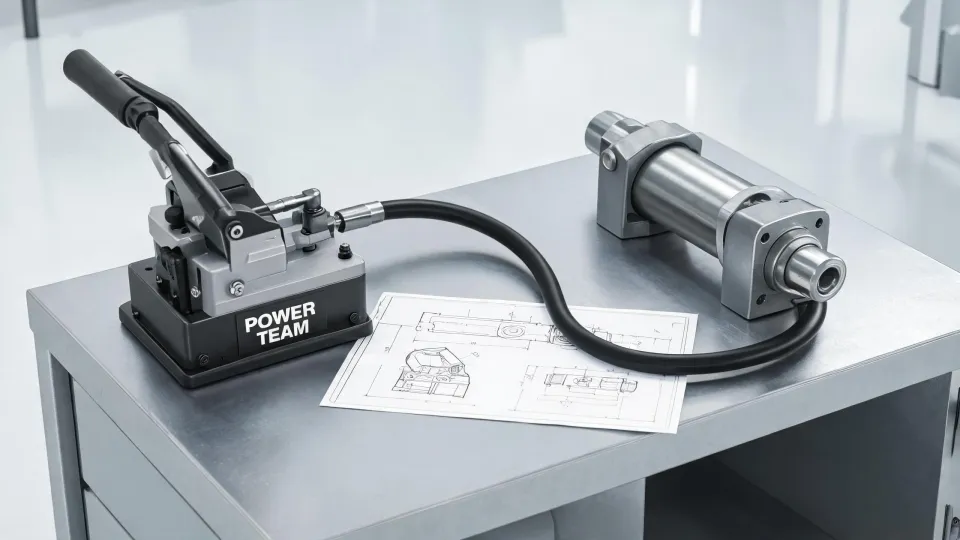
If there's one sentence I've learned to distrust in industrial supply, it's “We can handle that.” I've been handling hydraulic equipment orders for 11 years. I've personally made (and documented) 23 significant mistakes, totaling roughly $18,300 in wasted budget. Most of those mistakes trace back to one decision: choosing a vendor that promised everything instead of a specialist that admitted what it didn't do.
Take it from someone who's paid the tuition: the vendor who said “this isn't our strength—here's who does it better” earned my trust for everything else. I'd rather work with a specialist who knows their limits than a generalist who overpromises.
Where the “one-stop shop” idea goes wrong
The “you need one supplier for everything” thinking comes from an era when distributors were inventory-rich and information-poor. If your local guy carried three brands and could get you a fitting by Friday, you stuck with him. Today, a specialist across the country can have the right component at your dock tomorrow morning. That changes the math.
But old habits die hard. I still meet maintenance leads who default to a general catalog because it's comfortable. Then they call me after paying for an “equivalent” that wasn't equivalent.
The $3,800 lesson about a Power Team pump
In my first year (2014), I made the classic specification error: I assumed “same specifications” meant the same performance across vendors. Didn't verify. The application needed an SPX Power Team pump for a 100-ton cylinder—specifically a Power Team electric hydraulic pump with a preset relief valve. A general supplier told me their “universal equivalent” would work. It looked fine on paper. But the flow control behaved differently under load, and the relief valve let the system spike past the cylinder's rating. Result: seal failure, a bent ram, a $3,800 repair, and a week of downtime.
Looking back, the decision felt like a risk/reward tradeoff. The upside was saving about $1,100 on the purchase. The risk was that the cheaper pump didn't have the same relief-valve curve. I kept asking myself: is $1,100 worth potentially ruining a $3,200 cylinder? The answer, obviously, was no—but I let the spreadsheet decide instead of the application. Even after the pump arrived, I told myself it would be fine. Then the first pressure test spiked, and I knew I'd made a $3,800 mistake.
Now, I'm not saying every pump needs a brand name. But when you're talking about power-team hydraulic products, the reason people specify them is the data behind the components. The manual for a Power Team pump gives you flow, pressure, and oil capacity in black and white. A generic pump often gives you a range “good enough” for no specific cylinder. That's a red flag. Whether you type “power-team hydraulic pump” or “Power Team pump,” you're looking for the engineering, not the marketing.
In Q3 2024, I pulled quotes from four suppliers for a Power Team electric hydraulic pump. The prices varied by 22%. The bigger difference: only two suppliers could tell me the relief valve setting without checking. Those two got my order.
Now my team uses a three-line checklist before any pump order: verified pressure rating, verified flow rate, and verified coupling type. That's it. Three lines. The checklist has caught 47 potential errors in the last 18 months—not because we're geniuses, but because we stopped assuming “same size” meant “same spec.”
A wrench taught me about specialization
I used to think a wrench was a wrench. Then I spent an hour trying to loosen a fitting in a cramped manifold with a cheap 12-point wrench that kept slipping. A colleague handed me a 12 point full polish combination wrench—not from a fancy brand, just a proper one. The difference was night and day. The full polish isn't vanity. It resists corrosion, wipes clean easily, and in a hydraulic environment, that means you can actually feel a fastener before you round it off.
Would I have learned that from a general supplier? Probably not. They'd have sold me whatever wrench was on sale. The specialist explained why the 12-point version, not a 6-point, was the right call for that joint. That expertise is what you're paying for.
Why generic sump pumps reviews are almost worthless
I spent a frustrating afternoon reading sump pumps reviews on a giant retail site. Most were useless: homeowners comparing 1/3-hp units on a 10-minute cycle. I needed pumps that run 18 hours a day in a plant. The reviews didn't mention duty cycle, thermal protection, or how the float switch fails after 2,000 cycles. I finally found a niche forum with actual maintenance logs. That data was worth more than all the “best pick” lists combined.
Same principle, different product: choose your source based on how deeply they know the thing. General reviews give general answers. A specialist gives you failure modes.
How to unlock a hose clamp (without losing your cool)
Let's get practical. One question new technicians ask is how to unlock hose clamp on a hydraulic line. If you're dealing with a spring-loaded locking clamp, here's the safe sequence.
- Kill the power and release the pressure. According to OSHA's lockout/tagout standard (29 CFR 1910.147), stored energy—including hydraulic pressure—must be released before servicing. Don't skip this.
- Clean the clamp area. Grease and hard debris make the lock tang stick.
- Press the lock tang inward, then twist the collar counterclockwise. Don't pry against the body; that damages the lock mechanism.
- If the clamp is corroded, apply penetrating oil, let it sit five minutes, then use a line wrench—not pliers—on the collar.
That trick sounds basic, but I've watched a technician spend two hours on a stuck clamp because they assumed the collar turned clockwise. It's the kind of detail a specialist gives you in thirty seconds and a general site won't mention at all.
But isn't a one-stop shop more convenient?
I get the appeal. One phone call, one invoice, one place to blame if something goes wrong. But then again, convenience doesn't make a wrong spec right. After my pump disaster, I changed the policy: if a vendor says “universal” or “equivalent” without a detailed spec sheet, I ask for engineering data. If they can't provide it, I move on.
That's not about being loyal to one brand. It's about respecting boundaries. Power Team covers a big slice of hydraulic tools—pumps, cylinders, presses, torque wrenches, jacks, pullers, hoses. But I also know a tooling specialist who only does fittings, and I send customers to him for the stuff I don't carry. I've never lost a customer by saying “we don't do that.” I've lost them by delivering something that was “good enough.”
Bottom line: I'd rather answer “what's this not?” than defend a vague “we handle everything.” The next time you hear a supplier promise the world, ask them what they're bad at. If they can tell you, they're worth talking to. If they can't, keep looking.
Trust me on this one. I paid $3,800 for the same lesson.

Maren Jorgensen
Maren Jorgensen is an independent hand tool and torque applications analyst covering wrenches, pliers, screwdrivers, hammers, sockets, ratchets, hex keys, and tool sets. She applies ISO 6789-1 torque-tool conformance principles while examining jaw capacity, leverage, fastener engagement, torque range, accuracy, handle geometry, and material hardness. Her practical guides help tradespeople and procurement teams select suitable tools, plan controlled tightening, and compare durability without relying on brand reputation alone.