Power Team Hydraulic Pumps vs. Aftermarket Rebuilds: A Cost Controller’s Sourcing Comparison
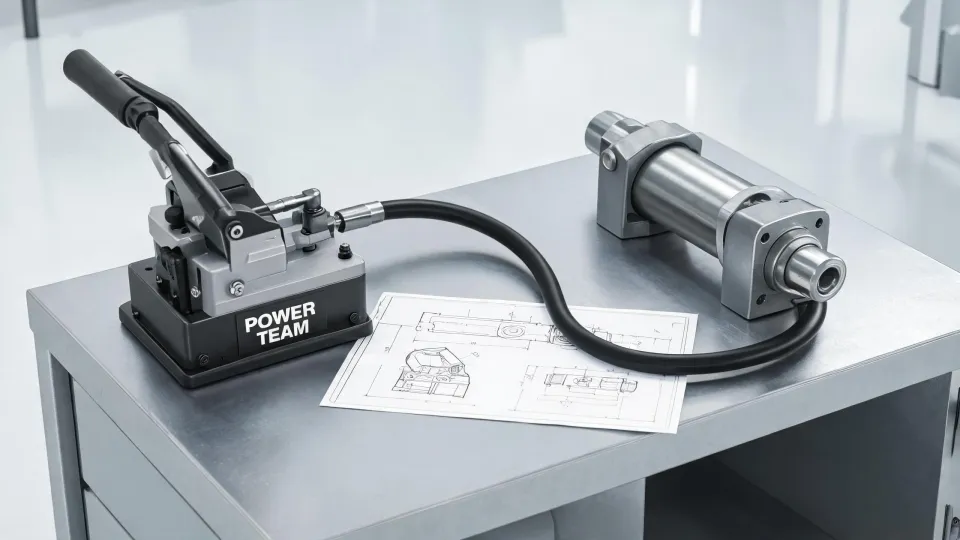
In the spring of 2024, I sat at my desk with two quotes for the same job. One was from the local SPX distributor for a genuine Power Team hydraulic pump. The other was from an online seller for a supposedly equivalent pump at 62% of the price. To a lot of people, that decision would take thirty seconds. I spent two days running numbers.
That is how most of my buying decisions go. I have managed procurement for a 60-person industrial maintenance company for six years, with an annual repair budget near $180,000 across hydraulics, air compressors, and washdown equipment. The brand on the label matters less than the cost of a failure. But the cost of a failure is not always on the quote.
The comparison framework I actually use
When I compare a genuine Power Team pump against a generic alternative, I don't start with horsepower or maximum PSI. I start with four things: fitment, total cost, supplier certainty, and traceability. If a supplier can't answer all four, they don't get the PO.
That framework applies whether I'm sourcing a Power Team hydraulic pump, IR air compressor parts, or a replacement 3600 PSI pressure washer pump. Different equipment, same logic.
Dimension 1: Fitment, or the point where “compatible” gets dangerous
On paper, the cheap hydraulic pump looked identical. Pump type, flow rating, port sizes, pressure range. On paper. I learned a long time ago not to assume a supplier's spec sheet matches the physical part.
What most people don't realize is that the word compatible in an online listing often means the seller believes it will work. It does not mean they tested it against your bracket, your coupling, or your hose thread. I once approved a quote based on that assumption. Didn't verify. Turned out the mounting flange was shifted by a quarter of an inch. That required an adapter plate, extra labor, and a phone call I still remember.
Genuine Power Team hydraulic pumps come with known dimensions, and an authorized distributor can cross-check the serial number. That certainty costs more upfront. It saves time on the back end.
The same issue appears with IR air compressor parts. Some IR air compressor parts, like filters and basic gaskets, are fine from a third-party supplier. But if a valve plate is a few thousandths of an inch different, the compressor's performance changes. And those changes show up slowly, in higher discharge temperatures or lower output. Not ideal for a production compressor.
For a 3600 PSI pressure washer pump on a washdown skid, fitment is even more specific. Shaft keyway size, shaft rotation direction, unloader port thread pitch, inlet and outlet positions. Get one detail wrong and you get a pump that looks right but doesn't fit. Worse than expected, because now you are down another week waiting for the correct part.
Dimension 2: Total cost, not sticker price
I am not against saving money. I get paid to save money. But I look at the total cost of ownership.
Let's say the generic pump saves $490 on the initial quote. Then add the adapter plate, the extra labor hours, the freight charge for the return, and the cost of the second replacement if the first fails. Suddenly, the cheap pump is no longer cheap.
Here's the thing: a Power Team hydraulic pump is not always the right answer. Sometimes the application is light-duty, non-critical, and an aftermarket pump is perfectly serviceable. I don't pretend otherwise. But for a floor-mounted hydraulic press that runs every day, I want the purchase to be boring. Boring means no surprises.
On air compressors, I split the difference. For routine consumables, I buy IR air compressor parts from whoever has the best price. For valve assemblies, unloader valves, and safety controls, I buy the manufacturer's kit. That split has saved us money without creating repeat failures.
Take this with a grain of salt, but after tracking our repairs for several years, I believe about 70% of aftermarket air compressor parts are acceptable for non-safety items. The remaining 30% can cost you a compressor or, worse, a maintenance call on a weekend. I'd rather spend the extra $80 on the part that came in a sealed authorized box.
The same logic applies to a 3600 PSI pressure washer pump. A cheap replacement can show good flow on day one and then fail during a spring cleanup when you need it most. We now budget for a commercial-grade pump and treat it as preventive expense. That was a lesson learned the hard way.
Dimension 3: Time certainty is part of the purchase
In March 2024, our Ingersoll Rand compressor had an unloader failure during a 48-hour production window. The local dealer had the IR air compressor parts in stock and could deliver them overnight. An online supplier said they could probably ship in four to five days. Probably.
I paid the overnight freight. The extra charge was about $180. Missing the deadline would have cost us more than $3,200 in lost labor and late delivery penalties. The premium bought certainty, not just speed.
That is the exact logic I use when someone needs a Power Team hydraulic pump quickly. An authorized SPX Power Team distributor can usually confirm part numbers and lead times without guesswork. If I need a pump for a job with a hard deadline, predictable delivery is worth a premium. The phrase “probably on time” is not a delivery date.
To be fair, you don't always need that level of certainty. If the pump is a spare that can sit on a shelf, waiting four days is fine. But if you are facing a shutdown, the calculation changes. Uncertain cheap is more expensive than certain expensive.
Dimension 4: Traceability and documentation
The last thing I check is documentation. A genuine Power Team hydraulic pump has a nameplate, a serial number, and a manufacturer that can support it. That matters when a customer audit requests maintenance records or when you need a replacement part two years later.
For IR air compressor parts, the same rule applies. Keep the model number and serial number on hand. A filter cross-reference chart only gets you so far. When a control valve needs replacing, the OEM part number removes the guesswork.
For a 3600 PSI pressure washer pump, you need pump model, shaft size, and connection style. Pressure rating alone is not enough. I always tell our team to take a photo of the nameplate before calling a supplier. That one habit saves more time than any search shortcut.
People ask the oddest things, too. A few will type where to find water pump arc raiders and expect a single clear answer. That kind of search works when you are looking for loot in a game, not when you are sourcing real industrial parts. In a factory, there is no spawn point for a water pump. There is a part number, and the part number is your map.
So when do I choose Power Team hydraulic pumps?
After six years of comparing quotes, my decision rules are pretty simple:
Choose genuine Power Team hydraulic pumps when:
- The pump supports a lifting, bending, or pressing operation where failure means downtime or physical risk.
- You need serial-number-specific documentation for audits or warranty records.
- Your deadline matters and you need a supplier who can answer questions with certainty.
Choose an aftermarket pump when:
- The application is non-critical and a failure won't stop production.
- You have verified fitment from the actual part in your hand, not from an online photo.
- The price difference is big enough to cover the risk of rework and replacement.
The same rules follow me into air compressor and pressure washer purchases. For IR air compressor parts, I buy filters and consumables aftermarket, but I stick with OEM for valves and controls. For a 3600 PSI pressure washer pump, I buy from a supplier who can tell me the exact spec of the pump, not just the pressure rating.
Looking back, I should have adopted this framework earlier. At the time, I was chasing line-item savings and ignoring the costs that appeared later. But that is what the spreadsheet is for. It doesn't care about brand loyalty. It only cares about what actually happens after the purchase.
If you take one thing from this, let it be this: compare the whole cost, not the invoice. A Power Team hydraulic pump isn't always the right answer. But in an emergency, the cost of waiting for a maybe is never worth it.

Maren Jorgensen
Maren Jorgensen is an independent hand tool and torque applications analyst covering wrenches, pliers, screwdrivers, hammers, sockets, ratchets, hex keys, and tool sets. She applies ISO 6789-1 torque-tool conformance principles while examining jaw capacity, leverage, fastener engagement, torque range, accuracy, handle geometry, and material hardness. Her practical guides help tradespeople and procurement teams select suitable tools, plan controlled tightening, and compare durability without relying on brand reputation alone.