Power Team Hydraulics FAQ: SPX Pumps, Cavitation, Compressor Oil & Torque Bits
-
What is Power Team hydraulics, and why is it labeled 'SPX Power Team'?
-
What is hydraulic pump cavitation?
-
Why does my Power Team SPX hydraulic pump lose pressure?
-
What's the right rotary screw compressor oil, and can I use hydraulic oil?
-
Do torque screwdriver bits really make a difference?
-
Where can I get Power Team hydraulic pump parts fast?
-
What can I do to avoid hydraulic problems before they start?
Every week, our parts desk gets called by maintenance teams, procurement people, and plant managers who have the same questions. Some are about Power Team hydraulics. Some are about hydraulic pump failures. And two surprise me every time: one about compressor oil and one about small screwdriver bits. After 10 years on the parts side of industrial maintenance—plus more than 400 emergency orders—I've developed strong opinions. Here are straight answers.
What is Power Team hydraulics, and why is it labeled 'SPX Power Team'?
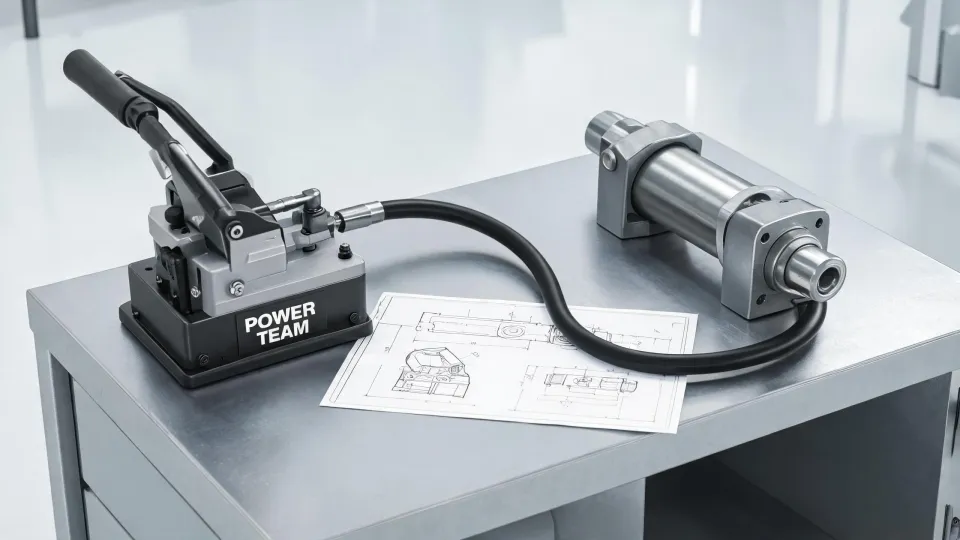
Power Team has been a name in high-pressure hydraulics for decades, and the brand carries the SPX heritage. You'll see labels that say SPX Power Team, and some product pages list a Power Team SPX hydraulic pump in the specs. That's not two different companies—it's the same product line with the same engineering lineage. Power Team hydraulics covers hand pumps, electric and air-driven pumps, cylinders, presses, jacks, pullers, and torque tools, plus hoses and accessories.
If you're new to hydraulic systems, the simplest way to understand the lineup is to think in terms of flow: the pump pushes oil, the cylinder or tool turns that oil into force, and valves, couplers, and hoses direct it where it needs to go. That's why parts lists matter. One loose coupler can make a new pump perform like it's worn out. And if you search for power-team with a hyphen, you're looking at the same brand. The hyphen is just a web address quirk, not a separate product family.
What is hydraulic pump cavitation?
Cavitation happens when a pump doesn't get enough oil at its inlet. The pressure drops below the vapor pressure of the oil, tiny vapor bubbles form, and then they collapse the moment they reach the high-pressure side. Those collapses act like miniature jackhammers on pump metal. The noise is unmistakable: gravel rattling through the pump, not a healthy hum. Common causes are a clogged suction strainer, a kinked inlet line, a low oil level, or oil that's too thick for the temperature.
I remember a March 2024 call about a Power Team SPX hydraulic pump that sounded like it was eating rocks. Everyone suspected the pump was done. I asked the maintenance lead to check the suction strainer first, and he found a layer of what looked like paint chips. Cleaned the strainer, replaced the oil, and the pump ran quiet. If yours sounds like that, shut it down and check the suction side before ordering a replacement. Running a cavitating pump won't just make more noise—it will eventually cause metal damage you can't undo.
Why does my Power Team SPX hydraulic pump lose pressure?
Most of the time, the pump isn't the first thing to blame. Loose or half-seated quick couplers are a classic cause. So is low reservoir oil. And a relief valve set too low will give you pressure problems all day. After those checks, look for internal leakage—a worn seal in the pump or a cylinder that's bypassing oil. A cylinder with a bad seal lets fluid slip past, and the pump cycles repeatedly without doing useful work.
My advice is to treat the whole circuit as one system. I've seen crews order a rebuild kit for a pump that only needed a properly seated coupler. It's an easy thing to miss when a machine is down. Another clue: if the pressure is fine when cold but fades after the system warms up, suspect heat-related seal wear. Include that detail when you call a distributor, because it helps them send the right parts the first time.
What's the right rotary screw compressor oil, and can I use hydraulic oil?
Don't use hydraulic oil in a rotary screw compressor. Not as a substitute, not as an emergency stopgap. Hydraulic oil is designed to transmit power and lubricate pump components at high pressure. Rotary screw compressor oil has to tolerate heat, moisture, and air mixed into the oil while resisting varnish and oxidation. They're different base stocks with different additive packages.
If the compressor manufacturer calls for ISO VG 32 or VG 46, use a lubricant labeled as rotary screw compressor oil in that range. And don't mix different brands or old oil from another machine into the reservoir. Additive incompatibility can cause problems too. Early in my career, I thought oil is oil, until one of our clients ran a screw compressor on leftover hydraulic oil and ended up with a varnished air end. That repair bill could have bought a used car. Don't learn that lesson the expensive way.
Do torque screwdriver bits really make a difference?
If you're torquing components that need low-level accuracy—electrical terminations, control panels, pneumatic valves—a torque screwdriver is the right tool. But the bits are part of that accuracy. A worn or rounded bit will slip, so the fastener actually receives less torque than the screwdriver reads. That can lead to a loose connection or a stripped head.
Keep a small set of precision-ground torque screwdriver bits: Phillips #1 and #2, Torx T10, T15 and T20, plus metric and SAE hex sizes. And replace them when the corners start to round. It's cheap insurance compared to the downtime caused by a tiny fastener failure. A torque screwdriver doesn't replace a hydraulic torque wrench for large bolts, but it belongs in the same maintenance toolbox for different reasons.
Where can I get Power Team hydraulic pump parts fast?
Start with the nameplate. Write down the full model number, serial number, and pressure rating before you call. Then go through an authorized Power Team/SPX distributor. A correct replacement kit beats a universal aftermarket kit, especially on high-pressure components. I've seen aftermarket parts fail twice, and both times, what should have been a simple seal swap became a full pump replacement.
If your operation depends on hydraulics, buy a spare pump or complete service kit in advance. That inventory cost is nothing compared to a shutdown. In a real emergency, an authorized distributor can tell you what's in stock nearby and what can ship the same day. Don't waste the first three hours calling random online sellers. You want a supplier who can verify the part against your machine's serial number, not a seller who just says 'it will fit.'
What can I do to avoid hydraulic problems before they start?
Pay attention to the early signs. If a pump starts making noise or an operator says it feels slow, don't put it on next month's PM list. Check the oil level, strainer, and pressure settings today. Change the oil on the manufacturer's schedule, not on the calendar in your head. Air in the lines after a repair causes the same kind of rough, jerky operation as a starving pump, so bleed the system before going back to full load.
The most cost-effective habit I've seen is also the simplest: put a monthly inspection checklist on the wall and actually use it. It won't make a noisy pump exciting, but it will keep you from getting a 3 a.m. emergency call about a dead hydraulic pump.

Maren Jorgensen
Maren Jorgensen is an independent hand tool and torque applications analyst covering wrenches, pliers, screwdrivers, hammers, sockets, ratchets, hex keys, and tool sets. She applies ISO 6789-1 torque-tool conformance principles while examining jaw capacity, leverage, fastener engagement, torque range, accuracy, handle geometry, and material hardness. Her practical guides help tradespeople and procurement teams select suitable tools, plan controlled tightening, and compare durability without relying on brand reputation alone.