Stop Paying Twice: The Total-Cost Rule for Power Team Hydraulic Jacks and Presses
-
What I Mean by Total Cost
-
One March 2024 Rush That Proves the Point
-
Why a Power Team Hydraulic Jack Is Not a Commodity
-
The Wrench Set Analogy That Makes Buyers Uncomfortable
-
The Sump Pump Question Is the Same Question
-
Yes, I Profit From Rush Orders. Here's Why That Doesn't Change the Math.
-
My Position on Buying Hydraulic Equipment
If you're still choosing hydraulic equipment by comparing the price on the quote, you're probably going to pay twice. I know that sounds like a sales guy's line. I'm not a typical salesman—I'm the guy you call when the cheap option fails on a Friday night. I've handled 200+ rush orders in 14 years, including same-day turnarounds for manufacturing plants, steel fabricators, and maintenance contractors. Almost every one of those rush orders was avoidable. And almost all of them happened because someone made a decision on price instead of total cost.
The sticker price is not the cost. The total cost of ownership is the cost—and it includes freight, setup, repairs, downtime, and the risk of missing a deadline.
What I Mean by Total Cost
Total cost of ownership is not a procurement buzzword. It's just the answer to: "How much does this tool really cost me over five years?" The formula is:
- Purchase price
- Freight and handling
- Setup or installation
- Planned maintenance
- Unplanned repairs
- Downtime when it fails
- The cost of a missed deadline
That last line is the one that hurts. A $200 difference on a hydraulic jack can become a $5,000 difference in lost production if the jack fails at the wrong moment.
One March 2024 Rush That Proves the Point
In March 2024, a fabrication shop called me at 3 PM on a Saturday. They had a large assembly due Monday morning, and their 100-ton press was down. The cylinder was leaking fluid and wouldn't hold pressure. They needed a replacement by Sunday evening.
Here's the part that matters. The old cylinder had been bought because it was $800 cheaper than a genuine Power Team 100 ton hydraulic press cylinder. The savings lasted exactly until that phone call. We sourced the Power Team cylinder, paid $800 in overnight freight and an emergency service fee, and had the press running by 6 AM Sunday. The total emergency bill was over $4,000. That still beat the alternative—the client would have missed a contract with a serious penalty clause. But they didn't just lose $800. They lost the savings, the freight charge, and the cost of a ruined weekend.
No, wait—I should be fair. The original cylinder might have worked for years. The problem wasn't necessarily the parts. The problem was that nobody calculated the cost of failure. That is the definition of total cost thinking: you don't buy equipment for the best day. You buy it for the worst day.
Why a Power Team Hydraulic Jack Is Not a Commodity
A Power Team hydraulic jack is often compared with jacks that look identical on paper: same capacity, same stroke, same lift height. The difference is internal. Better seals, better tolerances, better materials, and a brand with actual service support. The National Fluid Power Association has long noted that contamination is a leading cause of hydraulic component failure (Source: NFPA educational resources). Good sealing isn't a luxury. It's the reason a jack can sit in a dirty shop and still lift a load at 2 AM.
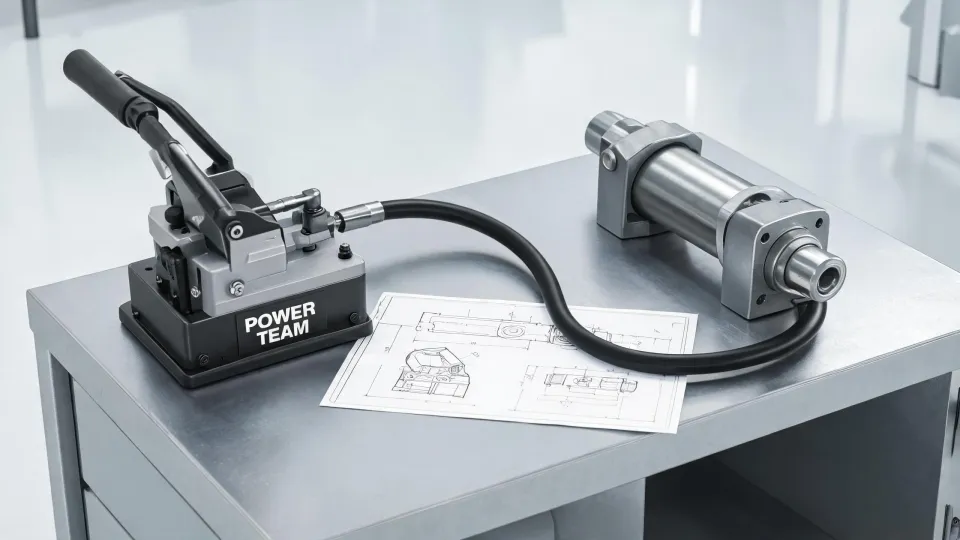
People think brands like Power Team charge more because of the badge. Actually, it's closer to the reverse: they can charge more because fewer units fail, and because they have a long service history to back them up. Power Team's SPX heritage matters here. You're not just buying a cylinder or a pump; you're buying the engineering and documentation that comes with it.
The Wrench Set Analogy That Makes Buyers Uncomfortable
I know it's odd to bring consumer tools into a B2B article, but think about a Dale Earnhardt wrench set. Nobody buys that set because it's the cheapest way to turn a bolt. They buy it because of the name, the quality, and the trust that the wrench won't slip. A cobra and pliers wrench is the same logic. You can buy a $5.99 pair of pliers and they'll work for a while. But a cobra and pliers wrench grips better, adjusts one-handed, and lasts. Professionals who use one rarely go back.
When the same people sit in a procurement meeting, they suddenly treat every hydraulic tool as a commodity. They look for the lowest number on the spreadsheet and ignore everything else. That's backwards. The stakes with a hydraulic pump or press are much higher than with a wrench. If your wrench slips, you redo the job. If your press fails under load, you might have an injury, a damaged part, and a production line stopped.
The Sump Pump Question Is the Same Question
A facility manager once asked me, "Do I need to replace my sump pump?" The pump was two years old, cycling every 30 seconds, and the motor was getting hot. My answer wasn't about the pump itself. It was about total cost:
- Can you repair it for less than half the replacement cost?
- Will one more failure cause damage that exceeds the replacement cost?
- Are repair parts available now, or are you waiting on a special order?
If any answer is "no," replace it. That same rule works for hydraulic pumps, cylinders, and jacks. "Do I need to replace my sump pump" is not a plumbing question. It's a cost-of-failure question. The exact same calculation tells you whether to splice a hydraulic hose or replace it, whether to rebuild a cylinder or buy a new one, and whether to pay $1,800 for a reliable press or $900 for a gamble.
Yes, I Profit From Rush Orders. Here's Why That Doesn't Change the Math.
I'm expecting the objection: "You make money from emergencies, so of course you want people to buy expensive equipment." Fair. In Q1 2025, our team processed 47 rush orders with 95% on-time delivery. That revenue is real. But if those 47 customers had done a total-cost analysis before the failure, most of them could have planned a standard replacement and saved the rush premium. They would be better off, and I would have less late-night revenue. I'm not going to pretend I'd prefer that. I am going to say the math is still on their side.
I've also made the same mistake. Looking back, I should have pushed a client in 2023 to order a spare cylinder even though their budget was frozen. At the time, I didn't want to sound like I was selling. Then they called nine months later needing that exact cylinder overnight. If I could redo that one, I'd be more direct about the cost of waiting.
My Position on Buying Hydraulic Equipment
The cheapest quote is a data point, not a decision. If you need a Power Team hydraulic jack, a Power Team 100 ton hydraulic press, or any critical hydraulic equipment, the question is not "Can I save $100?" The question is, "What is the total cost of this tool over its life in my operation?"
The lowest price only matters if nothing ever goes wrong. And in industrial maintenance, something always goes wrong.
That's my position. I'm not going to soften it. Buy equipment for the worst day, not the best price.

Maren Jorgensen
Maren Jorgensen is an independent hand tool and torque applications analyst covering wrenches, pliers, screwdrivers, hammers, sockets, ratchets, hex keys, and tool sets. She applies ISO 6789-1 torque-tool conformance principles while examining jaw capacity, leverage, fastener engagement, torque range, accuracy, handle geometry, and material hardness. Her practical guides help tradespeople and procurement teams select suitable tools, plan controlled tightening, and compare durability without relying on brand reputation alone.